









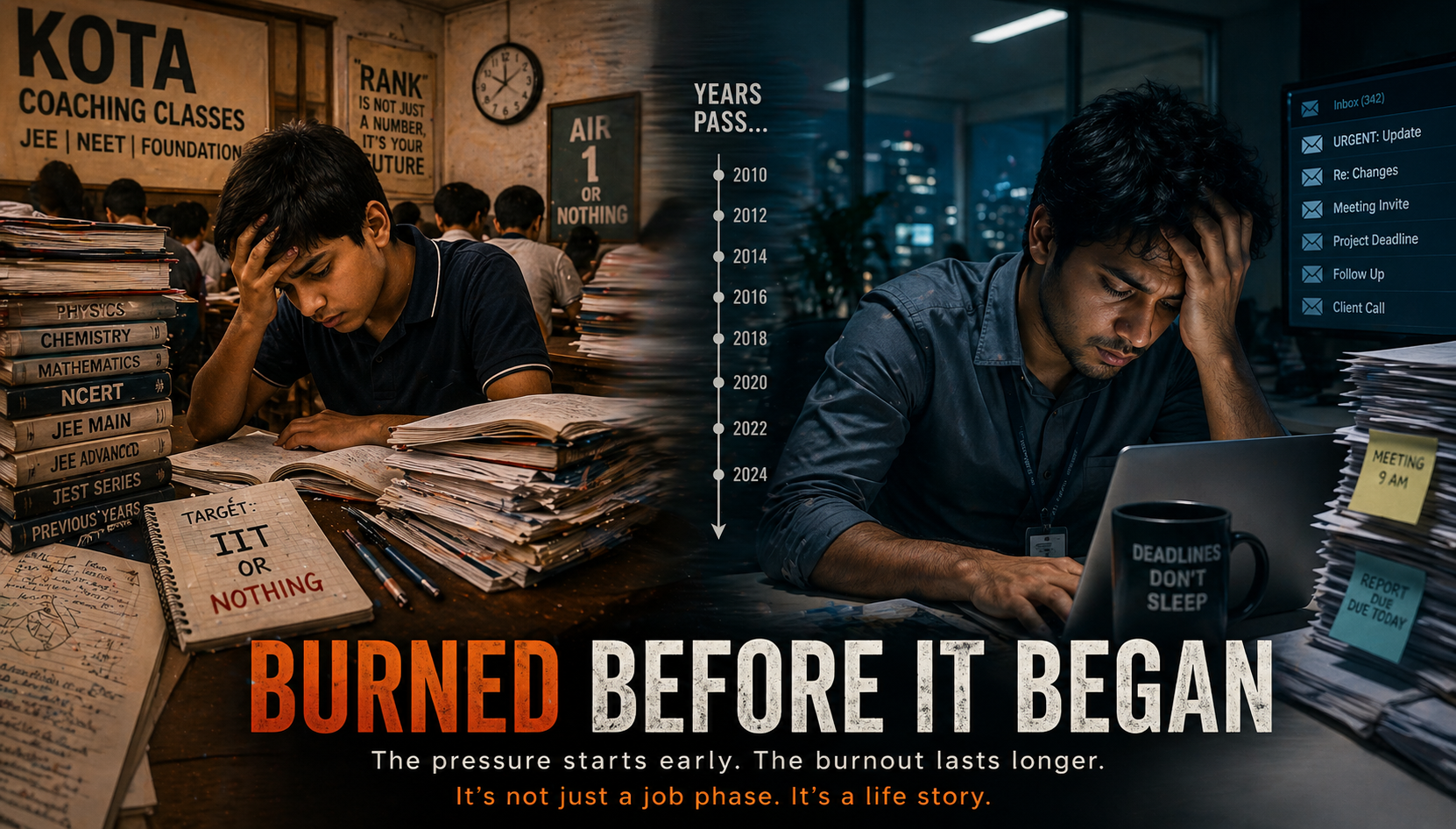
By the time many Indian Gen Zers print their first business card, they have already survived a decade of competitive war.
There is a story India has been telling itself for decades. It goes something like this: study hard, get into a good college, land a stable job, and life will reward you. For Generation Z those born between 1997 and 2012 this story started earlier, ran harder, and asked for far more than any generation before it. And what nobody is talking about enough is what that story cost them before they ever clocked into their first job.
The global conversation around Gen Z burnout almost always starts at the workplace. Quiet quitting, bare minimum Mondays, toxic bosses these are the images that dominate headlines. But in India, that framing misses the most important chapter entirely. Because for a vast number of young Indians, burnout didn’t begin at the office. It began in a Class 6 classroom in Kota.
The starting gun fires at eleven
India’s coaching industry is unlike anything else in the world. Valued at over ₹50,000 crore and projected to cross ₹1.5 lakh crore by 2030, it is a parallel education economy that has quietly grown to rival the formal school system in influence. At its most visible extreme sits Kota, Rajasthan the city that brands itself the Coaching Capital of India where approximately 1.25 lakh students descend every year from across the country, many of them teenagers, some barely adolescents, to prepare for the JEE and NEET entrance exams.
What is less discussed is how young the starting line has become. Major institutes like Allen Career Institute, Resonance, and others now offer foundation courses explicitly designed for students from Class 5 and Class 6 onward children who are ten and eleven years old laying the groundwork for exams they will not sit for another six or seven years. The rationale is straightforward: the competition is so brutal that beginning preparation in high school is already considered too late.
The numbers behind that competition are staggering. Approximately 1.3 million students appear for JEE Main every year, of which only around 40,000 eventually gain admission to IITs, NITs, IIITs, and equivalent institutions. For NEET, over 20 million applicants compete for roughly 90,000 MBBS and BDS seats. These are not just tough exams. They are statistical elimination events, and the coaching industry has responded by pushing the preparation window earlier and earlier into childhood.
The result is a generation of Indian students who have spent much of their formative years, the years meant for play, curiosity, and identity formation inside a pressure system calibrated to sort and discard.
What kota’s numbers don’t tell you
The city of Kota has produced extraordinary success stories. Its posters celebrate toppers. Its institutes advertise selection ratios. What its brochures do not advertise is what happens to the far larger majority who arrive carrying their families’ hopes and leave carrying something heavier.
Research published in peer-reviewed journals paints a stark picture. Studies show that 65% of students preparing for competitive exams like JEE and NEET experience high stress, while 42% exhibit symptoms of depression. Kota recorded 26 student suicides in 2023 among the highest ever in the city’s history averaging more than two per month. A research paper published in Early Intervention in Psychiatry in 2024 noted that the suicide rate among coaching students has been consistently rising, with academic pressure and parental expectations cited as the dominant contributing factors.
These are not just tragedies. They are data points that illuminate a deeper truth: a significant portion of India’s Gen Z spent their adolescence in a state of chronic, unmanaged stress. And chronic stress, when sustained long enough, does not simply disappear when the exam ends or the admit card arrives. It restructures how young people relate to effort, failure, rest, and ambition often permanently.
The National Crime Records Bureau reported 12,526 student suicides in 2021 alone, many attributed to academic pressure. Nationally, student suicides rose 21% between 2019 and 2021, even as helplines and counselling initiatives expanded. The gap between the scale of the crisis and the scale of the response has never been wider.
Then came the pandemic
If competitive exam culture was the first layer of pre-workforce burnout for Indian Gen Z, the COVID-19 pandemic was the second arriving precisely as this generation was moving through its most critical educational years.
Students who had been preparing for board exams and entrance tests found their schedules dismantled overnight. Research published during the pandemic period found that among Indian college students, 51.5% reported mild to severe anxiety and 28.7% reported moderate to severe depression during the lockdown period. The disruptions were not merely inconvenient. For students in the middle of two-year JEE or NEET preparation cycles, they were destabilising in ways that are still being understood.
Unlike Millennials, who entered adulthood before social media became a constant presence, Gen Z processed the anxiety of a global pandemic through devices that were simultaneously their classrooms, their social lives, and their news feeds. There was no separation. The fear of infection, the economic uncertainty of their parents, the guilt of lost preparation time, and the scrolling dread of social media all arrived through the same screen.
A 2023 study by Sapien Labs, a global mental health research organisation found that 51% of Indian youth aged 18 to 24 are struggling or distressed. A Deloitte India survey from 2022 found that 49% of Indian Gen Z experience consistent anxiety or stress. These are not fringe numbers. They describe the majority experience of a generation.
Arriving at work, already exhausted
Here is the invisible toll that employers, commentators, and critics of Gen Z almost universally miss: by the time this generation enters the workforce, many of them have already spent the better part of a decade in high-stakes performance environments. They have been ranked, tested, filtered, ranked again, and judged against peers in ways that previous generations simply were not and certainly not starting at age eleven.
The McKinsey Health Institute’s global survey found that India had the highest reported rate of burnout symptoms among employees across the countries it studied 59%. A mental health platform’s demographic analysis of its own consultations found that individuals under 25 accounted for 53% of the sessions, the highest of any age group. Meanwhile, the India-specific Gen Z workforce data shows that nearly half of Gen Z professionals do not feel economically stable even within formal employment.
These statistics exist in the same country where the public narrative about Gen Z in the workplace is that they are “too soft,” “unwilling to work hard,” or “lacking the hunger of previous generations.” The irony is almost cruel. This is a generation that has been performing under pressure since before puberty. What looks like disengagement at work is often something more specific: the physiological and psychological exhaustion of people who have been running at high intensity for so long that their systems have simply begun to shut down.
Global research supports this timeline collapse. A widely cited survey found that while the average person historically reached peak burnout at around 42 years old, Gen Z and Millennials are hitting their highest stress levels at an average age of just 25 a full 17 years earlier than prior generations.
The conversation we are not having
India is very good at celebrating the toppers. It is much less practiced at asking what the system costs the rest.
For every student who cracks JEE Advanced and goes on to IIT, there are dozens who spent years in the same pressure cooker and emerged without the rank, without the coping skills, and without anyone acknowledging what the attempt itself cost them. The coaching ecosystem is not designed to support the ones who don’t make it. The school system often has no vocabulary for the kind of exhaustion these students carry. And families, who invested financially and emotionally in the process, frequently frame the outcome as a character question rather than a systemic one.
What India’s Gen Z needed and largely did not receive was an educational environment that taught them how to manage pressure, not just how to perform under it. Resilience is not the same as endurance. One prepares you for challenge; the other merely defers the collapse.
What needs to change
The Union Education Ministry issued new guidelines for coaching institutes in 2024, mandating registration, minimum infrastructure standards, and fixed teacher-student ratios. These are meaningful steps. But regulation of the coaching industry is only one part of a larger answer.
Schools need mental health infrastructure that is proactive, not crisis-reactive. The language around academic ambition needs to change from “work harder” to “work sustainably.” Employers need to understand that the Gen Z employees walking through their doors are not blank slates: they are people who have been through an unusually demanding decade, and what they need is not more pressure but better support systems.
And perhaps most urgently, India needs to stop treating burnout in young people as a sign of weakness and start recognising it for what it actually is: a rational response to an irrational amount of sustained stress, beginning far too early in life.
Gen Z did not arrive at the workplace lazy or entitled. They arrived tired and tired in ways that compound years of coaching classes, competitive exams, pandemic disruption, and social media saturation. The burnout conversation that keeps starting at the office needs to scroll back much further, to the eleven-year-old sitting in a Kota classroom with seven years of preparation still ahead and no one asking how they are doing.
That child grew up. They are your colleagues now. And they were burned before they ever began.
Subscribe Deshwale on YouTube


