











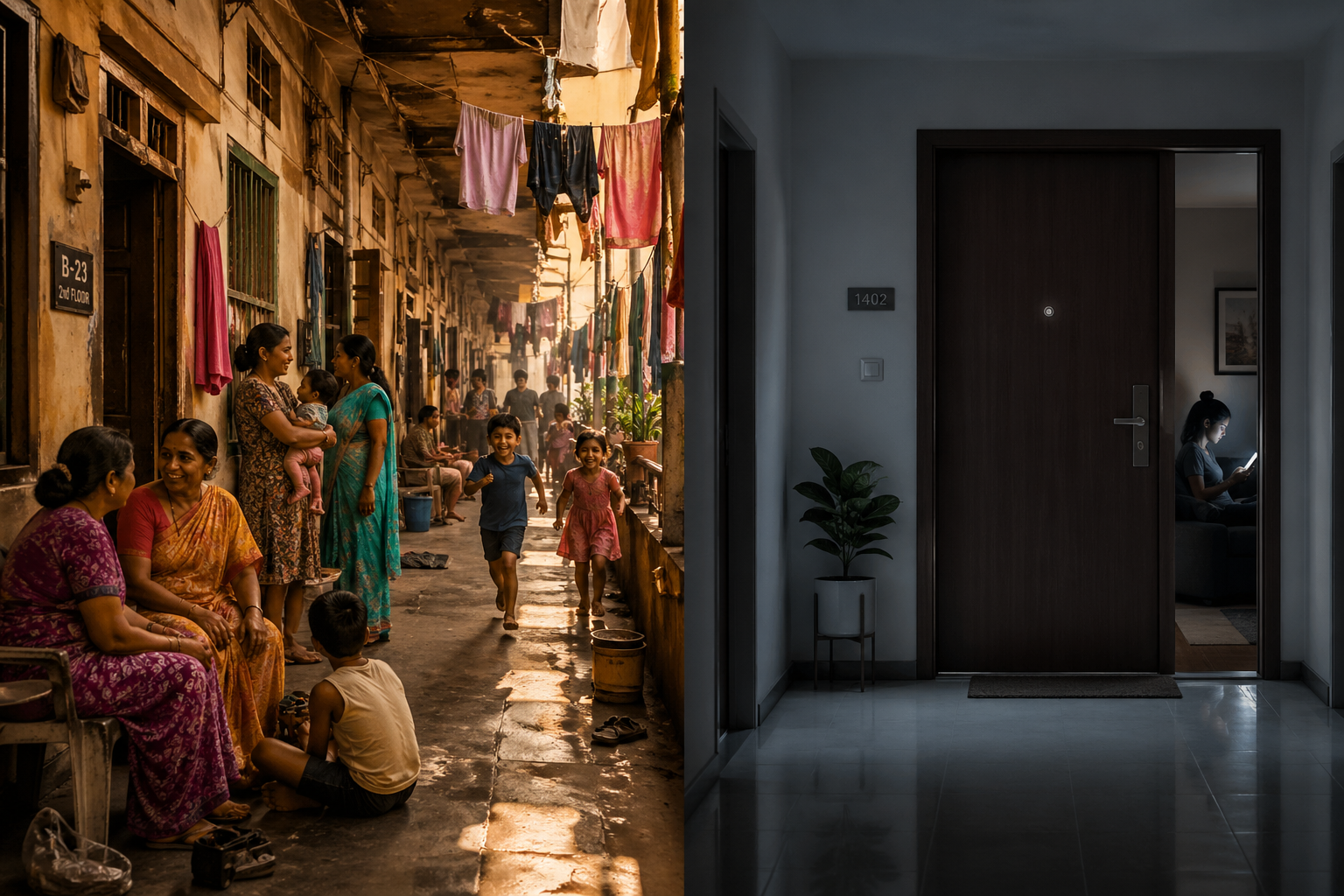
India’s loneliness crisis did not begin with Instagram. It began the day we closed our front doors and built walls between ourselves.
There is a line that has stayed with me ever since I first read it. Rohit Shringare, a photographer whose family moved out of a South Mumbai chawl in the 1980s, was describing what life was like before they left. He said it simply, without drama.
“We never closed our doors.”
Four words. An entire world.
If you grew up in India before the apartment era, you already know what he means. The chawl that was a long corridor of small rooms built around a shared courtyard was not just a housing type. It was a social contract. You shared toilets, you shared festivals, you shared food, you shared noise, you shared grief. The walls were thin enough to hear your neighbour’s arguments and their laughter. Weddings spilled into the corridor. A child who fell sick at midnight had twelve aunties at the door by morning.
Chawls first came up in Mumbai during the 19th century, built to house textile mill workers pouring in from the countryside during British colonial rule. They were never meant to be beautiful. They were meant to be functional. What nobody planned and what nobody could have planned is that they accidentally solved one of the oldest human problems: how do you stop people from being alone?
The answer, it turned out, was simple. You build a corridor and make them share it.
Then something changed. From the 1960s onwards, developers began to see the land that chawls and textile mills stood on as some of the most valuable real estate in the country. Families were offered something better. A self-contained unit in a new cooperative housing society. A door with a lock. A kitchen that was only yours. Privacy, marketed as progress.
People took the deal. Of course they did. The chawls were old, many of them structurally dangerous, with inadequate sanitation. Nobody is romanticising poverty here. The move to better housing was real and necessary.
But something left with the chawl that nobody wrote on the checklist. The corridor. The shared courtyard. The unlocked door. The neighbour who knew your name not because you introduced yourself, but because she had been listening to your life for fifteen years.
What replaced it was a front door. A peephole. A society that called itself a “community” but meant a building with a gym and a no-pets policy.
This same story played out across the rest of India in a different form. The joint family, one of the oldest social structures in human civilization, began to break apart in the same decades that independent India began to urbanise. Sons moved to cities for work. Daughters moved to other cities after marriage. Parents stayed behind or were brought along to live in a 2BHK where there was no longer a courtyard, no longer a neighbourhood peepal tree, no longer a verandah where elders sat and talked to everyone who passed.
The floor plan changed. Three generations under one roof became two. Then one. Then one person, alone, in a studio apartment in Bengaluru on the fourteenth floor, who has not spoken to another human being since Tuesday.
We built walls for privacy. We did not know we were also building a loneliness crisis.
The World Health Organization declared loneliness a global public health threat in November 2023. Not a feeling. A threat. One that raises the risk of heart disease, stroke, depression, and early death. The health impact of loneliness, according to research cited by the WHO Commission on Social Connection, is the equivalent of smoking fifteen cigarettes a day.
We did not need a global health commission to tell us something was wrong. We could feel it. It is why rent-a-friend platforms now operate in Bengaluru, Mumbai, Delhi, and Chennai, charging ₹699 an hour for what a chawl gave you for free. It is why therapy waiting lists in Indian metros run into months. It is why people in their twenties and thirties describe feeling completely alone inside cities of twenty million people.
The smartphone did not do this to us. Social media did not do this to us. They arrived later and made it worse but they did not start the fire.
The fire started when we knocked down the shared corridor and called the apartment an upgrade.
We got bigger rooms. We lost our neighbours. And somewhere in that trade, without meaning to, without noticing, we lost something that no app has yet figured out how to give back.
The door is still there. We just never leave it open anymore.
Subscribe Deshwale on YouTube


