











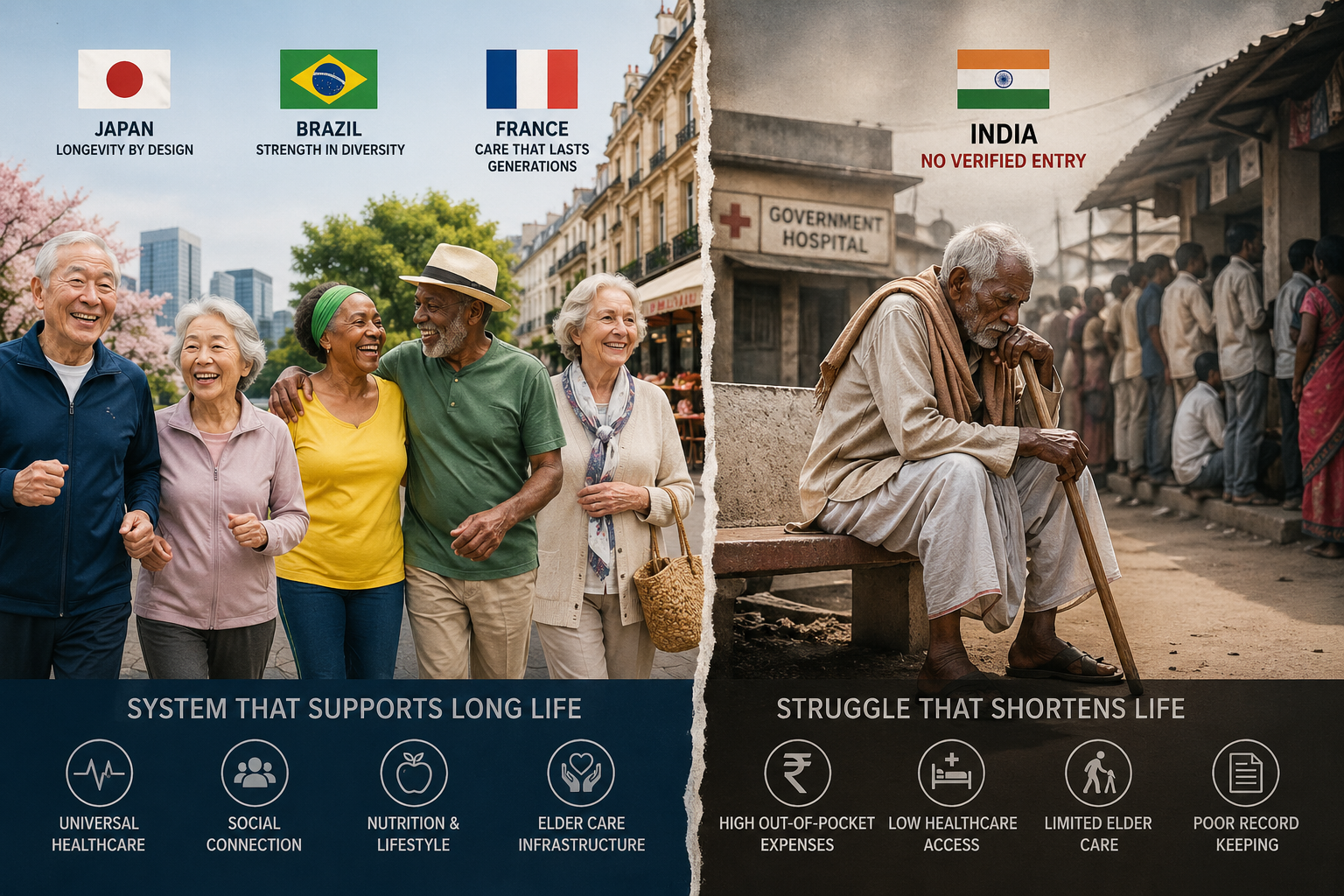
Look at the global list of the oldest verified living people and a pattern jumps out immediately. Japan appears over and over again with dozens of names, decade after decade. Brazil punches dramatically above its weight, with three of the world’s longest-lived validated men and women appearing more frequently in the top 15 than citizens of far wealthier nations. France holds steady with multiple entries across generations. And then there is India, the world’s most populous country, with 1.4 billion people, ancient wellness traditions, and a civilization older than almost any on earth.
Zero entries. Not one verified name.
The easy assumption is that this is purely a documentation problem and documentation certainly plays a role. But to stop there is to miss the deeper and more uncomfortable story. Because when you look closely at what Japan, Brazil, and France actually have in common, it stops being a mystery about paperwork. It becomes a mirror held up to every country’s choices about how it treats the people who are still alive.
Japan: Where longevity is a system, not a coincidence
Japan’s dominance on every longevity list in the world is not an accident of genetics or diet alone. It is the result of deliberate, sustained, and decades-long investment in the conditions that allow human beings to grow genuinely old.
Japan achieved universal health coverage in 1961. Since 1983, Japanese seniors have had health coverage financed through a national pool that today serves approximately 35 million elderly citizens. The system emphasises preventive care routine health assessments, early detection, and regular check-ins that catch problems before they become crises. Japan has the longest life expectancy in the world at 85 years, and its age-standardised mortality rate is the lowest among G7 countries.
But what is often overlooked in the healthcare conversation is the social architecture that sits alongside the medical one. Japan has the concept of moai particularly in the Okinawan population which are tight-knit social support groups that provide emotional connection and companionship to elderly members. Loneliness, which researchers increasingly identify as a major predictor of early death, is actively countered by community design. Elderly Japanese people are not warehoused and forgotten. They are woven into the fabric of daily life.
In 2000, Japan introduced a Long-Term Care Insurance system, a mandatory programme for everyone over 40 that funds home-based and facility care for the elderly. It is specifically designed so that growing old does not mean financial ruin or family collapse. The infrastructure of extreme longevity in Japan is not accidental. It was built, piece by piece, over seventy years.
Brazil: The surprise on the list
Brazil’s presence near the top of the world’s oldest living list surprises many people. It is not a wealthy country by global standards. It has deep inequality, significant rural poverty, and a universal health system, the Sistema Único de Saúde, or SUS, that has struggled for decades with underfunding and uneven coverage. And yet, the world’s oldest living man is Brazilian. Three of the longest-lived validated men in recorded history are Brazilian. Brazilian women appear in the global top 15 more frequently than women from far richer nations.
The answer, researchers now believe, lies partly in something that no health policy can manufacture: genetic diversity.
Centuries of admixture between Indigenous peoples, Africans, Europeans, and Asians have produced one of the most genetically diverse populations on earth. A recent study by Dr. Mayana Zatz and colleagues at the University of São Paulo found that Brazil’s supercentenarians carry rare genetic variants linked to immune strength and cellular maintenance that are simply invisible in genetically homogeneous populations. Many of these supercentenarians grew up with limited access to modern healthcare. They survived not because the system held them up, but because their biology, shaped by extraordinary genetic diversity, held them up from within.
Brazil’s lesson is not that you can reach 113 without good healthcare. It is that longevity has multiple pathways, and the science of extreme old age has been systematically missing the populations whose biology might tell us the most.
France: The infrastructure of a long life
France’s consistent presence on the longevity list reflects something straightforward: a country that has built comprehensive, accessible, universal healthcare and has done so for long enough that its effects have compounded across generations.
France operates a multi-payer universal health insurance system where the government covers the majority of medical costs, and out-of-pocket expenses are among the lowest in the developed world. Elder care is institutionally supported, not left entirely to families. The French concept of the extended lunch, the unhurried pace of social life, and the cultural emphasis on food quality over convenience are frequently cited in longevity research as protective factors not because of any single meal, but because of the chronic stress reduction that comes from a society that has not entirely sacrificed human rhythm to economic productivity.
France is not perfect. But it has built the structural conditions in which living to 113 is possible, verifiable, and crucially not a matter of personal luck.
India: What the numbers actually reveal
Now look at India through the same lens.
India’s public healthcare expenditure stands at approximately 1.9 percent of GDP far below the government’s own National Health Policy target of 2.5 percent, and dramatically lower than Japan’s 9 percent, Brazil’s 3.9 percent, and France’s comparable figure. Even with significant recent improvements driven by programmes like Ayushman Bharat, out-of-pocket healthcare expenditure in India was still 39.4 percent of total health spending in 2021-22. That means nearly four rupees out of every ten spent on healthcare in India comes directly from a patient’s pocket at the moment of crisis.
For context: in the United Kingdom and Australia, out-of-pocket expenses represent roughly 13 percent of total health spending. In countries where people live the longest, healthcare costs do not regularly push families into poverty. In India, research by the Observer Research Foundation has found that between 3 and 7 percent of Indian households fall below the poverty line every year specifically because of medical expenses.
The gap is not just about money. India has 1.3 hospital beds per 1,000 people — far below the World Health Organization’s recommendation of 3.5 per 1,000. The doctor-patient ratio stands at approximately 1:1,511, against the WHO recommendation of 1:1,000. In rural areas, where the majority of India’s elderly population lives, these shortages are more severe. For the elderly poor in rural India, the question is often not whether to access quality care but whether to access any care at all.
Countries like Japan have dedicated geriatric care policies. India does not yet have a comprehensive national geriatric care framework that matches the scale of the challenge it is about to face.
The actual lesson
None of this is to say that India’s elderly are not surviving into old age. Many are. But surviving into old age and thriving into extreme old age are two different things separated by decades of accumulated healthcare access, nutritional security, social connection, and the simple absence of catastrophic financial shocks.
What Japan, Brazil, and France actually have in common is not language, culture, cuisine, or climate. What they share is that their oldest citizens for different reasons, through different systems, were not left entirely alone to manage the weight of growing old.
Japan built a system that caught people before they fell. Brazil produced a population whose biology carries a resilience that science is only beginning to understand. France created the cultural and institutional scaffolding that allows ordinary people to reach extraordinary ages.
India has a philosophy. It has seva, the tradition of caring for elders. It has yoga, Ayurveda, a plant-based dietary culture, and millennia of accumulated wisdom about the human body. What it has not yet fully built is the institutional expression of those values: the hospitals, the insurance, the elder care policy, the civil registration infrastructure that turns cultural reverence for old age into the actual conditions under which extreme old age becomes possible.
The world’s oldest people are not Japanese, Brazilian, and French because of something magical in the water. They are from those countries because those countries, in different ways and at different costs, decided that their oldest citizens were worth counting, worth funding, and worth keeping alive.
India has not yet made that decision at the scale its population demands.
The question is not whether it will. The question is how many more generations will grow old and disappear unrecorded before it does.
Subscribe Deshwale on YouTube


