










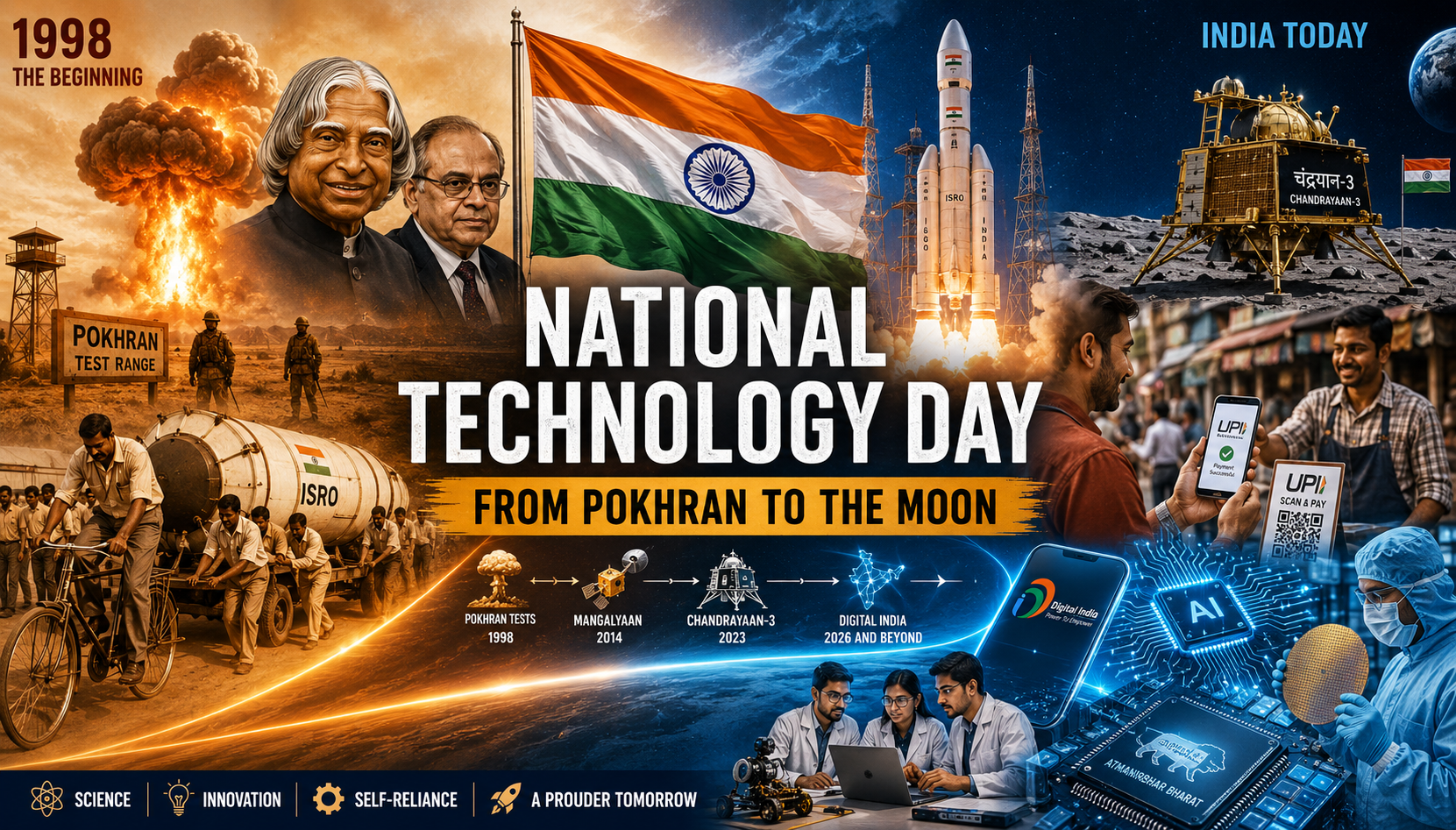
Every year on May 11, India celebrates National Technology Day. Most people scroll past it on social media, maybe share a post, and move on. But if you actually stop and think about what this day represents and how far India has come since the story is far more remarkable than a holiday notification on your phone.
The day that changed everything
On May 11, 1998, at exactly 3:45 PM IST, the ground beneath the Thar Desert in Rajasthan shook not from an earthquake, but from something India had built entirely on its own.
Under the code name Operation Shakti, three nuclear devices were detonated simultaneously at the Pokhran Test Range. Two more followed on May 13. In total, five nuclear tests. Prime Minister Atal Bihari Vajpayee walked up to the press and declared India a full-fledged nuclear state. The architects of this moment were two extraordinary scientists Dr. APJ Abdul Kalam, who later became the President of India, and Dr. R. Chidambaram, Chairman of the Atomic Energy Commission.
The world was stunned. The United States, which had been monitoring the site with satellites, completely missed the preparations. India had outsmarted one of the most sophisticated intelligence agencies on the planet.
The reaction was swift and harsh. The US, Japan, and several other countries imposed sanctions. But India stood its ground. It did not sign the Comprehensive Nuclear-Test-Ban Treaty, believing it was not in the nation’s interest.
In that defiance was a promise that India would build its own path. In science. In technology. On its own terms.
The space chapter: From bicycles to the moon
If you want to understand how seriously India took that promise, look no further than ISRO.
In the early days, ISRO scientists famously transported rocket parts on bicycles and bullock carts. That image became a symbol not of poverty, but of determination.
In 2013, India launched the Mars Orbiter Mission, popularly known as Mangalyaan. It reached Mars orbit on September 24, 2014, making India the first Asian nation and the first country in the world to successfully reach Mars in its very first attempt. The entire mission cost just $74 million less than what Hollywood spent making the space film Gravity.
But the greatest moment came on August 23, 2023.
At 6:04 PM IST, India’s Chandrayaan-3 successfully landed near the Moon’s south pole, a region no country had ever reached before. India became only the fourth country in history to soft-land on the Moon, after the United States, the Soviet Union, and China. And it did so for approximately $75 million, a fraction of what comparable missions cost elsewhere.
A nation that once carried rocket parts on bicycles had landed on the Moon.
The digital revolution nobody saw coming
While ISRO was reaching for the stars, something equally revolutionary was happening right in people’s pockets.
In April 2016, India launched UPI, the Unified Payments Interface. At the time, most Indians were still paying in cash. Nobody imagined that a decade later, street vendors, autorickshaw drivers, and roadside tea sellers would all accept digital payments with a simple QR code scan.
The numbers today are staggering. In 2025 alone, UPI processed 228.5 billion transactions, a 33% jump from the year before. By early 2026, the platform had over 500 million active users and was live across 8 countries, including the UAE, Singapore, France, Bhutan, Nepal, Sri Lanka, Mauritius and Qatar. The IMF has officially recognised UPI as the world’s largest real-time payment system by transaction volume.
India did not just build a payments app. It built a global blueprint. India has signed formal MoUs with 23 countries to share and replicate its digital public infrastructure from digital payments to digital identity systems.
The honest part of the story
It would be unfair to only celebrate. Some promises from 1998 are still works in progress.
India remains heavily dependent on importing semiconductors, the tiny chips that power every smartphone, laptop, and electric vehicle. Despite being a software giant, India does not yet manufacture its own chips at scale. The government has launched a major semiconductor mission, and the first indigenous fabs are expected to come online in the next few years but we are not there yet.
Research and Development spending in India still lags behind global standards. Countries like Israel (around 6%) and South Korea (over 5%) invest heavily in R&D as a share of GDP. India spends around 0.64%. Breakthroughs need investment, and this gap needs urgent attention.
Where does that leave us?
From a nuclear test that surprised the world to landing on the Moon’s south pole. From cash-only transactions to building the world’s most used digital payments system. The distance India has covered in 28 years is genuinely extraordinary.
National Technology Day is not just a date in the calendar. It is a reminder of what India is capable of when it backs its scientists, trusts its engineers, and refuses to be told what it cannot do.
The promises made in 1998 are still being fulfilled one mission, one innovation, one bold idea at a time.
Subscribe Deshwale on YouTube


