









As chemists go on a nationwide strike over e-pharmacies, a key question is being asked how strictly do online platforms verify prescriptions before selling medicines?
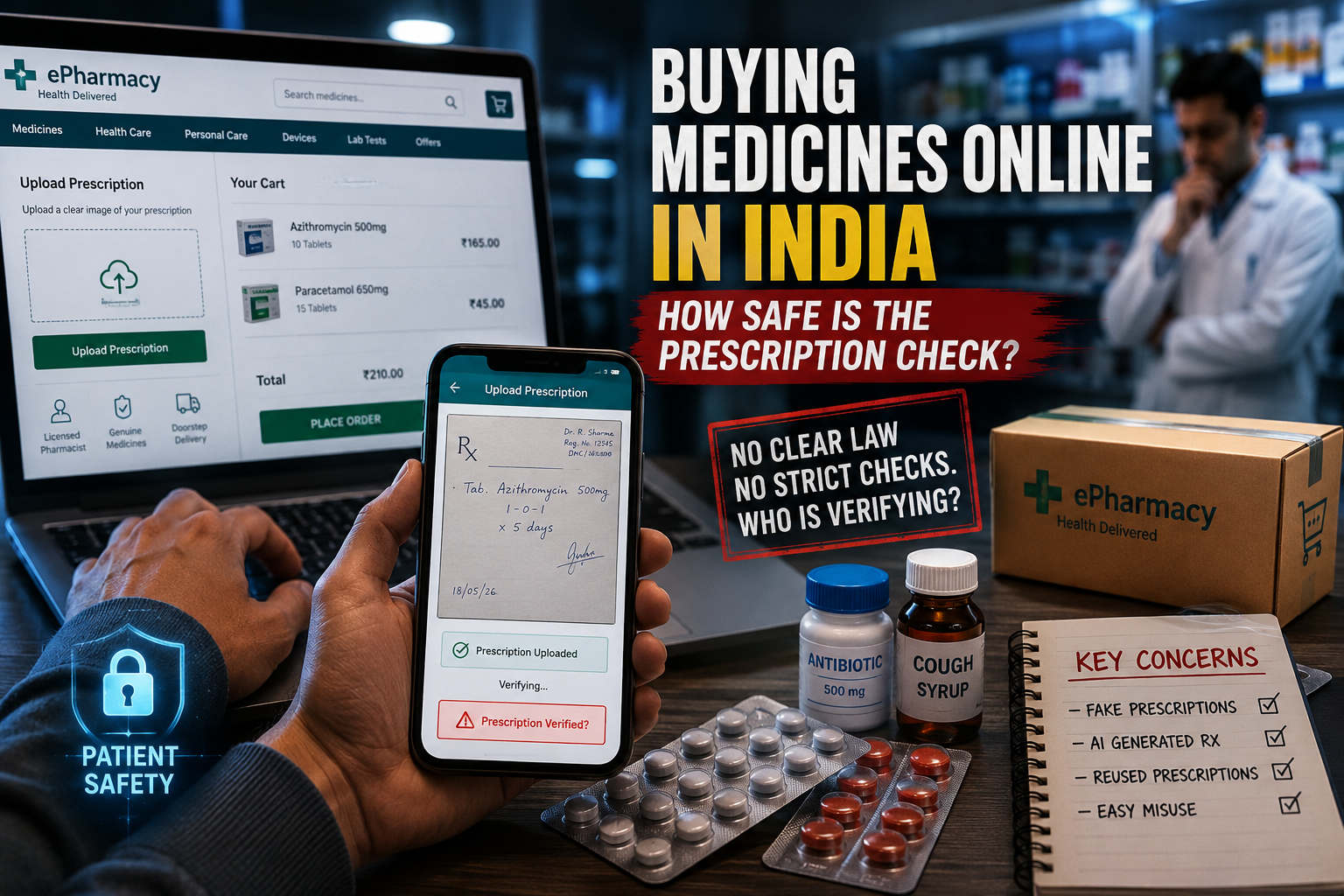
When you order medicine online in India today, you are usually asked to upload a photo of your prescription. A box pops up on the screen, you take a picture of your doctor’s slip, and within minutes the order is confirmed. The process feels routine. But behind this simple step lies a serious and unresolved regulatory question: is anyone actually checking that prescription carefully?
This is at the heart of one of the concerns raised by the All India Organisation of Chemists and Druggists (AIOCD), which represents over 1.24 million chemists and pharmaceutical distributors across India, and which called a 24-hour nationwide strike on May 20.
What the law says
Indian law is clear on this. Under the Drugs and Cosmetics Act, 1940, a chemist can dispense prescription drugs only on the prescription of a doctor. A prescription must carry the name of the doctor, their address and registration number, along with the name of the drug, its potency, dosage and duration. Before dispensing any drug, the pharmacist is expected to verify the completeness, authenticity and legality of the prescription.
This rule applies online too. A December 2015 notice issued by the Office of the Drugs Controller General made it clear that the provisions of the Drugs and Cosmetics Rules, 1945, would also apply to the online sale of drugs. So in theory, the same rules that govern your neighbourhood chemist also govern an app delivering medicine to your doorstep.
The problem: No dedicated law for E-pharmacies
Here is where things get complicated. Online pharmacy laws in India are still in a nascent stage and there are no dedicated online pharmacy laws in the country. The government drafted rules specifically for e-pharmacies back in 2018. The rules remain unnotified as of May 2026, and no statutory definition of “e-pharmacy” exists in Indian law. A Right to Information query filed by MediaNama in 2022 revealed the government’s own response: finalisation of these rules “may not be possible to say any timelines at this stage.”
This regulatory gap has been acknowledged at the highest levels. In February 2023, the Central Drugs Standard Control Organisation (CDSCO) issued show-cause notices to more than 20 online pharmacies, including Flipkart, Amazon, and Tata 1mg, for non-compliance. But notices alone have not resolved the underlying absence of a formal legal framework.
Timeline — regulations that never reached the finish line
- August 2018: Ministry notifies draft e-pharmacy licensing rules and invites public comments.
- December 2018: Delhi High Court bans online medicine sales without a licence in a PIL filed by Delhi-based dermatologist Dr Zaheer Ahmed.
- February 2023: CDSCO issues show-cause notices to more than 20 online pharmacies for non-compliance with the HC order.
- November 2023: Delhi HC gives the government a final eight-week deadline to frame a policy and warns that the Joint Secretary will be personally summoned if the deadline is missed.
- May 2026: Rules still unnotified. No statutory definition of “e-pharmacy” exists in Indian law.
The Prescription Loophole
Currently, most online pharmacy platforms ask customers to upload a photo or scan of a prescription. OTC medicines can be ordered directly, whereas for prescription drugs, the customer is required to upload a scanned copy of an original prescription. However, there are two specific concerns that have been flagged by chemists’ organisations and medical bodies.
Fake or AI-generated prescriptions: In February 2026, a Times of India investigation found that online pharmacy platforms accepted AI-generated prescriptions with fabricated hospital names and doctor details, and dispensed psychotropic drugs, opioids, antibiotics, and some banned medicines. AIOCD wrote to the Prime Minister’s Office about this, calling for AI-generated prescriptions to be declared invalid nationwide.
The same prescription is used multiple times: A prescription can easily be manipulated and misused by individuals by uploading one prescription several times on a website, or using a single prescription on different platforms. There is currently no central registry that flags a prescription that has already been used to purchase medicines.
The drugs that are most at risk
Not all medicines carry the same risk. Indian law categorises drugs into schedules based on their potential for harm. Schedule H, Schedule H1, and Schedule X drugs can be sold by retail only on production of a valid prescription from a registered medical practitioner. Schedule X drugs include narcotics and psychotropic substances. For Schedule H1 drugs, a licensed pharmacist must maintain a separate register with details of the patient, the doctor and the name of the drug this register must be kept for three years and is open to inspection by regulatory authorities.
The draft 2018 rules proposed that e-pharmacy activities must not be carried out with respect to any drug referred to in the Narcotic Drugs and Psychotropic Substances Act, or tranquilisers or Schedule X drugs. However, since these rules were never finalized and notified, this remains a proposal rather than enforceable law.
What the online platforms say
Online pharmacy platforms generally claim that they have internal systems for prescription verification, and that a licensed pharmacist reviews every prescription before an order is approved. They also argue that online transactions can be tracked with complete details including the medicine’s batch number, the retail pharmacy’s details, the prescribing doctor and the customer which, they say, can help prevent drug abuse and overconsumption.
What the chemists want
AIOCD has placed three specific demands before the government. The first is cancellation of Notification GSR 817 and the drafting of a fresh framework for medicine sales. The second is the withdrawal of Notification GSR 220, which was introduced during the COVID-19 pandemic to allow home delivery of medicines during lockdowns but was never withdrawn after the pandemic ended. The third is action against deep discounts as high as 50% being offered by online medicine platforms, which offline chemists say they cannot match under current pricing rules.
“Either put an end to these deep discounts offered by online platforms, or amend the DPCO to provide us with higher margins so that we, too, can offer greater discounts to consumers.” JS Shinde, National President, AIOCD
The debate is not simply about chemists protecting their business. It touches on patient safety in a country where self-medication is already common and regulatory capacity is stretched. AIOCD estimates that the livelihoods of 50 million people are tied to the pharmacy retail trade. At the same time, online pharmacies have brought medicine access to patients in remote and rural areas who previously had limited options.
The draft e-pharmacy rules, if finalised, would require mandatory registration, pharmacist oversight, prescription verification and periodic inspection of platforms. However, even the draft rules only cover the obligation of e-pharmacies to check the legitimacy of prescriptions; they do not deal with consumers who provide fake prescriptions. Legal experts say this gap still needs to be addressed in any final framework.
Until a proper law is in place, both the online platforms and the offline chemists will continue to operate in a grey zone. And the person uploading a photo of their prescription will never quite know who, if anyone, is looking at the other end.
Subscribe Deshwale on YouTube


