










A Crisis Hidden in Plain Sight
There is a particular kind of injustice that hides in plain sight. It does not announce itself through marches or manifestos. It does not accumulate outrage or earn prime-time urgency. It simply persists, embedded in the architecture of institutions, in the grammar of law, in the casual cruelties of culture, until the numbers become too large to explain away and the silence around them becomes its own indictment.
India is living through exactly such a moment.
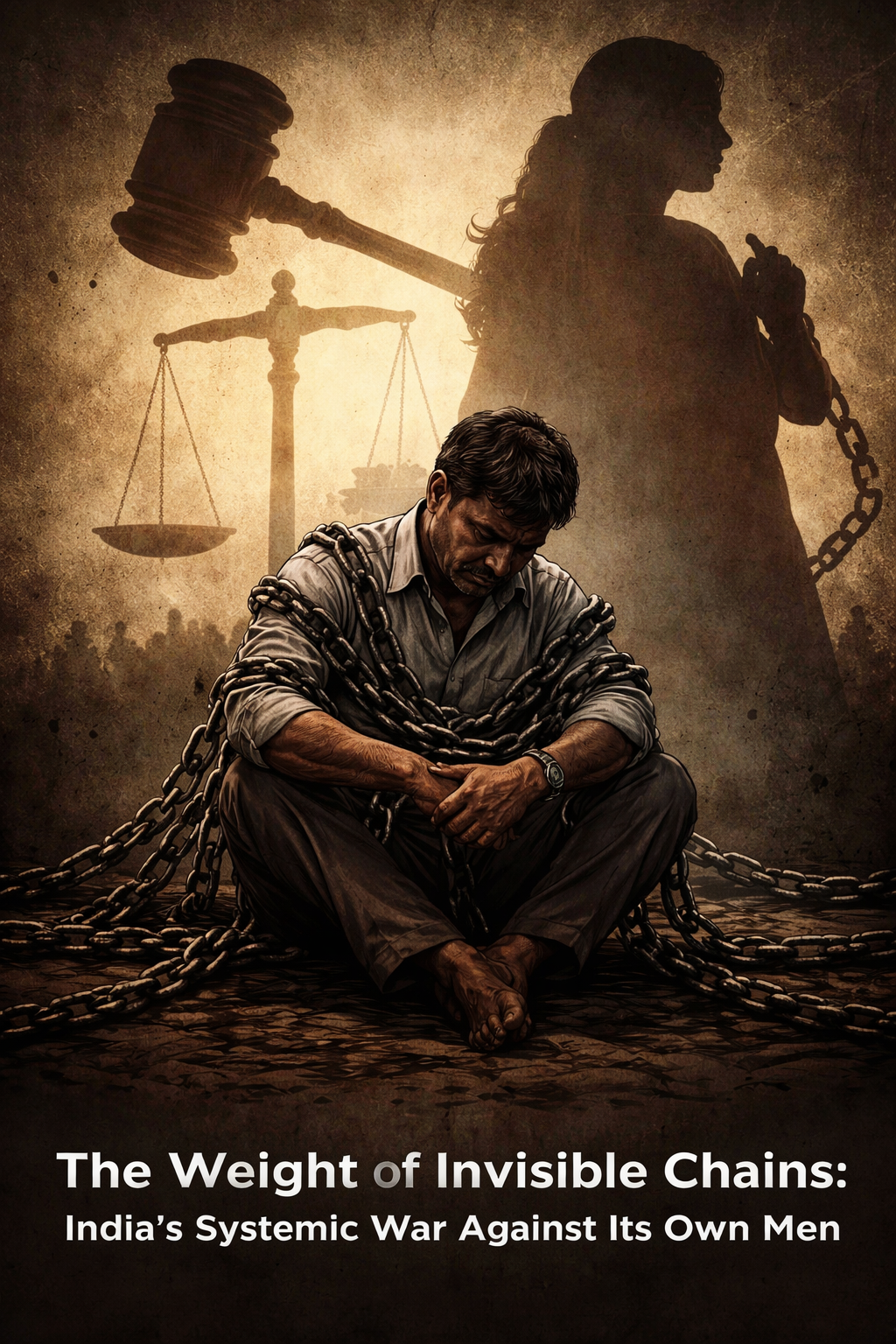
Every year, more than 118,000 Indian men die by suicide. That figure, drawn from the National Crime Records Bureau’s own data, represents not just a public health statistic but a civilisational signal. It dwarfs the female suicide count by a ratio that has not narrowed but widened with each passing year. In 2023, an even more uncomfortable reversal emerged. For the first time in documented Indian history, more men than women died by suicide specifically due to marital distress. This should have triggered national debate, emergency legislative review, and targeted policy architecture. It triggered none of those things. It was received, processed, and quietly filed away.
The question this country has systematically refused to ask is why.
The Myth of Uniform Female Vulnerability
The answer begins with understanding how India learned to talk about gender in the first place. Over three decades, a framework was built around a theory of harm that was, in many ways, both necessary and dangerously incomplete. Necessary, because the country’s record on violence against women is genuinely catastrophic, and the legal infrastructure built in response addressed real, documented harm. Incomplete, because in the process of constructing that framework, an assumption hardened into orthodoxy: that gender vulnerability flows in one direction only.
This assumption deserves to be challenged not merely on legal grounds but on empirical ones. India is not a country of uniformly powerless women. It is a country of extraordinary female diversity. It has produced some of the world’s most formidable executives, jurists, politicians, academics, and entrepreneurs. In vast swathes of Indian social life, particularly across matrilineal communities in Kerala, Meghalaya, and parts of coastal Karnataka, family structures are organised around female authority and female inheritance. In urban India, a significant and growing cohort of women are better educated than their male partners, financially independent, and embedded in family networks that provide them with social, legal, and emotional resources that many men simply do not have access to. The mother-in-law in the Indian family structure is frequently one of the most powerful figures in the domestic ecosystem, a reality that the framing of every matrimonial dispute as a story of female victimhood consistently erases.
Women, like men, are capable of cruelty. They are capable of financial manipulation, emotional abuse, psychological violence, and the calculated weaponisation of legal provisions against partners, husbands, and their families. This is not a controversial statement. It is a statistical and experiential reality that thousands of Indian families have lived and that the Supreme Court of India has acknowledged in its own judgments. The persistence of a legal and cultural framework that treats female perpetration as an anomaly requiring special explanation, while treating male perpetration as the default assumption requiring no evidence, is not a protection of women. It is a distortion of reality that ultimately serves no one well, least of all the women whose genuine suffering gets tangled up in the credibility problems created by systematic misuse.
This is not a conspiracy. It is a cognitive shortcut, the kind that institutions develop when responding to a visible crisis without the luxury of philosophical precision. The problem is that cognitive shortcuts, once institutionalised, become very difficult to dislodge. They get written into law. They get reinforced by culture. They get defended as common sense. And eventually, the people harmed by that shortcut have no language to describe their experience, because the dominant vocabulary was built without them in mind.
What replaced language replaced justice. Across institutions, presumption has quietly substituted for proof. Men are treated as default perpetrators. Women are treated as default victims. This is not written in policy. It is embedded in practice. In workplaces, an accusation is often enough to trigger consequences. Reputation collapses before investigation begins. Due process becomes a formality rather than a safeguard. In educational institutions, boys are more likely to be disciplined yet less likely to receive emotional support. They are controlled more and understood less.
Suspicion flows in one direction. Empathy flows in another.
What the Law Says, and What It Cannot Say
Nowhere is this asymmetry more precisely encoded than in India’s own law.
The Bharatiya Nyaya Samhita, which replaced the Indian Penal Code in 2023, was presented as a landmark decolonial overhaul. A closer reading reveals a different reality. Section 63 defines rape strictly as an act committed by a man against a woman, officially declaring that male bodily integrity is not worthy of equivalent legal protection. Male victims of sexual assault remain, in the language of the state, legally invisible. Section 69 criminalises sexual intercourse by deceitful means or a promise to marry, a provision that judicialises the complexities of modern relationships while assuming men to be the sole agents of deceit. Sections 73 and 74, addressing voyeurism and stalking, remain gender-specific. Only a man can be a perpetrator. Only a woman can be a victim. Section 84, which criminalises enticing away a married woman, treats the woman as a passive object while holding only the third-party male criminally liable. Sections 85 and 86, addressing cruelty within marriage, provide no equivalent recourse for a husband facing domestic or psychological abuse.
This is not a set of drafting oversights. It is a structural architecture. The BNS did not merely inherit these asymmetries from the IPC it replaced. It made a conscious decision to carry them forward into a century that already had the data to question them.
The Indian Supreme Court has noticed. In Rajesh Sharma v. State of U.P., the Court described the weaponisation of matrimonial cruelty provisions in language unusually blunt for a constitutional institution, noting how these tools are routinely deployed to harass men and their aging parents without preliminary verification. The judiciary, on multiple occasions, has termed this pattern legal terrorism. That term was not invented by activists on the margins. It was produced by the highest court in the land.
The legislative response to that judicial alarm has been, effectively, silence.
The Foreign Hand in India’s Gender Laws
That silence did not grow in a vacuum. It was cultivated, in significant part, by a well-funded and internationally connected ecosystem of advocacy that has shaped India’s legislative process on gender for decades, largely without public scrutiny or democratic accountability. Three documented examples illustrate the pattern with enough precision to move the argument beyond assertion.
The most direct example involves the Protection of Women from Domestic Violence Act of 2005, India’s primary domestic violence legislation. The PWDVA did not originate in Parliament or in any government ministry. Its first draft was prepared by the Lawyers Collective, the NGO co-founded by senior advocate Indira Jaising, in 1992. The organisation circulated and advocated for that draft for thirteen years before the UPA government placed it before Parliament.
The Lawyers Collective is therefore the organisation most directly responsible for the conceptual and textual architecture of the legislation that governs domestic violence in India to this day. The same organisation subsequently received foreign contributions of over Rs 32 crore between 2006 and 2015, according to Ministry of Home Affairs findings.
The MHA suspended its FCRA registration in 2016 and permanently cancelled it, alleging that foreign funds had been used to lobby Members of Parliament on legislation and to influence the political decision-making process. A CBI FIR followed in 2019. The Lawyers Collective has disputed these findings and contested the proceedings in court.
It is also worth noting that the FCRA cancellations occurred during a period when the current government cancelled the registrations of several other civil society organisations critical of its policies, a context that gives the proceedings a contested political dimension that any fair reading must acknowledge. What is not in dispute is the foundational fact: the organisation that drafted India’s domestic violence law was substantially foreign-funded, and that law contains no provision recognising male victims of domestic abuse. The two facts are not unconnected.
The second example concerns the Ford Foundation, whose engagement with India’s gender advocacy sector spans more than five decades. Ford began funding the Self-Employed Women’s Association shortly after its founding in 1972 and has maintained continuous, large-scale investment in Indian women’s rights organisations since. In 2021, Ford committed $420 million over five years to tackle gender inequality globally, of which $159 million was specifically directed at the UN Women Action Coalition on Gender-Based Violence, with India explicitly named as a priority region.
Ford’s own published strategy describes its work as including shaping legislative and policy environments, not merely supporting welfare delivery. It is, by its own description, an agenda-setting institution. The scale of this investment across fifty years has produced an advocacy ecosystem on one side of the gender argument that has no equivalent on the other. No comparable foreign funding infrastructure exists for organisations working on male welfare, gender-neutral law reform, or the due process rights of men accused under gender-specific provisions. The consultation table was set with one side of the argument already resourced, trained, networked, and in the room.
The third example operates at the treaty level. India ratified the UN Convention on the Elimination of All Forms of Discrimination Against Women in 1993. The Supreme Court’s landmark 1997 Vishaka judgment, which laid the groundwork for what became the POSH Act of 2013, explicitly cited India’s CEDAW obligations as the basis for its directions, stating that in the absence of domestic law, international conventions were significant for interpreting constitutional guarantees. When Parliament codified the Vishaka Guidelines into the POSH Act, the legislation drew directly on CEDAW’s framework.
CEDAW is itself a convention whose content was shaped by globally coordinated advocacy, much of it funded by the same foundations and bilateral donors discussed above. India’s domestic gender laws are therefore downstream not merely of directly funded domestic NGOs but of an international treaty architecture built without any equivalent input from organisations representing male welfare or gender-neutral legal frameworks. The argument here is structural rather than conspiratorial: the international framework that became domestic law was itself the product of a single-directional advocacy process, and its domestic implementation faithfully reproduced that single-directionality.
None of this diminishes the genuine harms that drove the original advocacy. It does raise a serious and still-unanswered question about who was and was not at the table when India’s gender laws were designed, who funded their presence there, and whose experiences of harm were and were not written into the resulting statutes.
The Researchers Who Refused to Look Away
Among the researchers and advocates who have spent years mapping this terrain, a few names stand out not merely for their persistence but for the quality and honesty of their work.
Madhu Kishwar, the scholar and founder of the journal Manushi, occupies a singular position in this conversation. Manushi, which she launched in 1979, was among the earliest serious Indian publications to examine gender questions with rigorous, empirically grounded analysis rather than ideological convenience. What distinguished Kishwar from many of her contemporaries was her willingness to follow the evidence rather than the narrative.
As certain gender laws began to show patterns of misuse, as data on male suicide accumulated, and as the structural asymmetries in India’s legal framework became increasingly visible, Kishwar was among the first prominent voices to name what she was seeing without flinching from the political cost of doing so. Her critique was never anti-woman. It was pro-accuracy. The distinction matters, and it is the distinction that her detractors have consistently refused to make.
Deepika Bharadwaj has carried that work into the documentary form with a directness that has made her one of the most important and most targeted journalists working in this space. Her film Martyrs of Marriage gave faces and voices to the men and families destroyed by the weaponisation of Section 498A, the dowry harassment provision that the Supreme Court itself described in terms suggesting systemic abuse.
Bharadwaj’s work is significant not only because it documented individual cases with journalistic precision but because it demonstrated, through the accumulation of specific human stories, that the pattern was not incidental. It was structural. She has faced sustained attempts to discredit and silence her work, which is itself a form of evidence about how much discomfort that work has generated in the right places.
Jyoti Tiwari’s book Ladka Hua Hai, which translates roughly as A Boy is Born, approaches the crisis from a direction that makes it particularly valuable: it examines the socialisation of Indian boys into a framework of obligation without recognition, of responsibility without protection, from the earliest stages of life.
Tiwari’s argument is that the crisis visible in the adult male suicide statistics does not begin in courtrooms or marriage registries. It begins in how boys are raised, what they are told their suffering is worth, and what cultural permission they are given to acknowledge it. The book is a crucial contribution because it connects the legal and institutional asymmetries documented elsewhere to the intimate, formative processes through which a generation of Indian men internalised the idea that their distress was not worth naming.
The Save Indian Family Foundation, a grassroots network that emerged from the early 2000s largely in response to the misuse of Section 498A, represents something important in this landscape: organised male voices that arose not from ideology but from documented personal catastrophe. The organisation’s members are, in the main, men and families who encountered the legal system at its most asymmetric and survived to build something from the wreckage. Their data collection, their support networks, and their persistent engagement with legislators and courts have kept this conversation alive during years when the mainstream was entirely uninterested in having it.
The Ekam Nyaya Foundation has taken the work further into the domain of legal reform advocacy, arguing consistently and with careful documentation for gender-neutral legislation across the spectrum of criminal and civil law. Its contribution lies in translating the experiential evidence gathered by organisations like Save Indian Family into the formal language of legislative drafting, judicial petition, and policy recommendation. The foundation represents the maturation of a movement that began in personal pain and has arrived at institutional engagement.
What unites these voices, despite their different methods and registers, is a shared insistence on something that ought to be unremarkable: that the law should protect human beings rather than categories, and that evidence of harm should determine the architecture of protection rather than ideological assumptions about who is capable of causing it.
The Man as Revenue Source
The consequences of the existing architecture are financial as much as they are legal. India’s economic social contract rests on what might be called a utility trap. Men contribute the overwhelming majority of direct income tax revenue, with workforce participation and income data consistently pointing to a figure in the range of 80 to 85 percent. Against this, the Union Budget of 2025 to 2026 saw the Gender Budget, specifically allocated for women and girls, surge to 4.49 lakh crore rupees, a 37 percent increase. There is no equivalent gender-specific welfare architecture for men. There is no targeted suicide prevention framework built around the demographic that accounts for 70 percent of suicide deaths. The state harvests male labour and reinvests almost exclusively in the female demographic. A population that funds a system from which it is structurally excluded is not a citizenry. It is a resource.
Nowhere is this reduction more visible than in the family court system. Fathers are routinely awarded only visitation rights, reduced from parents to Sunday guests, while being held to full maintenance obligations under BNS-related procedures. The divorced woman has acquired, rightly in cases of genuine suffering, a narrative of social empathy. But the narrative has been applied so broadly and so automatically that the divorced man, regardless of the specific circumstances of his marriage or its dissolution, is presumed guilty of having caused the failure. If he lacks financial resources, he is viewed not as a person navigating a fracture but as a failed utility. His parental worth is measured in rupees. His emotional reality is largely invisible to the institution adjudicating it.
The marriage institution itself has become, for men, a structure of managed legal exposure. Allegations can trigger immediate consequences. Arrests can precede investigation. Social stigma attaches instantly and permanently. Fear has replaced trust. Litigation has replaced resolution. And the consequences are visible in the only data India seems willing to generate but not act upon: thousands of men pushed to the edge every year by the intersection of legal risk and marital conflict.
The law does not merely respond to these crises. It helps produce them.
The Culture of Acceptable Contempt
Law does not operate in isolation, and neither does this crisis. Culture builds the environment in which law becomes coherent, and contemporary Indian culture has made a particular habit of representing men through a set of lenses so narrow and so consistently unflattering that they have become, simply, normal.
Consider what Indian popular culture has normalised. The incompetent husband who cannot manage basic domestic responsibilities. The emotionally stunted partner. The middle-aged man whose physical appearance is considered appropriate material for comedy. In the urban Punjabi and Bollywood rap genres that currently dominate youth culture, the Indian man is frequently presented as a creature of pure instinct, a lecher whose desire is inherently predatory and low-brow. Many of the women who participate in these representations do so willingly, profit from them, and perform them at social functions. The hypocrisy emerges only when the cultural tide shifts and the same imagery becomes a grievance.
The body image double standard is particularly revealing. Male actors are routinely displayed shirtless in advertisements and film promotions as if their only cultural value resides in their abdominal definition. Men without the approved physical form are subject to open ridicule. The Indian cultural conversation around male hair loss is a study in tolerated cruelty. A man with a receding hairline is framed as prematurely old, sexually diminished, and socially comic. The same compassion extended to women experiencing hair loss, routed through the language of body positivity and dignity, is simply not extended to men. It is not that the standard does not exist. It is that it is considered not to apply.
This is how bias becomes invisible. It becomes familiar. It becomes the water the culture swims in. And when bias becomes familiar, it begins to shape how laws are interpreted, how institutions assign credibility, and how suffering is ranked in the hierarchy of public concern.
The Mental Health Void
The mental health consequences of this accumulated indifference are not theoretical. They are the 118,000 deaths. They are the male suicide rate in India’s major cities running at nearly three times that of women. They are the leading causes of those deaths: financial pressure, family disputes, marital conflict, all categories where structural factors play a significant and almost entirely unexamined role.
India has no large-scale national campaign targeting male mental health. It has no policy framework built to address the specific documented crisis in male suicide. The NCRB publishes the data annually. Researchers cite it. Journalists occasionally reference it. The absence of a policy response is not a gap in knowledge. It is a gap in will, a specific and structural unwillingness to treat male suffering as a category that demands institutional attention proportional to its scale.
Naming this is not an act of competition with female suffering. It is an act of arithmetic. A country cannot claim to take mental health seriously while maintaining a studied indifference to the gender that accounts for the majority of its suicide deaths. Equality that applies only where it is politically comfortable is not equality. It is a hierarchy wearing equality’s name.
When a Society Stops Believing in Itself
Societies do not collapse for a single reason. They weaken when internal balance breaks down, when obligation and recognition drift apart, when sections of a population are expected to carry burdens without corresponding support. The later phases of the Roman Empire illustrate one version of this: civic participation declined, military responsibility weakened, institutional confidence eroded long before external pressure became decisive. The internal rot preceded the external fall. When a society treats its men as potential criminals and disposable instruments of revenue, the internal stake in defending that civilisation begins to thin.
The modern version of this pattern is no longer speculative. It is visible in government data. The Ministry of Statistics and Programme Implementation found that the share of never-married young men aged 15 to 29 rose from 20.8 percent in 2011 to 26.1 percent in 2019, a rise of more than five percentage points in less than a decade in a country where marriage has historically been near-universal.
The Youth in India Report 2022 reinforced the trend from a different angle, finding that nearly one in four young Indians now says they have no interest in marriage at all, up from 17.2 percent just years earlier. These are not marginal shifts in social preference. They are structural signals from a generation that has done the legal, financial, and cultural risk calculus and reached conclusions that the institutions responsible for that calculus have shown no interest in examining.
Imbalances compound. The disengagement of one generation shapes the conditions of the next. Social trust, once eroded, is not easily rebuilt.
What Fairness Actually Requires
What fairness actually requires is not complicated, even if it is politically inconvenient to say. A legal system that recognises male victims of sexual violence does not thereby reduce its protection of female victims. A domestic violence framework that extends remedies to men does not weaken those available to women. A mental health policy that specifically addresses the crisis in male suicide does not reduce investment in female mental health. A custody framework that treats fathers as parents rather than wallets does not diminish the rights of mothers.
The goal is not symmetry for its own sake. It is accuracy. It is the honest recognition that Indian women are not a monolith of vulnerability, that Indian men are not a monolith of culpability, and that a justice system worth the name must be built around the actual complexity of human behaviour rather than around the ideological assumptions that an externally resourced advocacy ecosystem spent fifty years embedding into domestic law.
The Numbers Are Waiting
More than 118,000 men. Every year. In India alone.
Behind each of those numbers is a life that ended, a family that fractured, a father who became only a visitor, a man who found that the institutions around him were fluent in every kind of suffering except his own. The researchers who documented this, from Kishwar’s early analytical courage to Bharadwaj’s cameras to Tiwari’s examination of how boys are taught to endure silently to the thousands of members of the Save Indian Family Foundation who built community from catastrophe, have been doing the work that the state has refused to do. They have been counting the dead and naming the system that produced them.
The data is not hidden. It is published annually by the government’s own agency, cross-referenced by independent researchers, documented in Supreme Court judgments, and visible to anyone willing to look at it without the filter of a predetermined conclusion.
It is simply awaiting a reckoning that the country has not yet found the will to begin.
The silence around those deaths is not a neutral position.
It is a choice.
And a choice, unlike an accident, can be made differently.


