



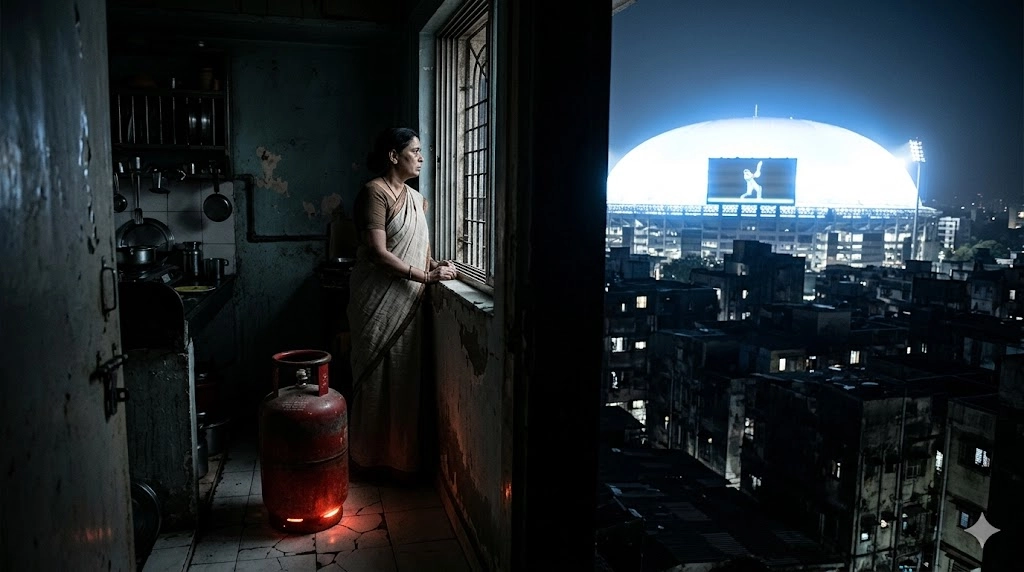
The floodlights at the M. Chinnaswamy Stadium are so bright they can probably be seen from the orbit of a mid-sized communication satellite. On 28 March, as Royal Challengers Bengaluru begins its title defence, the electricity bill for a single over could likely power a small village in Vidarbha for a week. But consistency has never been the strong suit of the Indian conscience. We are a nation that can simultaneously mourn a geopolitical catastrophe and check the projected strike rate of a Finnish-born associate player bought for Rs. 4 crore.
Tomorrow is March 28, 2026. It is the day the Indian Premier League (IPL) commences its 19th edition. It is also the twenty-ninth day of the 2026 Iran War. While the Strait of Hormuz is choked with naval mines and the charred remains of tankers, the only “explosions” many upwardly mobile Indians care about are the ones coming off the bat of a superstar opener. It is a spectacular, nauseating triumph of the brand over the barrel.
The Geopolitics of a Half-Volley
Operation Epic Fury, as the Americans call their latest Middle Eastern misadventure, has effectively turned the global energy market into a crime scene. Crude oil is flirting with 130 dollars a barrel. In Mumbai and Delhi, the middle class is rediscovering the joys of the induction cooktop because a standard LPG cylinder now costs upwards of Rs. 1,200, provided you can even find one. The government has invoked the Essential Commodities Act, but apparently, the entertainment of a billion people is the most essential commodity of all.
The IPL is no longer just a cricket tournament. It is a sovereign entity. It has its own economy, its own foreign policy, and a gravitational pull that makes the Ministry of External Affairs look like a local municipal ward office. Remember Operation Sindoor of 2025? The India-Pakistan skirmish had barely cooled down. The dust from the border shelling had not even settled on the olive branches before the BCCI announced the resumption of the league. The message was clear: wars may come and go, but the strategic timeout is eternal.
Global Gladiators and the Smell of Petrol
There is something deeply cynical about watching global cricketers go about their jobs with clinical indifference. We have Australian fast bowlers and English all-rounders earning more in eight weeks than a heart surgeon earns in a lifetime. They arrive in private jets, shielded from the reality of the Indian street where the “Impact Player” rule is being applied to the family budget.
In the player auctions held last December, the numbers were obscene. We saw a left-arm pacer go for Rs. 24.5 crore. At the current exchange rate and given the war-induced inflation, that amount could probably buy enough LPG to keep a mid-sized Indian town cooking for a month. But the élite do not worry about refills. The hospitality boxes at the stadiums will still serve imported lamb and artisanal cheeses, even as the transport sector in the country grinds to a halt because diesel is being rationed for “strategic reserves.”
Jaati, Class and the Cricket Subsidy
The sociology of the 2026 IPL is a study in brutal contrasts. On one hand, you have the Digital Public Infrastructure (DPI) that allows a farmer in Bihar to bet his last Rs. 50 on a fantasy cricket app. On the other, you have the same farmer unable to transport his produce to the mandi because the freight costs have tripled since the first missiles hit Tehran.
The IPL serves as the ultimate social sedative. It flattens the anxieties of a country dealing with religious fault lines and class anger. For three hours every evening, it does not matter that your daughter’s school van fees have doubled. What matters is whether the mystery spinner can nail the yorker. The tournament is a massive subsidy for the Indian psyche, paid for by broadcasters who know that a panicked population is the easiest one to sell soda and insurance to.
The Fragile Bubble of Bengaluru
Bengaluru is a funny place these days. The startup bros are still talking about “disruptive AI” while the city deals with a water crisis and an energy crunch that feels like something out of a 1970s dystopian novel. The Chinnaswamy Stadium, however, remains an oasis. The grass is perfectly manicured using recycled water that the residents of Whitefield would kill for.
The opening match between RCB and SRH is being billed as a “clash of titans.” In reality, it is a clash of distractions. The Sunrisers, owned by a media behemoth, and RCB, the perennial heartbreakers till 2024, represent the pinnacle of the Indian sports-industrial complex. It is a system that thrives on the fact that we are a “sports-loving” nation only when the sport involves a high production value and a celebrity owner dancing on a podium.
The LPG Household and the Seven-Ball Over
Let us talk about the Indian household for a moment. The average kitchen is currently a site of tactical negotiation. Mothers are telling their children to eat fewer fried items because oil is expensive and the gas is running low. There is a genuine fear that if the Iran War drags into May, the “10-kg refill” plan will become a permanent reality.
Yet, when the first ball is bowled tomorrow, these same households will be glued to the screen. The cognitive dissonance is staggering. We are suffering from a collective Stockholm Syndrome where the captor is a cricket league. The BCCI has mastered the art of making itself indispensable. It has convinced the world that the IPL must go on because “the show must go on,” ignoring the fact that the theatre is currently on fire.
The Great Gas-Light
The government’s response to the energy crisis has been a mix of frantic diversification and patriotic posturing. They are buying Russian oil at a discount while telling us to be “Atmanirbhar” (self-reliant) with our cooking habits. Meanwhile, the IPL schedule remains untouched. Not a single match has been moved, not a single light bulb dimmed.
The irony is that the very tankers being attacked in the Gulf are the ones carrying the lifeblood of the Indian economy. But as long as the satellite link is stable and the ad slots are sold, the war is just “background noise” for the sports analysts. They will talk about “firepower” in the middle order without irony, while actual firepower is leveling refineries across the Arabian Sea.
A Transition into the Absurd
I suppose we should mention the technical side of things. The “Impact Player” rule, now in its fourth year of refinement, has turned the game into a statistical nightmare. It is basically a way to ensure that the game never slows down. In a world where the global supply chain is slowing to a crawl, the IPL demands more speed, more runs, and more consumption.
It is a bit awkward to write about cover drives when the world is worried about World War III. But that is the job. We analyse the grip of a bowler because analysing the grip of a geopolitical crisis is too depressing. The transition from a discussion on LPG prices to a discussion on a team’s group standings is a stumble every Indian makes every morning over their newspaper.
The Final Over of Sanity
The IPL is so powerful that it creates its own reality. In this reality, the 2026 Iran War is just a “supply chain issue” that can be managed with a few sanctions waivers and some clever accounting. The reality for the man on the street, however, is a bit more forensic. He knows that his Rs. 320 hike in monthly expenses is directly linked to a war he has no control over.
As the matches progress towards the final on May 31 in Bengaluru, the gap between the stadium and the street will only widen. We will see the élite in their linen shirts, cheering for a game played by millionaires, while the “not so élite” struggle to keep the pilot light on. It is a world-class spectacle of inequality.
The 19th edition of the IPL will likely be the most watched in history. Not because we love cricket more than ever, but because we need to look away from the horizon more than ever. The horizon is glowing orange, and for once, it is not because of a sunset or a stadium light. It is the glow of a region in flames, reflecting off the shiny surface of a trophy we have decided is the only thing worth winning.
