









We built the most powerful, connected, intelligent devices in human history. And now young people are paying hundreds of dollars to escape them. That’s not a tech story. That’s something else entirely.
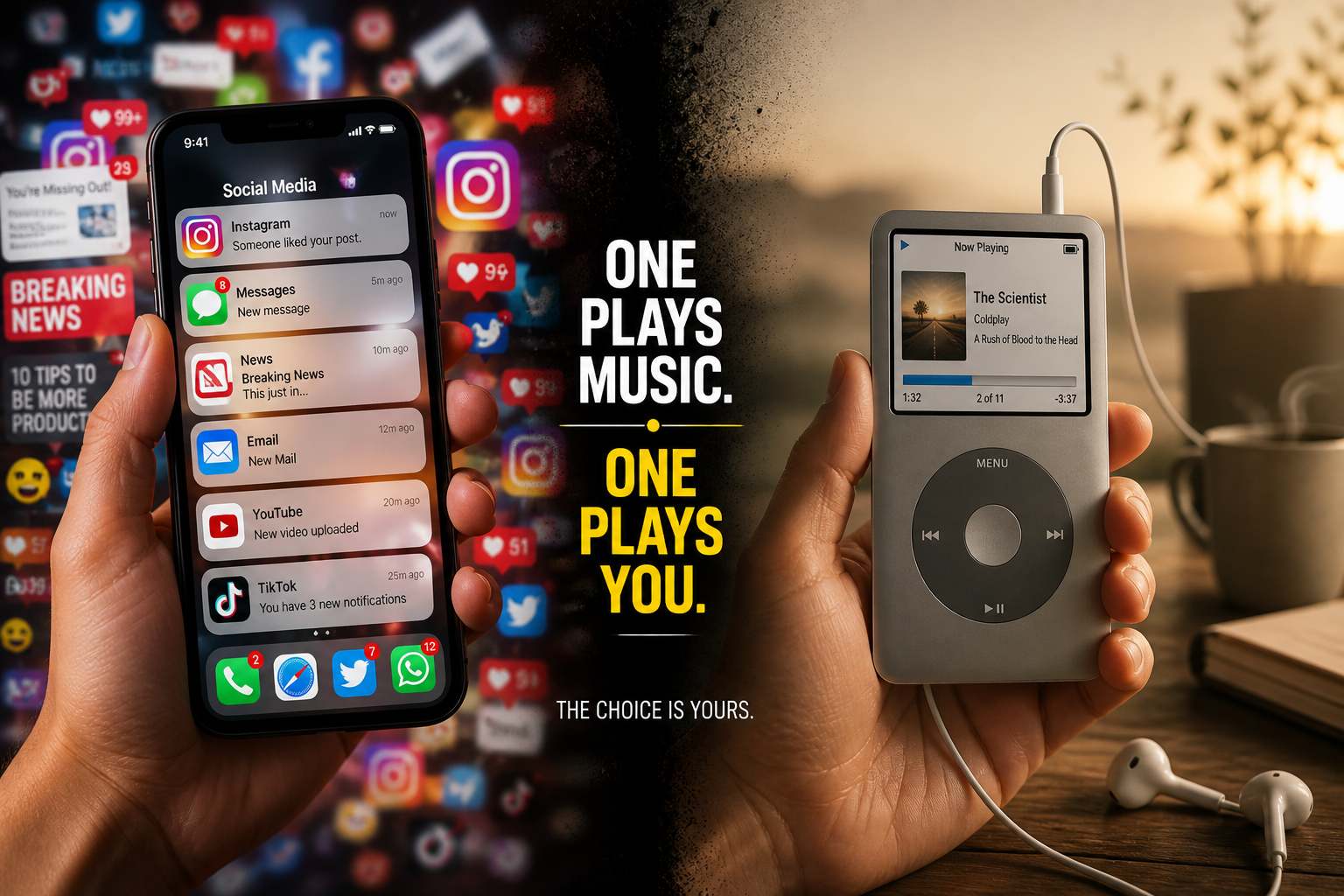
Picture this. You pick up your phone to play a song. A notification slides in someone liked your photo. You check it. Then another one. You open Instagram, just for a second. You read a comment that irritates you. You close Instagram and open the news. The news is bad. You put the phone down. Twelve minutes have passed. The song never played.
This is the defining experience of listening to music in 2026. And it is exactly why thousands of young people are spending money sometimes a lot of it on a device that Apple discontinued in May 2022. The iPod is back. Not as a collector’s item, not as a costume prop for a Y2K party, but as a daily carry. As something genuinely useful in a way its original designers never quite intended, because they couldn’t have predicted what we were building toward.
The phone broke music
Here is the thing nobody says clearly enough: the smartphone didn’t just replace the iPod. It contaminated the experience of listening to music. When your music player is also your news feed, your social life, your work inbox, and your anxiety machine, none of those things stay in their lane. They bleed into each other constantly. You put on a song to relax and a work message arrives. Now the song is playing over a low hum of obligation. You put on an album to focus and an alert breaks the silence. Now the album is just background noise to the thing you ended up doing instead.
The iPod cannot do any of that to you. It has one job. It plays music. It cannot notify you, distract you, or serve you an ad in the middle of a verse. It is, structurally, incapable of ruining the moment you are in. And in 2026, that incapacity has become valuable enough that eBay searches for the iPod Classic jumped by around 25% in a single year, refurbished models are selling for close to $600 on some platforms, and the number of listings has grown by nearly a third — because even the people who own one have noticed that it is suddenly worth something again.
What “can’t ruin your day” actually means
Let’s be specific about what the iPod cannot do, because the list is the point. It cannot send you a notification. It cannot show you what someone said about you online. It cannot surface breaking news during a quiet walk. It cannot interrupt a song with an ad. It cannot recommend something based on an algorithm that has been quietly studying your behaviour for years. It cannot be picked up for one reason and used for twelve others. Cal Newport, a computer science professor who has written extensively about digital minimalism, puts it plainly: the iPod does one thing. A smartphone throws music, messages, social feeds, and news into a single device, making it nearly impossible to keep your use in check. The power of the iPod, in 2026, is the constraint.
“For a generation that has grown up inside devices designed to be impossible to put down, a clean beginning and ending is genuinely strange. And genuinely appealing.”
This is about ownership, not nostalgia
It would be easy to dismiss all of this as nostalgia young people romanticising a past they never actually lived through. But that reading misses something important. The iPod forces you to own your music. You hunt for it, download it, drag it into a folder, sync it through a cable. The friction is real. And the friction is the feature. Because at the end of that process, the music is truly yours. No subscription can revoke it overnight. No company can pull an album because of a licensing dispute. No algorithm decides what plays next. You built the library. It reflects you, not a machine’s model of you. Research into this trend finds that a significant share of young iPod buyers are not just using the devices — they are repairing and modifying them too. They are becoming curators again rather than consumers, which is a quiet but meaningful rebellion against a decade of being told that owning things is inefficient and that renting everything from a platform is the modern way to live.
The wider pattern nobody wants to name
The iPod is not alone. According to the Recording Industry Association of America, vinyl record sales grew for the nineteenth consecutive year in 2025, reaching nearly 48 million units sold in the United States alone. Film cameras are expensive and inconvenient and sell fast. Paper notebooks fill every bookshop shelf. Dumb phones devices that call and text and nothing else have a small but stubborn market of people who chose them deliberately. The pattern is identical in every case: a tool that does one thing, does it well, and then stops. No feed. No loop. No design team whose entire job is to keep you engaged for one more minute. Researchers have even given this tendency a name friction-maxxing the deliberate choice of the slower, harder, more intentional experience over the frictionless, algorithmic one. Frictionless means the platform decides. Friction means you do.
What this is really saying
Tony Fadell, the engineer who helped build the original iPod, was asked recently about the revival. He said the demand proves something he has believed for a while: people want digital that is not always connected. Not analog forever. Not offline permanently. Just a device you can pick up, use for its purpose, and put down without losing forty minutes of your life to something you never intended to do. He said Apple should build a modern iPod one where the internet is available if you choose to turn it on, but turned off by default.
That sentence contains the whole story. We have spent twenty years making everything default on, always connected, always watching. And the market response, expressed in search data and refurbished device prices and a twenty-year-old gadget suddenly becoming hard to find, is a quiet but clear message back.
We’d like the off switch to come first.
Subscribe Deshwale on YouTube


