



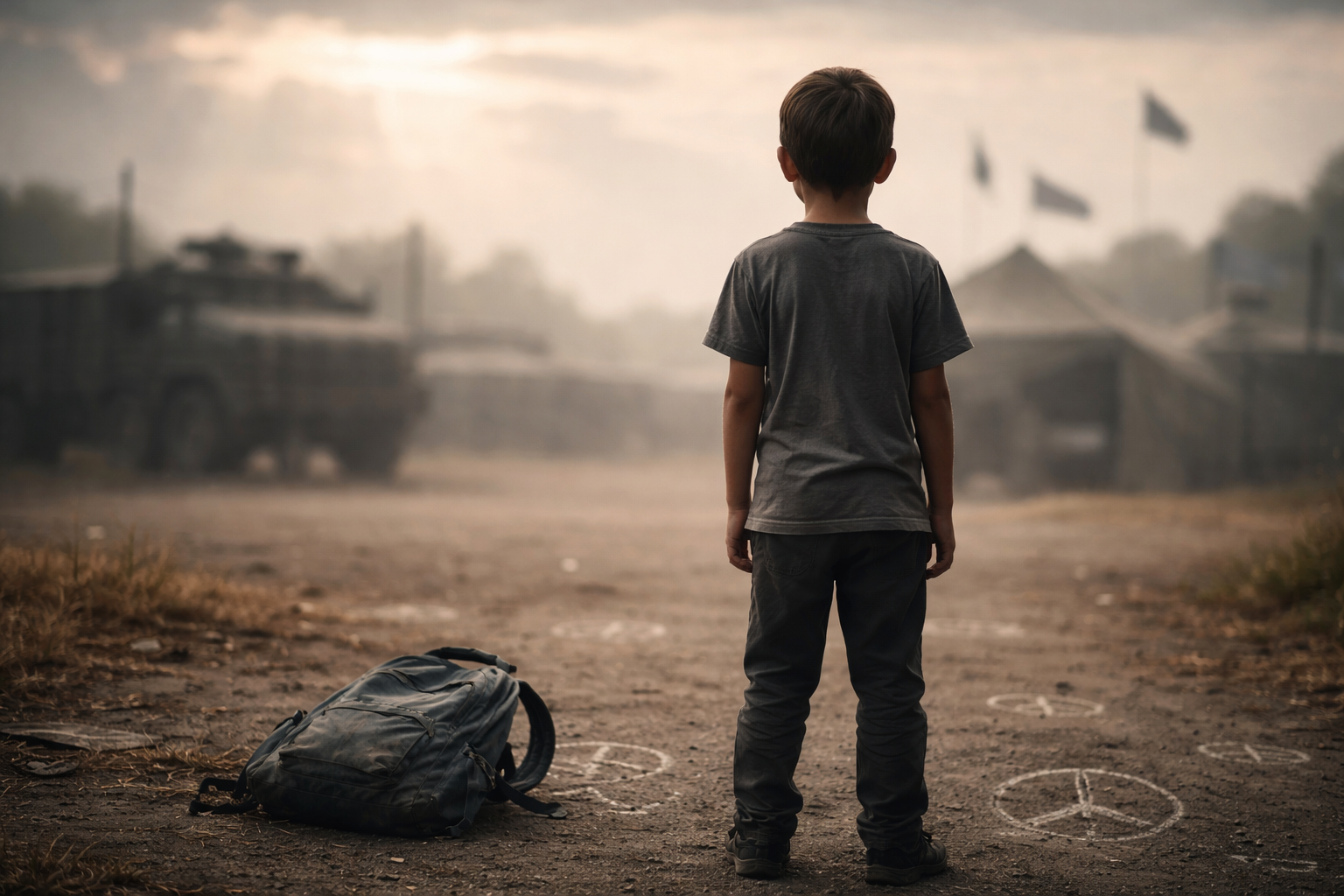
Iran’s state announcement allowing children as young as 12 to participate in war support roles has sent shockwaves across human rights circles. The news, coming amid escalating regional tensions, highlights a complex intersection of state policy, law, and humanitarian norms. The move has drawn scrutiny from international agencies, activists, and local families, while also raising questions about the future of Iran’s youth and the ethical boundaries of state authority in times of conflict.
The New Face of Recruitment
The Islamic Revolutionary Guard Corps, Iran’s elite military force, recently confirmed that children aged 12 and above can be deployed in support roles. These roles, officials state, include logistics, checkpoints, and other non-combat duties. The policy marks a stark departure from international norms that prohibit the use of minors in conflict situations.
Experts note that while Iranian law sets 18 as the age of majority for most civic responsibilities, military policy has been fluid, particularly during periods of heightened national security. The declaration reflects not just a tactical decision but a deeper ideological stance that frames youthful participation as patriotic duty. Families, however, report feeling pressured and uncertain, caught between state messaging and instinctive parental concern. One father, speaking on condition of anonymity, said he did not know whether to protest or comply.
A Human Rights Alarm
Human rights organisations were quick to respond. The Centre for Human Rights in Iran highlighted that hundreds of children have already died during recent protests and internal conflicts. Activists point out that involving children in any form of military or quasi-military activity violates the UN Convention on the Rights of the Child, to which Iran is a signatory.
Amnesty International and Human Rights Watch have documented incidents where minors were detained, injured, or killed in clashes with security forces. Even when not directly involved in hostilities, children are exposed to trauma that can last a lifetime. Psychologists warn that participation in militarised environments at such a young age can distort moral understanding, heighten susceptibility to indoctrination, and severely impact mental health.
There is also a subtle difference between combat roles and support roles. While the state presents these positions as administrative or logistical, the line is often blurred on the ground. Reports from local sources suggest that children manning checkpoints can be directly exposed to armed confrontation.
Legal Boundaries and International Law
Under international law, children under 15 are not permitted to be involved in armed conflict, even indirectly. The Rome Statute of the International Criminal Court considers recruiting children under 15 as a war crime.
Iran’s constitution does not contain any provision authorising the use of child soldiers or lowering the age for military participation. Ordinary laws set military service for males at 18, with conscription starting at that age. Article 151 obliges the government to ensure general military readiness, but it is age-neutral and does not specifically allow minors to serve. Media claims that children as young as 12 are participating in support roles remain unverified by multiple independent sources. While some narratives may be amplified by external or internal actors, the reports are legally unsupported and should be treated cautiously.
Islamic law, including Shiite jurisprudence and the Quran, does not authorise the recruitment of children for military roles, even in times of crisis. Classical teachings emphasise that minors must be protected from harm, and historical sources explicitly prohibit their involvement in combat. Modern interpretations align with international norms, recognising children as civilians requiring special protection. Recruitment of minors by any Muslim-majority state reflects political expediency rather than religious or legal sanction. Reports of children fighting in Iran’s past wars or militia conflicts are historical and political phenomena, not the result of legitimate jurisprudential endorsement. Any claims to religious sanction are not supported by mainstream Shiite legal doctrine or recognised fatwa literature.
A particularly complex issue arises when considering state sovereignty. Iran might argue that the exceptional security situation warrants extraordinary measures. Yet human rights advocates counter that sovereignty cannot justify violating the rights of children. The policy may also set a precedent for other regional actors, potentially normalising the involvement of minors in conflict zones.
The Geopolitical Context
Iran’s announcement must be seen against the backdrop of escalating regional conflict. Airstrikes, proxy wars, and rising tensions with neighbouring countries have created a climate where the state claims extraordinary measures are necessary. Children are not only being recruited; schools, hospitals, and civilian areas have increasingly been affected by military operations.
The recruitment policy could be intended to bolster morale and project an image of unity and resilience. Analysts warn, however, that it risks amplifying international criticism and could invite sanctions or targeted interventions. Local communities report that the pressure to participate is unevenly applied, with children in border provinces facing more direct expectations than those in major cities.
Voices from the Ground
Parents, teachers, and local activists provide a more granular view. Some families express resignation, seeing compliance as the only way to ensure safety for their children. Others fear psychological and physical harm. Teachers report that students exhibit anxiety, difficulty concentrating, and increased absenteeism. These indirect effects of militarisation are rarely captured in official statements but are visible in everyday life.
One teacher in Tehran described the atmosphere in a middle school as “a mix of fear and duty,” where children are encouraged to participate in patriotic drills and logistical exercises. She admitted that while the drills are framed as educational, students understand that there may be real consequences for refusal.
Economic and Social Dimensions
The new policy also intersects with economic realities. Many families are already struggling with inflation, unemployment, and disrupted livelihoods. Participation in military support roles offers modest stipends, sometimes cited as Rs. 320 per week or Rs. 590 per month. For families living at subsistence levels, even small sums can be a persuasive factor.
Beyond money, there is a social element. Children participating in official programmes may gain prestige within their communities. However, this prestige is fragile and comes at the cost of personal safety and childhood freedom. Local NGOs express concern that economic incentives may mask coercion, creating a veneer of voluntary participation where choice is severely constrained.
The International Response
United Nations agencies, including UNICEF, have condemned the policy. Official statements highlight that hundreds of children have been killed in schools and protests, and that the inclusion of minors in military roles exacerbates an already dire situation.
Observers note that the international response is complicated by geopolitical alliances and the ongoing regional conflict. Efforts to pressure Iran through UN resolutions or sanctions have been only partially effective. Critics argue that without robust enforcement mechanisms, such policies may persist despite global disapproval.
Media and Public Perception
Coverage of the issue varies widely. State media tends to frame children’s involvement as an act of patriotism and national resilience. Independent journalists, local blogs, and human rights groups offer a counter-narrative, emphasising vulnerability, coercion, and long-term consequences. Social media channels in Iran show both pride and protest, revealing a society deeply divided over what constitutes duty and what constitutes exploitation.
A subtle but important detail emerges from reports: children are rarely given direct information about the risks. They are encouraged to internalise a narrative of service and sacrifice without full comprehension of potential harm. This information gap is a form of control that shapes behaviour and perception, subtly normalising risk for minors.
Long-term Implications
The recruitment policy could have lasting effects on Iran’s youth. Beyond immediate physical danger, there are psychological, educational, and social costs. Children who spend formative years in militarised roles may face difficulty integrating into civilian life later.
Experts suggest that the situation could also impact Iran’s international standing. Countries already critical of Iran’s human rights record may use the policy as a benchmark to escalate sanctions or diplomatic measures. In the long term, children’s experiences today may shape domestic discourse on civic rights, national duty, and the role of the state in individual lives.
Conclusion
Iran’s policy to allow children as young as 12 into war support roles is a complex and alarming development. It sits at the intersection of domestic law, international law, religious guidance, human rights, socio-economic pressures, and geopolitical tensions. The impact is felt in homes, schools, and communities, extending far beyond the immediate sphere of military support.
While international condemnation continues, the voices of children, parents, teachers, and local communities reveal a nuanced picture of fear, duty, and survival. The future of Iran’s youth is now entwined with decisions made at the state level, with long-term consequences that may only be understood years from now.
The story is not just about policy. It is about childhood, morality, and the limits of state authority in moments of crisis. Children on the frontline are both a symbol and a reality of a society wrestling with war, rights, and the price of obedience.
This article examines reports and state announcements regarding youth participation in military support roles in Iran. Some claims, including the participation of children as young as 12, remain unverified by multiple independent sources. The piece contextualises legal frameworks, human rights obligations, and cultural narratives without asserting unconfirmed facts as truth. Readers are encouraged to interpret unverified claims cautiously.
