



When Iran rejected American peace terms, demanded reparations, and closed the Strait of Hormuz, it did not just resist a superpower—it exposed the lie that the United States can start wars with impunity and end them on its own terms.
Tehran Province 6:17 AM
Parisa left her apartment at 5:48, before the first light, because the strikes come earlier now. She is twenty-four. She was a literature student at the University of Tehran before the bombs began falling on February 28. Now, she has moved north to stay with her aunt in a village outside Karaj, because her mother called one night and said, ”Baché, come home, the city is not safe.” She brought three books, a bag of dried figs, and her running shoes.
Every morning, she runs the same dirt road that winds between almond orchards. She runs because her father told her once, when she was twelve, that the body must be stronger than the fear. She runs because the alternative is to sit inside and count the seconds between the sound of engines and the sound of impact. She runs because running is what people do when they refuse to stop.
At 6:17, she hears the buzz. Not the high whine of a jet, that sound belongs to the Americans, the ones who promised air superiority and then discovered that superiority is a word that means nothing when the thing you are fighting does not care about your sky. This is the buzz of a Shahed 136. The Iranians call it the witness. It costs $20,000. It carries a warhead the size of a suitcase. It flies on a propeller, slow enough to be seen, and it makes a sound like a lawnmower passing through the gates of hell.
She does not stop running. She has been running for twenty-six days. And somewhere in Washington, in Tel Aviv, in the Pentagon briefing rooms where generals stare at satellite images and try to understand why this war is not ending, they are beginning to realise that Parisa is still running, and that her country, against every calculation, is running with her.
I. The Refusal
On March 24, 2026, the United States delivered a fifteen-point plan to Iran through Pakistani intermediaries. It was the kind of document that American presidents have been handing to Middle Eastern nations for seventy years: a checklist of humiliation dressed up as peace. Dismantle your nuclear programme. End support for your allies. Limit your missiles. Open the Strait of Hormuz. Surrender, in other words, but surrender with dignity, which is the American way of saying that the boot on your neck is a gesture of friendship.
Iran’s response was not a counter offer. It was a counter-accusation. Through state media, a senior official listed five conditions. A complete halt to aggression. Concrete mechanisms to ensure the war cannot be reimposed. War damages and reparations, paid to Iran. An end to conflict across all fronts, for all resistance groups. And, most devastating of all: international recognition of Iran’s sovereign right to exercise authority over the Strait of Hormuz.
Let us be clear about what happened in that exchange. The United States, with the most expensive military in human history, with carrier strike groups and stealth bombers and an alliance structure that spans the globe, asked a country it was actively bombing to please stop fighting back. And that country said: No. And you owe us money.
Ebrahim Zolfaqari, the spokesperson for Iran’s joint military command, put it in terms that no diplomatic cable could soften. Appearing on live television, he said: “The level of your inner struggle has reached the stage where you negotiate with yourself. People like us cannot get along with people like you”.
This is the voice of a nation that has learned, over forty years of sanctions and assassinations and the casual violence of empire, that the American offer of negotiation is always, always an offer of surrender dressed in the language of diplomacy.
The United States withdrew from the Joint Comprehensive Plan of Action in 2018. At the time, Iran was in full compliance. The International Atomic Energy Agency had verified it repeatedly. The deal was working. The nuclear programme was contained. The inspections were intrusive and continuous. And the United States tore it up, not because Iran cheated, but because the man who made the deal was named Obama and the man who broke it was named Trump and the American political system cannot sustain a foreign policy longer than a single electoral cycle.
What did Iran learn from that? It learned that compliance does not matter. It learned that when you keep your word, the other party will keep its word only until it is politically convenient to break it. It learned that the United States does not negotiate in good faith; it negotiates to create the conditions for the next round of coercion.
So when the fifteen-point plan arrived, Iran did what any nation with memory and dignity would do. It refused. And in that refusal, it did something that no country has done since Vietnam: it made the American war machine look not just overmatched, but obsolete.
II. The Arithmetic of Attrition
Here is the number that keeps the Pentagon awake at night: 200 to 1.
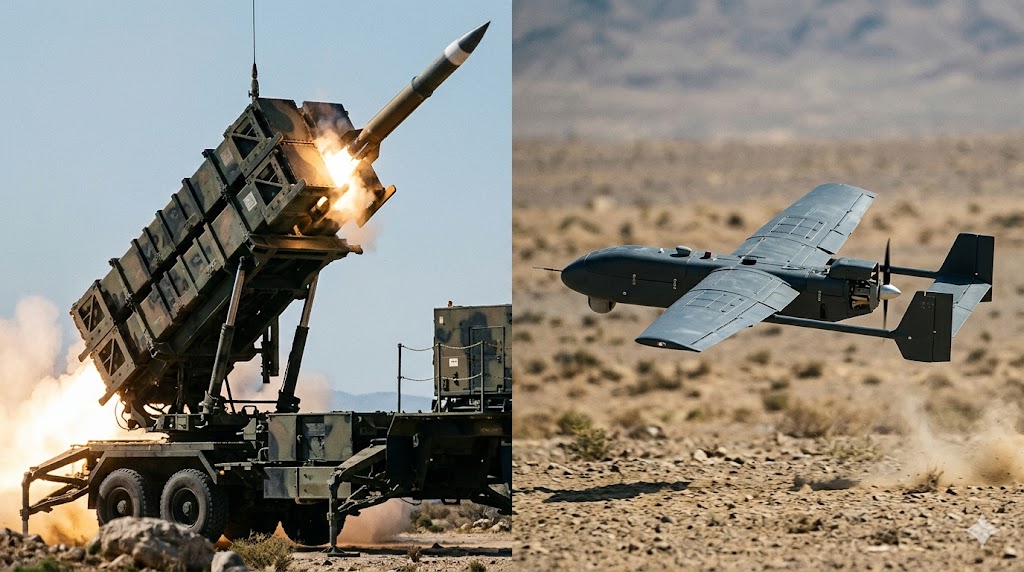
That is the approximate ratio of the cost of a Patriot interceptor missile to the cost of a Shahed 136 drone. The interceptor is $4 million. The drone is $20,000. Every time an American battery fires to knock down an incoming Shahed, the exchange rate is two hundred to one in Iran’s favour. And Iran has thousands of these drones. Russia, which manufactures a similar system, can produce several hundred per day. Iran’s inventory is believed to be in the tens of thousands.
This is not a war of technology. It is a war of mathematics.
The United States and Israel began this conflict with what they believed was overwhelming force. They killed Iran’s supreme leader. They struck missile sites. They claimed to have destroyed Iran’s ballistic missile capacity and rendered its navy “combat ineffective”. They announced the establishment of “complete and total aerial dominance over Iran”.
And then, Iran launched its drones.
Not in ones and twos. In swarms. Hundreds at a time. Designed not to evade detection but to overwhelm it. Designed not to survive the engagement but to make the engagement so expensive that the defender cannot sustain it. The Shahed is not a precision weapon. It is a consumable. It is meant to be intercepted. Every time it is intercepted, Iran wins the transaction.
The strategy is brutally simple. Kelly Grieco, a senior fellow at the Stimson Center, put it this way: “They are calculating the defenders will exhaust their interceptors and the political will of Gulf states will crack and put pressure on the US and Israel to cease operations before they run out of missiles and drones”.
Within days of the conflict’s start, analysts were warning that Patriot interceptor stocks in the region could run dangerously low if attacks continued at the same rate. The United States has expanded production, but only around 600 PAC 3 missiles were produced in 2025. The conflict has consumed them at a rate that production cannot match.
This is the arithmetic the empire never had to do. For decades, the United States fought wars against enemies who could not meaningfully strike back. The Gulf War was a shooting gallery. Iraq 2003 was a procession. The assumption was always that American technology would overwhelm any adversary, that the cost of resistance would be prohibitive.
Iran reversed that equation. It made the cost of defence prohibitive. It did not try to match American air power, that would be suicide. Instead, it made American air power irrelevant to the question of whether Iran could continue the fight. The drones do not need to win the sky. They need to make the sky so expensive that the United States cannot afford to keep it.
III. The Word That Changes Everything
The word that the White House press releases will never use, the word that Israeli briefings will never include, the word that European diplomats will dance around with the careful language of people who are paid to avoid clarity, that word is dignity.
This war is not about nuclear centrifuges. It was never about nuclear centrifuges. The centrifuges were contained. The inspections were in place. The deal was working. The war is about a question that the United States has refused to answer for forty years: does Iran have the right to exist as a sovereign nation, with its own interests, its own alliances, its own control over its own waters?
The United States says no. It has always said no. It says no through sanctions that target Iranian children’s access to medicine. It says no through assassinations of Iranian commanders on Iraqi soil. It says no through the withdrawal from a deal that Iran was honouring. It says no through a fifteen-point plan that demands Iran dismantle everything that makes it a nation while offering nothing in return but the privilege of being allowed to exist.
And Iran says yes.
The Strait of Hormuz is the expression of that yes. Twenty per cent of the world’s oil and gas passes through that narrow channel. Under normal conditions, about 20 million barrels of crude move through it every day. Iran has effectively closed it. Ships do not transit. Tankers wait in safe zones. The global economy is choking on a bottleneck that Iran controls.
The United States has threatened to destroy Iran’s power plants if the strait is not reopened. Iran’s parliament speaker responded: if you target our infrastructure, we will target yours, energy facilities, desalination plants, the vital systems that make the region function. This is not bluster. This is the logic of dignity. If you will not allow us to exist, we will ensure that you cannot exist without us.
This is what the empire does not understand. The American way of war assumes that the adversary will eventually capitulate because the cost of resistance becomes too high. But the cost of resistance is not measured only in bombs and casualties. It is measured in the weight of history, in the memory of 1953, in the years of sanctions, in the assassination of scientists, in the withdrawal from a deal that Iran kept while the United States broke it.
For Parisa, running through the almond orchards, that weight is not abstract. She knows what her country has endured. She knows that the United States has been trying to break Iran for four decades and has failed every time. She knows that this war will end not when Iran surrenders, but when Washington finally understands that some nations cannot be bombed into submission because submission is not a condition they recognise.
IV. The Cracks
On March 7, Israeli jets struck fuel depots and petroleum logistics sites in Tehran. Washington was not informed in advance. The White House was angry. Donald Trump told reporters that the United States had “no prior knowledge” of the operation and that any future strikes on energy targets would require American approval.
This was the first public crack in the alliance. It will not be the last.
The divergence between the United States and Israel was baked into the conflict from the beginning. Israel’s goal is maximalist: the overthrow of the Iranian system, the permanent degradation of its capabilities, the elimination of the threat it perceives as existential. The United States has a different calculus. It cares about oil prices. It cares about mid-term elections. It cares about not being dragged into a war that its own public does not support.
The polling in the United States has been clear. A majority of Americans do not understand why their country is fighting this war. Institutional dissent has emerged. The director of the National Counterterrorism Center resigned on March 17, stating that he could not “in good conscience” support the administration’s war against Iran. Conservative commentators have called it “Israel’s war”. The public appetite for a prolonged conflict is close to zero.
And the economic costs are mounting. Brent crude has surged past $116 per barrel, a sixty per cent increase since the eve of the conflict. The International Energy Agency has released 400 million barrels from strategic reserves, the largest drawdown in its history. Gasoline prices in the United States have risen thirty per cent. The global economy is taking a hit that will be measured in lost GDP and rising inflation.
This is what the United States did not calculate. It assumed that Iran would fold quickly, that the regime would collapse, that a few weeks of bombing would produce a compliant government in Tehran. Instead, it got a war of attrition that is bleeding its own economy and fracturing its most important alliance.
The cracks will widen. The longer the war continues, the more the United States will prioritise its own interests over Israel’s. The more the energy crisis deepens, the more pressure will build on Washington to find an exit. And the more Iran demonstrates that it cannot be broken, the more the American public will ask the question that no one in power wants to answer: why are we doing this?
V. The Verdict
When the history of this war is written, if the truth survives the historians, if the archives are not sanitised, if the journalists who have covered this conflict are allowed to keep their notes, it will record that Iran did not win in the way nations conventionally win. It did not march on Jerusalem. It did not sink the Fifth Fleet. It did not force the United States to sign a surrender document on a battleship.
But it did something more enduring. It broke the habit.
The American habit of war, the casual, arrogant, reflexive violence that the United States has visited upon the world for four decades, has met its match. Not in another empire. Not in a nuclear arsenal. In a swarm of $20,000 drones. In a strait that cannot be bombed into submission. In a people who, for all their suffering, have refused to break.
The United States began this war expecting collapse. It received a counter-demand. It offered a fifteen-point plan for surrender. It received a five-point plan for reparations. It assumed that the Strait of Hormuz was a choke point it controlled. It discovered that the strait is Iranian water, and that the global economy will tremble until Washington acknowledges that fact.
Parisa went for her run this morning. The almond trees are beginning to flower. The sound of engines is in the distance, but she does not stop. She runs because she is still here, and because being here is the only answer she knows how to give to the question of whether her country will survive.
She will return to Tehran when the war ends. She will find her city scarred, her country bleeding, her future uncertain. But she will also find a nation that refused to bend. She will find a government that told the most powerful military alliance in human history: You started this. You will end it on our terms, or you will pay for it until you do.
The empire is not dead. But its habit is. And that habit was the only weapon it ever really had.
Parisa ran this morning. The sky was grey with smoke, but she ran. The United States is running too, running out of interceptors, running out of public support, running out of allies who trust its judgment. The question is not whether Iran will survive. The question is whether the United States can learn, after four decades of failure, that dignity is the one thing its bombs have never been able to buy.
