









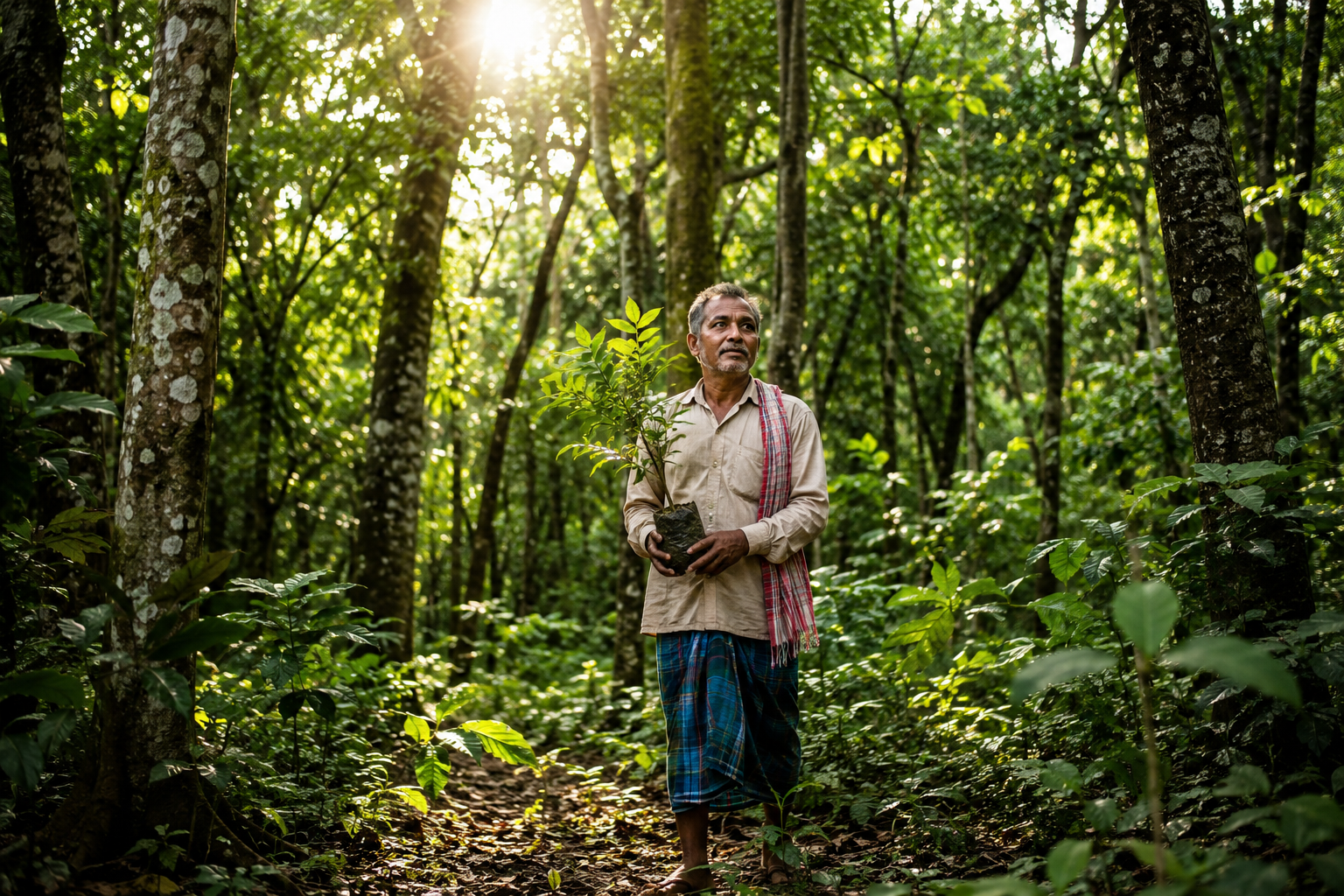
What one farmer built over four decades tree by tree, day by day.
In 1979, a young man in his late teens walked onto a barren sandbar on the banks of the Brahmaputra river in Assam, India. The ground was cracked and pale. The sun hit it without mercy. There was no shade, no water, no life, just sand stretching in every direction.
What he saw that day stopped him cold.
Hundreds of snakes lay dead across the sand. They had crawled onto the island looking for shelter and found none. The heat had killed them. There was nothing to protect them no trees, no grass, nothing.
His name was Jadav Payeng. He sat down among the dead snakes and wept.
Then he decided to do something about it.
One man, one mission
Jadav grew up in a small community near Jorhat in Assam. He was a member of the Mising tribe, people who had lived alongside the Brahmaputra for generations. He understood what the river gave, and he understood what happened when the land died.
The sandbar called Aruna Chapori — had been losing its green cover for years. Floods would wash away the soil. Without roots to hold the earth together, erosion got worse every season. Animals disappeared. The land became a wasteland.
After witnessing the dead snakes, Jadav approached the local forest department and told them what he had seen. Their response was simple: they could not help. The land was too far gone.
So Jadav went back alone.
He started with bamboo, humble, fast-growing, forgiving. He planted saplings by hand, day after day, in soil that was barely fit for anything. He had no equipment. No funding. No team. He simply showed up, dug a hole, placed a sapling, and came back the next day to do it again.
Decades of quiet work
For the first few years, Jadav lived on the sandbar. He built a small shelter. He carried plants from the mainland. When the bamboo began to grow and hold the soil, he introduced other species of herbs, shrubs, trees that attract birds, trees that provide fruit, trees that create shade deep enough for animals to rest in.
He had no scientific training. What he had was observation. He watched which plants the birds ate. He noticed which species drew insects, which drew frogs, which drew larger animals in their wake. He followed the logic of nature, one small decision at a time.
The years passed. The bamboo became a grove. The grove became a patch of green. The patch became something remarkable.
By the time forest department officials stumbled upon the forest in 2008 while tracking a herd of over a hundred elephants that had strayed into the area nearly thirty years had passed since Jadav had first walked onto that cracked sandbar. What they found left them speechless. A dense, living forest covering over 1,360 acres. Trees so tall and thick that sunlight barely reached the ground. A canopy stretching for miles.
The officials could not believe it. They asked local people who had planted all of this.
“Molai,” they said using Jadav’s nickname. “Just Molai.”
What the forest became
The Molai Forest, as it is now known, is not just trees. It is a functioning ecosystem.
Bengal tigers have been spotted there. Indian one-horned rhinoceroses, one of the most endangered animals on the planet, live within its boundaries. A herd of around a hundred wild elephants visits the forest every year, staying for months at a time. They have given birth there. Deer, monkeys, rabbits, vultures, and hundreds of species of birds have made the forest their home.
From a dead sandbar, Jadav Payeng had built a jungle larger than New York’s Central Park in fact, roughly five times larger.
In 2013, a documentary called Forest Man brought his story to the world. In 2015, the Government of India awarded him the Padma Shri, one of the country’s highest civilian honours. He received a standing ovation at a ceremony in New Delhi, the same city whose government he had once asked for help, and been turned away.
What obsession can build
People who study Jadav Payeng often reach for words like “visionary” or “hero.” But Jadav himself has never described what he does in grand terms.
He wakes up. He goes to the forest. He plants. He tends. He notices. He comes back the next day.
“The forest is my family,” he has said.
There is something quietly radical in that simplicity. We live in a world that moves fast, that demands scale, that asks for plans and budgets and teams and timelines. Jadav had none of those things. He had a patch of dying land, a grief he could not put down, and enough stubbornness to show up every single day for over four decades.
The snakes that died on that sandbar in 1979 would not recognise it today.
That is what one person, working alone, without recognition or reward, can do.
Jadav Payeng continues to tend the Molai Forest to this day.
Subscribe Deshwale on YouTube


