








On a warm March morning in Jewar, somewhere between the marigold garlands and the helicopter flypast, India quietly crossed a threshold it had been building toward for nearly two decades. Prime Minister Narendra Modi inaugurated Phase 1 of the Noida International Airport on 28 March 2026, handing Uttar Pradesh its fifth international airport and the National Capital Region its second. Civil Aviation Minister K. Ram Mohan Naidu, Uttar Pradesh Governor Anandiben Patel, and Chief Minister Yogi Adityanath were on the dais. Conch blowers had come from Kanpur. Drummers had travelled from Mahoba. Trumpet players arrived from across the state. The entire state, it seemed, had dressed up for the occasion.
In his address at the ceremony, Modi described the airport as a symbol of what he called a “new speed and scale of infrastructure development” in India. He said Jewar would become a major gateway for both passengers and cargo, strengthening the economic corridor of western Uttar Pradesh while easing pressure on Delhi’s aviation network. The Prime Minister also framed the project as part of a broader transformation in India’s connectivity landscape, noting that the country was expanding airports, highways and logistics networks simultaneously to support future economic growth.
The mood was celebratory. The numbers were impressive. But airports, like most large public projects in India, deserve to be read more carefully than a press release will ever allow.
So here is a more careful reading.
The Basics, and Why They Matter
Phase 1 of the Noida International Airport at Jewar in Gautam Buddha Nagar has been built at approximately Rs. 11,200 crore under a public-private partnership model. The Centre contributed Rs. 6,876 crore through the concessionaire. The Uttar Pradesh government spent Rs. 4,406 crore on land acquisition alone, which is itself a figure that deserves its own section and will get one. Zurich Airport International AG holds the concession. Tata Projects constructed the terminal. The design consortium of Nordic, Grimshaw, Haptic and STUP drew from the visual language of traditional Indian ghats and havelis, and the result is a building that, by most accounts, looks like it genuinely belongs in this part of the country.
Phase 1 is designed for 12 million passengers annually. At full build-out across all phases, five runways and a total investment of Rs. 29,560 crore are expected to push capacity to 70 million passengers by 2040. If those numbers materialise, Jewar will rank among Asia’s largest aviation hubs. That is a significant if, and anyone who has covered Indian infrastructure projections across multiple budget cycles will hold that if firmly in view.
Along with the passenger terminal, Modi inaugurated a cargo terminal and laid the foundation stone for a Maintenance, Repair and Overhaul facility. Both matter commercially. Cargo connectivity is what industrial corridors actually need first. An MRO facility is what turns an airport into an aviation ecosystem rather than a building with runways. The regulatory clearances are in place. The Directorate General of Civil Aviation has granted the aerodrome licence. The Bureau of Civil Aviation Security has cleared the facility. On paper, Jewar is ready.
The City This Airport Was Always About
Noida and its twin Greater Noida have spent three decades living in Delhi’s shadow. They have the information technology parks, the expressways, the Formula One circuit from that briefly wonderful period in Indian motorsport, and the residential towers. What they have lacked is the one piece of infrastructure that separates a satellite city from a self-sufficient one: an international airport within reasonable distance.
Delhi’s Indira Gandhi International Airport sits 70 to 80 kilometres away depending on your starting point, and on a typical weekday that translates to two hours minimum. For a region that has grown into one of India’s most economically productive corridors, this has been a quiet but persistent drag on competitiveness. Businesses have absorbed it as an operational cost. Residents have absorbed it as an everyday frustration. Neither group has had much choice.
Jewar changes the geometry. The airport’s planned catchment covers Noida, Ghaziabad, Meerut, Mathura, Agra, Faridabad and Bulandshahr. It sits at the confluence of the Yamuna Expressway and the planned Ganga Expressway. A metro connection linking the airport to the NCR’s rail network is in active planning. The airport is not simply passenger infrastructure for a few million commuters. It is the anchor piece the region has needed to convert economic potential into economic fact, and the distinction is worth understanding.
The Real Estate Number That Stopped Everyone
Here is where the story gets complicated in the way Indian infrastructure stories usually do. Between 2020 and 2025, apartment prices along the Yamuna Expressway corridor rose 158 per cent. Plot prices in the same period rose 536 per cent. Land valued at Rs. 25 to 28 lakh per hectare in 2018 was changing hands at Rs. 1.25 to 1.5 crore per hectare by mid-2024. These are extraordinary numbers by any measure.
They reflect genuine demand and genuine expectation. They also reflect something else: the way large infrastructure announcements in India tend to generate secondary markets in anticipation well before the primary market, the airport itself, has delivered a single operating flight to a verified destination.
Further appreciation of 28 per cent in plot values and 22 per cent in apartments is projected over the next two years. Industrial ambitions are equally audible. A Foxconn semiconductor facility, a solar manufacturing hub, factories by Havells India and Escorts Kubota, and specialised parks covering apparel, toys and medical devices are all at various stages of planning or commitment along the corridor. The billboards advertising these future zones already outnumber actual structures in certain stretches, which tells you something about the gap between announcement and reality.
But the fraud alert embedded in this story deserves equal billing. Fake land papers, forged registrations, and investors losing crores to unverified plots have already surfaced in the record. New guidelines now require all projects within 20 kilometres of the airport to obtain prior clearance from the Airports Authority of India for safety and height compliance. The enthusiasm is warranted. Serious due diligence before any transaction is not optional.
Who Was Here Before
This is the section that rarely gets adequate space in airport coverage, which is partly why it belongs here. Jewar is historically agrarian western Uttar Pradesh. The land acquired for Phase 1 alone required relocating farming communities whose families had worked that land for generations.
Land acquisition in India, even under the reformed Right to Fair Compensation and Transparency in Land Acquisition Act of 2013, is not a neutral transaction. Compensation is calculated on circle rates that routinely trail real market values. Rehabilitation is promised more reliably in official documents than in lived practice. The farmers who received compensation in 2018 and 2019 were paid at rates that, measured against 2024 prices, looked significantly inadequate in retrospect.
This is not a Jewar-specific failing. It is a structural condition embedded in how India builds large things. But it is worth stating clearly, because the 536 per cent appreciation in land values being celebrated in real estate commentary represents, at least in part, value that was extracted from people who were displaced before the announcement cycle attracted public attention. That tension does not make the airport wrong. It makes the project incomplete unless displaced communities are genuinely resettled rather than administratively processed and quietly forgotten.
When Compensation Becomes Sudden Wealth
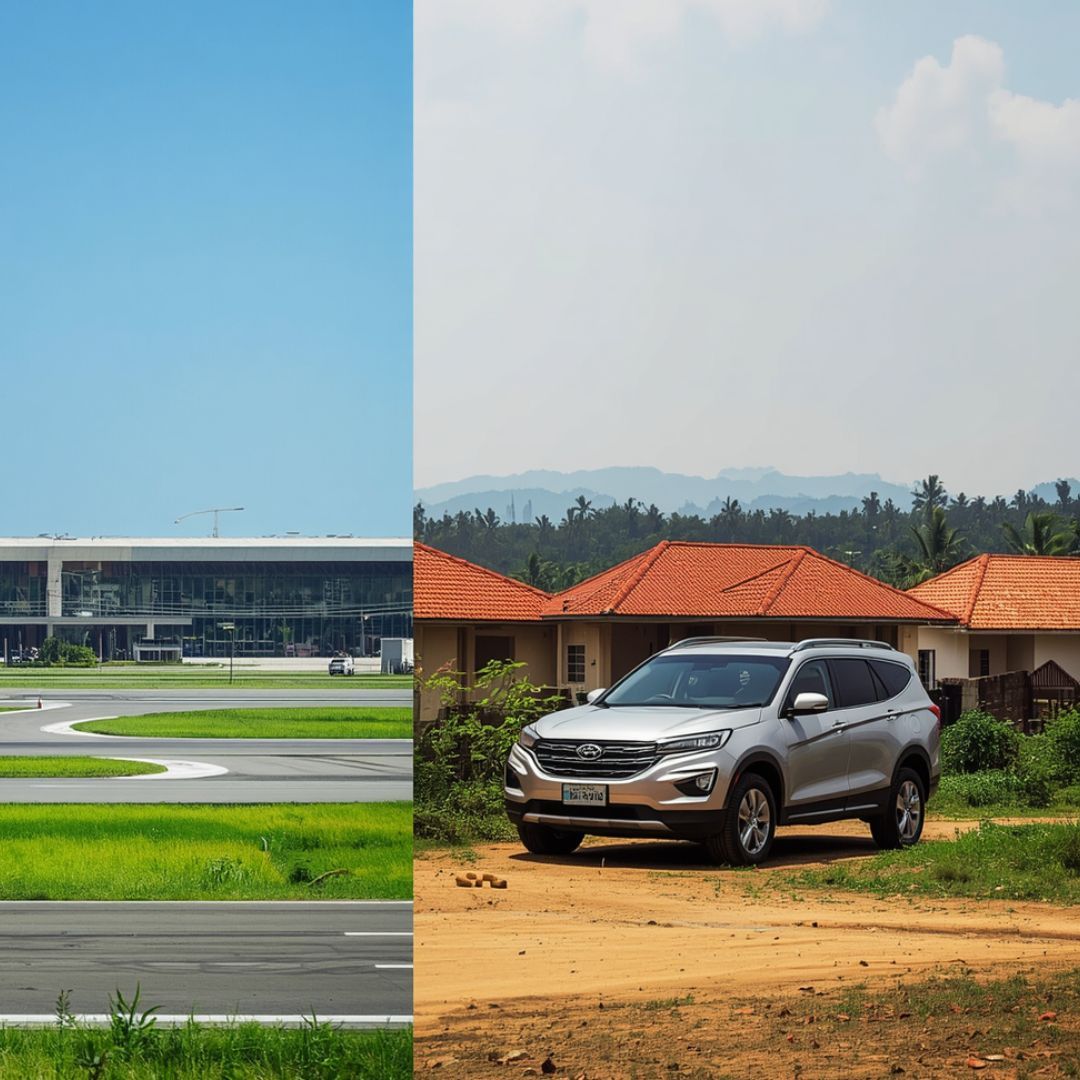
The human consequences of that transition are already visible across villages around Jewar. Roughly 12,000 acres of land were acquired for the airport project, and compensation running into crores reached hundreds of farming families. For many, this was the first time large sums of money had ever entered their households. Fields were replaced with newly built houses. Tractors gave way to SUVs. Expensive smartphones and modern appliances appeared almost overnight. For a brief period, prosperity seemed to arrive faster than anyone expected.
But sudden wealth can also expose vulnerabilities. Some families invested carefully, building homes, starting businesses or diversifying income. Others spent quickly on cars, luxury phones and lifestyle upgrades that proved difficult to sustain once the initial compensation ran out. Stories circulate of young men who left jobs after receiving land payouts and now find themselves without work, while social problems such as gambling, idleness and alcohol consumption have surfaced in some neighbourhoods. Meanwhile, farmers who sold land during earlier acquisition phases, when payouts were around 20 lakh per bigha, now see compensation figures closer to 40 lakh in later phases and demand additional payments.
Local officials acknowledge that compensation can replace land financially but not structurally. Land once provided steady income, food security and long-term stability. A lump sum, without financial planning support or safeguards, cannot always do the same. The result is a visible divide across Jewar’s villages: those who converted compensation into capital have moved ahead, while others now struggle with the consequences of spending wealth that arrived faster than experience could guide.
The PPP Question
India has a complicated relationship with airport public-private partnerships. The GMR-managed Delhi airport was genuinely innovative but produced years of regulatory disputes over user development fees. Navi Mumbai airport has been inching toward completion for over a decade. Hyderabad and Bengaluru, both greenfield PPPs, are broadly considered successes, though each went through difficult early phases that required adjustments nobody mentioned at their respective inaugurations.
India’s most successful aviation public private partnerships offer useful perspective here. The expansion of Delhi’s Indira Gandhi International Airport transformed it into one of the world’s busiest hubs. Greenfield airports such as Rajiv Gandhi International Airport in Hyderabad and Kempegowda International Airport in Bengaluru also began with cautious projections before traffic growth steadily validated their models. Jewar sits somewhere between those precedents and the uncertainties that accompany any large new aviation bet.
Zurich Airport International brings credibility. Its track record across multiple countries is real. The concession structure for Jewar places commercial risk appropriately with the private partner while the state has absorbed the land cost. That is broadly sound architecture for a project of this scale.
Whether it holds depends on traffic volumes. Phase 1 is designed for 12 million passengers annually. IndiGo is the launch carrier. Akasa Air and Air India Express are committed. International airlines are in conversation. But airports need anchor traffic from the first year rather than the fifth. Concession agreements in Indian infrastructure have a well-documented history of being renegotiated when projections meet the actual world, and Jewar will not be exempt from that risk simply because the inauguration ceremony went smoothly.
Pattern recognition is not pessimism. It is just professional habit.
The Politics of the Fifth Airport
Uttar Pradesh becoming the first Indian state with five international airports is a political achievement as much as an economic one. The inaugurations of Kushinagar and Ayodhya airports in preceding years, both with religious tourism as explicit rationale, were part of the same broad political architecture within which Jewar now sits. Jewar’s register is economic development rather than devotional, but Modi and Adityanath sharing a stage in the current political calendar is not an incidental detail.
This is simply how infrastructure politics functions in India and in most democracies. The ribbon is cut when political conditions favour the cutting. That does not mean it should not be cut. Jewar addresses a real connectivity deficit for a genuinely underserved region. But the timing, the scale of ceremony and the choreography of which achievements get headlined are never purely technical decisions. They never have been, and there is no particular reason to pretend otherwise.
Net Zero and What It Actually Means
The airport has been designed to operate as a net-zero emissions facility. Solar energy integration, energy-efficient building systems and water recycling have been incorporated into the terminal design. These are not decorative choices.
But a net-zero terminal is not the same as net-zero aviation, and that distinction tends to dissolve in inauguration communications. Aviation remains among the hardest sectors to decarbonise globally. Whether Phase 1’s sustainability commitments survive the commercial pressures of rapid scaling is a question worth returning to when Phase 2 is under construction. These commitments usually are worth revisiting.
What Comes After the Opening
India opens roughly one significant piece of transport infrastructure every few months now. The pace is genuine and the ambition is genuine. Jewar is among the more credible of these projects. It has a serious concessionaire, a thoughtfully designed terminal, a logical catchment geography, and anchor carriers already committed to routes.
What it needs now is patient scrutiny rather than continuous celebration. The 70 million passenger target for 2040 exists on a projection chart today. It becomes real only when the metro link is delivered on schedule, when international airlines commit actual routes, when the industrial corridor generates verifiable employment rather than hoardings, and when the farming communities displaced to build this airport are still part of the conversation a decade from now. The National Capital Region already generates more than 80 million air passengers annually across its existing infrastructure, a figure expected to grow sharply over the next two decades. Jewar’s real test will be whether it meaningfully absorbs that demand rather than simply redistributing it.
Airports are not finished on the day they open. That is only when they start.


