








In the verdant hills of Mizoram, where mist clings to rugged peaks, a new chapter unfolds. The Bairabi–Sairang rail line, a 51.38-km marvel, has woven Mizoram’s capital, Aizawl, into India’s vast railway tapestry. Completed in June 2025, this ₹8,000 crore project is more than a railway, it’s a lifeline for a state long isolated by its terrain. As trains prepare to roll through 48 tunnels and over 55 major bridges, Mizoram stands on the cusp of transformation. For Indians, this is a story of ambition, resilience, and the unyielding drive to connect every heart of the nation.
The journey to this milestone began in 2008-09, when the project was sanctioned as a national priority. Prime Minister Narendra Modi laid its foundation remotely on November 29, 2014, at Maligaon Railway Stadium. Yet, the path was fraught with challenges. Mizoram’s landscape, with its steep hills and heavy monsoons, allowed only four months of construction annually. “This has been one of the most challenging projects undertaken by Indian Railways,” said Vinod Kumar, Chief Engineer of the project, in a statement to IANS. Every segment tested the limits of engineering ingenuity.
The rail line stretches from Bairabi, near Assam’s border, to Sairang, 20 km from Aizawl. Until now, Bairabi was Mizoram’s only railhead, forcing travellers to endure a 90-km road journey to Aizawl, often disrupted by landslides. The new line changes this. Divided into four phases, Bairabi–Hortoki (16.72 km), Hortoki–Kawnpui (9.71 km), Kawnpui–Mualkhang (12.11 km), and Mualkhang–Sairang (12.84 km), it was commissioned progressively, with the final stretch completed in June 2025. The Bairabi–Hortoki section opened in July 2024, while the rest followed after rigorous safety inspections.
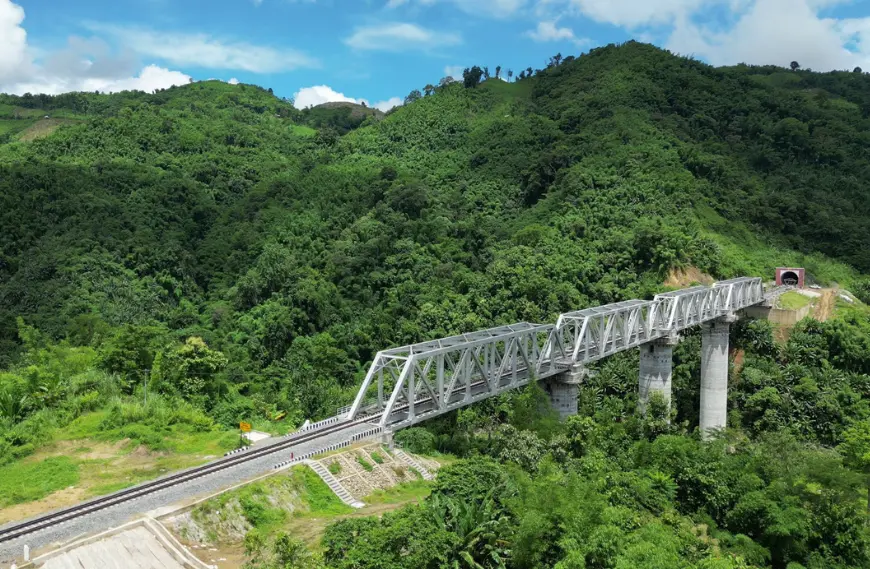
Engineering feats define this project. The line boasts 48 tunnels, spanning 12.853 km, and 55 major bridges, including one towering 104 metres, 42 metres taller than Delhi’s Qutub Minar. For the first time in Northeast India, ballastless tracks were laid inside tunnels, ensuring stability in Seismic Zone V. “We carried girders to Bairabi by rail, then used special transport to reach sites,” Kumar explained. Cranes were dismantled and reassembled to place these girders, turning days’ work into months. Labour and materials came from West Bengal, Assam, Uttar Pradesh, Bihar, and Jharkhand, showcasing India’s collective resolve.
Sustainability is woven into the project’s fabric. Tunnels feature eco-friendly LED lighting and solar power, as noted by Divisional Electrical Engineer Md Zahid Akhtar. Vibrant murals reflecting Mizoram’s cultural heritage adorn tunnel walls, blending tradition with modernity. These innovations make the line not just a transport link but a symbol of progress. “Railways are the arteries through which the life-blood of a nation’s commerce flows,” said Sardar Vallabhbhai Patel, India’s first Deputy Prime Minister, underscoring the transformative power of rail connectivity (BrainyQuote, 2025).
For Mizoram, this rail line is a game-changer. Previously, reaching Aizawl from Silchar, 180 km away, meant navigating treacherous roads. Now, direct rail links to Silchar and Guwahati promise seamless travel. Vande Bharat and Rajdhani trains are expected to ply the route, pending feasibility studies. This connectivity will slash travel times and boost tourism. Mizoram’s lush hills, vibrant festivals, and serene landscapes are poised to draw adventurers and cultural enthusiasts, as offbeat travel gains traction among Indian and global tourists.
Economically, the impact is profound. Mizoram, the fourth Northeastern state to have its capital rail-connected after Assam, Tripura, and Arunachal Pradesh, stands to gain from enhanced trade. Small-scale industries, from handicrafts to agriculture, will find new markets. The line’s strategic importance extends beyond commerce. By linking Aizawl to the national grid via the Siliguri Corridor, often called the “Chicken’s Neck”, it strengthens India’s geopolitical presence in the Northeast, reducing reliance on vulnerable routes.
The project’s completion is a testament to perseverance. Sanctioned in 2008-09, it faced delays under previous administrations. Land acquisition alone took until 2014. A tragic girder collapse in August 2023 further stalled progress, but the Northeast Frontier Railway (NFR) rallied. By June 2025, the Commissioner of Railway Safety, Sumeet Singhal, conducted final inspections of the Hortoki–Sairang stretch, approving it for operations. A successful speed trial on May 1, 2025, sealed its readiness. Union Minister Ashwini Vaishnaw celebrated this milestone, proclaiming, “Connecting Mizoram capital (Aizawl) to every heart of India!”.
This rail line is part of a broader vision. Since 1962, when Assam’s Guwahati joined the rail map, India has worked to integrate the Northeast. After Agartala and Itanagar, Aizawl’s inclusion marks a historic step. Projects like the Jiribam–Imphal line, with the world’s tallest railway pier bridge, signal more to come. Plans for tracks through Bangladesh could further ease access, bypassing the Siliguri Corridor’s constraints. This expansion strengthens India’s strategic and economic ties in the region, countering external influences.
Yet, challenges remain. Mizoram’s seismic activity and heavy rainfall demand constant maintenance. The project’s ₹8,000 crore cost, higher than the initial ₹5,021.45 crore estimate, reflects the immense resources required. Future extensions, potentially to Lunglei or Lawngtlai, will face similar hurdles. Still, the Bairabi–Sairang line sets a precedent. Its 142 bridges, including nine road underbridges, and four new stations, Hortoki, Kawnpui, Mualkhang, and Sairang, herald a new era for Mizoram’s infrastructure.
For locals, the rail line is a dream realized. No longer must they endure arduous road journeys. Students, traders, and tourists will benefit from faster, safer travel. The line’s cultural impact is equally significant. Mizoram’s Mizo heritage, with its vibrant dances and crafts, will gain a national stage. As one social media user noted, “It took 67 years and 13 PMs to recognise how critical it was to provide connectivity to NE India.” This sentiment captures the line’s transformative promise.
The Bairabi–Sairang rail line is more than steel and concrete. It’s a bridge to opportunity, uniting Mizoram with India’s heartland. As trains rumble through its tunnels, they carry hopes of prosperity and connection. For a state once cut off by geography, this railway is a beacon of progress, proving that no corner of India is too remote to be reached.


