



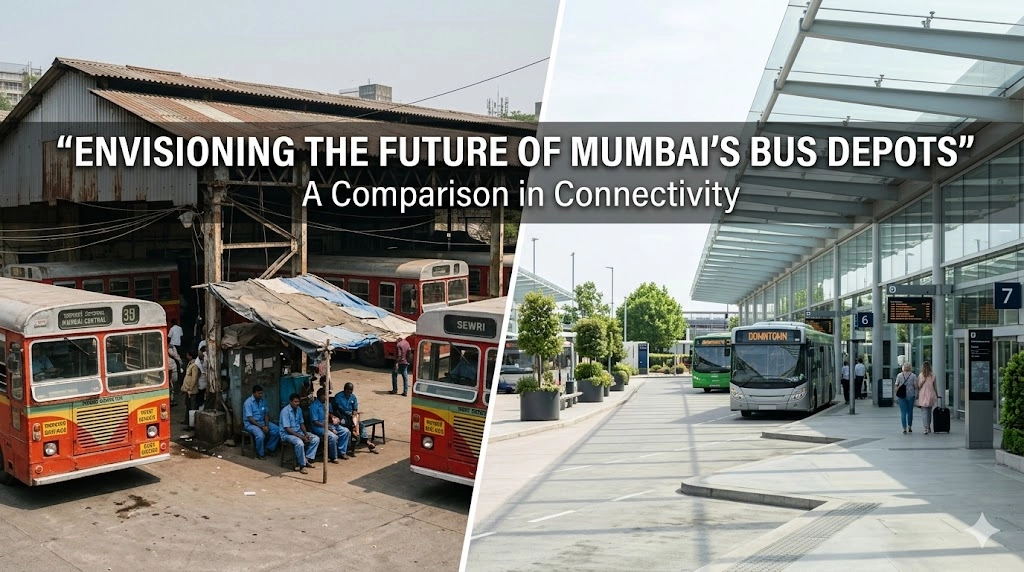
Mumbai’s public transport system is often praised for keeping the city moving. The suburban railways carry millions daily. The red buses of the Brihanmumbai Electric Supply and Transport Undertaking, widely known as BEST, remain a lifeline for neighbourhoods that trains do not reach.
Yet a recent inspection at the Bandra bus dépôt by leaders of Shiv Sena (Uddhav Balasaheb Thackeray) has pulled back the curtain on a problem that many transport workers have quietly lived with for years.
Workers described unsafe shelters, poorly-maintained canteens, ageing electrical systems, and basic facilities that have deteriorated to the point where staff say their safety is at risk. The images are not flattering. Rusted structures, broken roofing, and poorly-ventilated rest areas paint a picture of a transport institution struggling to maintain its own infrastructure.
This is not simply a labour-welfare issue. It is also an urban-design problem. It raises a larger question about what Mumbai expects its public infrastructure to look like.
Because elsewhere in the world, bus dépôts are not just parking yards. Some are among the most carefully-designed civic spaces in their cities.
A Different Story Abroad
Take the bus terminals in cities like Seoul, Singapore, and Curitiba.
In these places, transport dépôts are designed with architectural intention. They often include green-roofs, public plazas, clean rest facilities, digital monitoring systems, and dedicated staff areas that resemble office spaces rather than industrial yards.
Curitiba offers perhaps the most famous example. Its bus rapid-transit system turned stations into carefully-planned urban nodes decades ago. The glass-tube stations are recognisable symbols of the city. They are clean, well-lit, and designed to make both commuters and workers comfortable.
Singapore’s dépôts go even further. Maintenance facilities are structured like high-tech workshops. Bus drivers have proper rest lounges. Energy-efficient lighting and rainwater-harvesting systems are common features.
Seoul’s bus hubs combine transport infrastructure with civic architecture. Wide platforms, landscaped surroundings, and integrated commercial spaces give them the feel of modern urban squares.
These cities did not achieve this by accident. The transformation came from long-term planning and strict maintenance regimes. Public transport was treated as a central civic asset rather than a budget burden.
Mumbai, by contrast, still treats many of its dépôts as purely functional yards.
The Bandra Inspection That Sparked Questions
The inspection at the Bandra BEST bus dépôt revealed infrastructure that workers say has deteriorated steadily.
Shelters were reportedly in poor condition. Some rest areas lacked proper ventilation. Staff canteens were described as poorly-maintained. Electrical infrastructure appeared outdated.
For transport workers who spend long shifts operating buses across one of the most crowded cities on earth, these conditions matter. A bus driver’s day often begins before sunrise and stretches well past evening peak hours.
If the dépôt where they report for duty feels neglected, morale inevitably suffers.
Officials within BEST have acknowledged the need for upgrades in several dépôts across the city. However, large-scale modernisation has been slow.
The issue also touches governance. BEST operates under the umbrella of the Municipal Corporation of Greater Mumbai, commonly called the BMC. This is one of the wealthiest municipal bodies in Asia.
Which raises a rather obvious question.
Mumbai’s Budget Versus Mumbai’s Bus Yards
The BMC’s annual budgets frequently exceed Rs. 50,000 crore. Much of this goes toward roads, drainage projects, coastal infrastructure, and beautification programmes.
Over the past decade, the city has invested heavily in coastal promenades, waterfront redevelopment projects, and major road upgrades.
Yet the condition of many bus dépôts suggests that basic transport infrastructure has not received comparable attention.
Urban planners often point out that transport systems require two kinds of spending. One is the capital cost of vehicles and infrastructure. The other is routine maintenance.
Maintenance rarely attracts political attention. It is not glamorous. There are no ribbon-cuttings for repaired roofs or upgraded staff canteens.
Still, these things matter. Actually, they matter a lot.
When dépôts deteriorate, operational efficiency suffers. Poorly-maintained facilities also increase long-term repair costs.
In the end, the city pays more.
The Invisible Workforce Behind the Red Buses
BEST employs thousands of drivers, conductors, mechanics, and dépôt workers.
Their work is physically demanding. Drivers navigate narrow streets and relentless traffic. Mechanics maintain ageing fleets under intense pressure to keep buses on the road.
And yet the spaces where these workers rest or eat often receive little public attention.
There is a cultural issue here. Indian cities have historically undervalued the welfare infrastructure of public-service workers.
Clean staff lounges, comfortable rest areas, and well-maintained sanitation facilities are not luxuries. They are basic labour-dignity measures.
Cities like Singapore and Seoul learned this early. Their transit systems function better because the people who run them work in decent environments.
Mumbai still has some catching up to do.
The Politics Around Public Transport
Public transport in Mumbai has always been deeply political.
Control of the BMC has long been contested between major parties including the Shiv Sena, the Bharatiya Janata Party, and the Indian National Congress.
Each administration has promised to improve city infrastructure. Yet transport dépôts rarely become central campaign issues.
This may be because commuters see only the buses, not the yards where they are maintained.
But inspections like the recent one in Bandra highlight the reality that transport infrastructure is more than vehicles. It is an ecosystem of facilities that must function together.
And when one piece weakens, the entire system becomes fragile.
Encroachments and Urban Disorder
Another challenge facing many Mumbai dépôts is the constant pressure of encroachment.
Street vendors, informal parking, and temporary structures often accumulate around transport hubs. Over time, these spaces become cluttered and difficult to maintain.
Urban planners argue that enforcement is inconsistent. Illegal vending zones expand because local authorities struggle to maintain control over public land.
The result is visual chaos around infrastructure that should be orderly and functional.
In cities such as Seoul or Singapore, strict zoning rules keep transport spaces clear. Vendors operate in designated areas. Maintenance crews keep public infrastructure clean and uncluttered.
Mumbai’s enforcement culture is far more complicated.
Sometimes the rules exist on paper, but the ground reality is different.
The Aesthetics of Infrastructure
It may sound superficial at first, but infrastructure aesthetics shape how citizens experience their city.
A well-designed dépôt does not merely store buses. It contributes to the urban landscape.
Consider the psychological effect of clean platforms, landscaped surroundings, and thoughtfully-designed buildings. These spaces influence how people feel about their city’s public institutions.
An ornate and well-maintained bus dépôt in Mumbai could serve several purposes at once. It would improve working conditions. It would strengthen civic pride. And it would send a signal that public infrastructure matters.
Right now, many dépôts feel like forgotten industrial corners.
They should not.
A Small Observation From Bandra
During the inspection in Bandra, workers reportedly spoke about leaking roofs and deteriorating structures.
One mechanic mentioned that parts of the facility had simply aged without major upgrades. The remark was not dramatic. It sounded almost resigned.
That small moment says a lot.
Infrastructure does not collapse overnight. It slowly declines when routine upkeep is ignored.
Learning From Global Examples
The lesson from cities with better transport infrastructure is simple.
Maintenance must be institutionalised. Budget lines must be protected. Dépôts must be treated as civic assets rather than hidden backyards of the transport system.
This does not require extravagant spending. Often it begins with basic discipline.
Regular inspections. Clean surroundings. Adequate staff facilities. Clear rules against encroachment.
Even modest architectural improvements can transform a dépôt’s appearance.
It is honestly not complicated.
Mumbai’s Next Infrastructure Debate
Mumbai is currently investing heavily in new transport systems. Metro lines are expanding across the metropolitan region. Coastal roads and elevated corridors are reshaping mobility patterns.
These projects will change how people move across the city.
But infrastructure upgrades should not stop at new mega projects. The everyday facilities that support existing systems deserve equal attention.
Bus dépôts may not attract international headlines. Yet they remain vital to Mumbai’s transport ecosystem.
If the city of dreams wishes to project itself as a global metropolis, its public infrastructure must reflect that ambition.
Clean, well-designed, and dignified bus dépôts would be a small but meaningful start.
And honestly, the red buses of Mumbai deserve better homes.
