








The Mumbai–Pune Expressway has long been one of India’s busiest and most important highways. Every day, thousands of people travel between the two cities for work, business, and leisure. But if you have ever taken this route, you would know that the journey is not always smooth, especially in the ghat section near Lonavala. Sharp turns, heavy traffic, and frequent accidents have made this stretch stressful for many travellers. Now, things are set to change with the opening of the much-awaited Mumbai–Pune Missing Link. It is being seen as a major upgrade to the expressway. But what exactly is this project, and how will it affect your journey? Let’s break it down in simple terms.
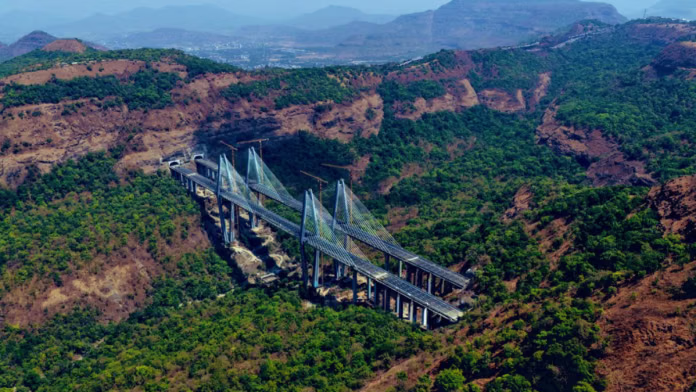
The Missing Link is a new stretch of road built to bypass the difficult ghat section of the Mumbai–Pune Expressway. It is not a separate highway but a part of the existing expressway itself. This project has been developed by the Maharashtra State Road Development Corporation with the aim of making travel faster, safer, and more efficient. The total length of the Missing Link is around 13 kilometres, and what makes it unique is that a large portion of this stretch runs through tunnels and bridges. It includes two long tunnels and several high bridges built across valleys, allowing vehicles to avoid the steep curves and risky slopes of the old route.
The need for this project had been clear for years. The old ghat section is known for its sharp bends, steep gradients, heavy traffic during weekends, and frequent accidents, especially during the monsoon. During peak hours, vehicles slow down significantly in this stretch, increasing travel time and adding to driver fatigue. Instead of trying to fix these long-standing issues on the same route, the idea behind the Missing Link was to create a new path that avoids these problem areas entirely.
For everyday travellers, this change could make a real difference. The new route reduces the overall distance between Mumbai and Pune by around 6 kilometres. Because the road is straighter and avoids the slow-moving ghat section, travel time is expected to come down by 20 to 30 minutes. The driving experience is also likely to improve. Moving through tunnels and wide, well-designed roads is far easier than navigating sharp mountain curves, making the journey more relaxed. Safety is another major advantage, as bypassing accident-prone areas and reducing sharp turns can lower the risk of mishaps.
The Missing Link is not just about saving time. It is also a significant engineering achievement. The stretch includes two major tunnels, including one of the longest road tunnels in India, along with multiple bridges built at great heights across valleys. Modern safety systems such as ventilation and emergency exits have been installed inside the tunnels. These features completely change the feel of the journey. Instead of winding through hills, travellers now move through a series of tunnels and open bridge sections, making the drive smoother and more predictable.
However, while the project has been inaugurated and opened, it is not entirely without issues. On the very first day, traffic congestion was reported, leading to delays for commuters. There were also reports suggesting that not all lanes were fully operational at the time of the launch. Such challenges are not unusual for large infrastructure projects. The initial days often involve adjustments as traffic patterns stabilize and systems are fine-tuned.
For regular travellers between Mumbai and Pune, the Missing Link could bring noticeable benefits. Office commuters may save valuable time every day, weekend travellers could experience less stress, and transport and logistics businesses may benefit from faster movement of goods. However, the real impact will only become clear over time, depending on how efficiently the route is managed.
Looking at the bigger picture, the Missing Link reflects India’s growing focus on infrastructure development. Better highways can boost economic activity, improve connectivity, and reduce travel fatigue and accidents. There is also a strong possibility that areas near the new route, such as Karjat and Lonavala, may see increased development in the coming years.
In the end, the Mumbai–Pune Missing Link is a positive step towards making one of India’s busiest travel routes more efficient. It promises shorter travel time, smoother roads, and improved safety. At the same time, its early challenges remind us that building infrastructure is only one part of the story. Proper management and execution are equally important. For now, if you are planning a trip between Mumbai and Pune, your journey is likely to become a little faster and a lot more comfortable, and for many travellers, that is a welcome change.
Subscribe Deshwale on YouTube


