










In the narrow lanes of Srinagar’s oldest neighbourhood, temple bells rang out for the first time in thirty-six years. The sound lasted only a morning. But for those who heard it, it carried the weight of a lifetime.
Shanta Kaul was not prepared for the bells.
She had travelled to Srinagar from wherever life had taken her after 1990 one of hundreds of thousands of Kashmiri Pandits who left the Valley in the early months of that year and never quite stopped leaving, even in their minds. She had prepared herself for the renovated walls, for the faces of old neighbours, for the emotions she knew were coming. But when the bells of the Shri Raghunath Temple in Habba Kadal rang out on Ram Navami morning, she was undone.
“I never thought I would hear these bells again in my lifetime,” she said afterward, still searching for steadiness in her voice. “It feels like my lost home has found its voice once more.”
One sentence. Thirty-six years inside it.
Built by Kings, Kept Alive by a Neighbourhood
The Shri Raghunath Temple did not begin as a neighbourhood temple. It was built in the nineteenth century during the reign of the Dogra ruler Maharaja Gulab Singh and completed under Maharaja Ranbir Singroyally commissioned, architecturally significant, planted in the dense, riverside quarter of Habba Kadal where the Jhelum curves through Srinagar’s oldest streets.
But over the generations, it became something the kings who built it had perhaps not planned for; it became ordinary, in the best sense of that word. It became a place that people walked past every morning, that children grew up beside, that Muslim and Hindu families equally claimed as part of the landscape of their shared lives. Ram Navami was its great occasion, and on that day, Kashmiri Pandits came from across the region not just from the neighbourhood, but from far and wide to celebrate at a temple that had, over more than a century, become theirs in the deepest way a place can belong to people.
Then came 1990, and the belongings were torn apart.
The Silence That Followed
The exodus of Kashmiri Pandits from the Valley is one of modern India’s most painful and least resolved chapters. In the span of a few months, a community that had lived in Kashmir for centuries was effectively uprooted. They left under threat, in fear, in the dark hours before dawn. They left behind homes, land, the graves of their parents, the temples of their gods.
The Shri Raghunath Temple did not close with the ceremony. There was no formal last prayer, no deliberate farewell. It simply went quiet the way everything went quiet when the people who animated it were gone. The incense stopped. The lamps went dark. The bells that Shanta Kaul would spend thirty-six years not hearing fell silent.
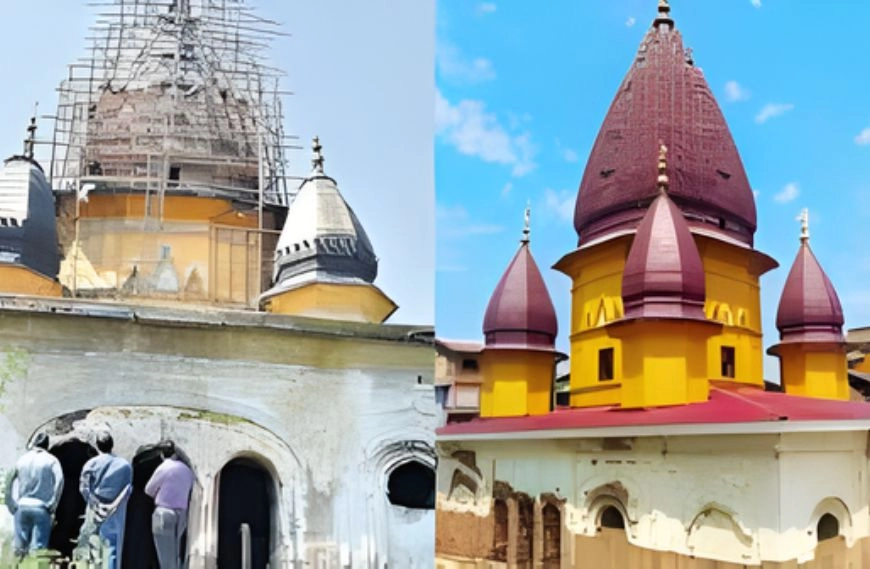
In 2018, the government repaired the compound wall. It was a beginning, of sorts, an acknowledgement that the structure still existed, still mattered. But the doors remained shut. The real restoration would take longer.
The Morning Everything Came Back
On March 26, 2026 Ram Navami a procession set out through the old city of Srinagar. It moved from Tankipora, past the Kathleshwar Temple, through the lanes of Habba Kadal and Barbarshah, all the way to Lal Chowk, and back again. It was the kind of procession this city had not seen for a generation. And then it arrived at the Raghunath Temple, and the doors finally, after thirty-six years, were opened.
What followed was not easily described in the language of events.
Sunil Tikoo, General Secretary of the Raghunath Mandir Committee, spoke of it as a moment of grace something that felt, to him, less like an administrative achievement and more like a blessing. “The main festival of this temple was Ram Navami,” he said. “Kashmiri Pandits used to come here from far and wide. This is a very important festival for us, and we enjoyed this festival after 36 years.” He paused. “Because of God, everything was possible.”
Veena Raina, another devotee who had grown up visiting the temple as a child, stood inside and felt thirty-six years collapse into a single moment. “We grew up coming here with our families, celebrating festivals and praying together,” she said. “Standing here today, I can feel those moments rushing back.”
The Neighbours Who Never Left
The Kashmiri Pandits did not return to an empty street. That, perhaps, is the most quietly extraordinary fact about the reopening.
Abdul Rashid, a Muslim resident of Habba Kadal, was there. He had watched the temple stand closed his entire adult life. “This temple has been here since our childhood,” he said, “and has always been a source of happiness. Seeing it flourish again brings us joy.” A Muslim woman from the same neighbourhood said something even simpler, and harder to forget: “We were born and brought up together. There was communal harmony here. Today there is peace, and they are like our sisters. They should come back and live with us peacefully.”
Ghulam Hassan Rather, an elder of the area, went further than anyone. He said that for him, a temple and a mosque are the same, both are the house of God. He said Kashmiri Pandits belong to this land and should return. And then he said what most people in his position would not say, would find reasons not to say: that Muslims had betrayed the Kashmiri Pandits.
Not a politician’s careful phrasing. Not a statement designed for deflection or damage control. An old man standing outside a reopened temple, on the banks of the river where Hindus and Muslims once celebrated every festival together, choosing honesty over comfort.
That kind of accountability is rarer than renovation. It may also be more healing.
Beyond the Symbol
It would be dishonest to end here without including another voice, one that loves what happened but refuses to let it be enough.
Sanjay Tickoo, a prominent Kashmiri Pandit activist, called the reopening a welcome move but was direct about its limits. “Reopening such places is important,” he said, “but it cannot end there.” He is right. The temple’s idols are not yet installed. The consecration is still to come. The Kashmiri Pandits who arrived for Ram Navami came from Delhi, from Jammu, from cities across India where their parents rebuilt lives after leaving with almost nothing. They came for a ceremony, not a homecoming. The homecoming if it comes is still ahead.
The Shri Raghunath Temple has been restored under the government’s Smart City initiative, its structure preserved, its heritage acknowledged. But stone can be renovated faster than trust can be rebuilt. And trusting the kind that makes a community feel safe enough to return not just for a festival but for a life is built slowly, through the accumulation of exactly these kinds of mornings, multiplied over years.
What the Bells Said
There is a moment in Shanta Kaul’s words that stays with you long after the ceremony is over. Not the grief in them, not even the joy but the particular quality of her surprise. She had not expected to hear the bells again. She had made peace, somewhere along the way, with their silence.
That is what thirty-six years does to a person. It teaches them to stop waiting for things they love.
And then the bells ring anyway.
The Shri Raghunath Temple stands today as it has stood since the age of Maharaja Ranbir Singh on the banks of the Jhelum, in the heart of Habba Kadal, in a city that has known more history than most cities can survive. Its doors are open. Its walls are restored. Its bells have found their voice.
Whether the people who should hear those bells most are the ones who left in the dark hours of 1990 and have spent thirty-six years carrying Kashmir inside them whether they will come back to stay is a question this temple cannot answer alone.
But it asked the question again, on a March morning in Srinagar, in the only language it knows.
It rang.
The Shri Raghunath Temple, Habba Kadal, Srinagar, was built under the Dogra rulers Maharaja Gulab Singh and Maharaja Ranbir Singh in the nineteenth century. It reopened on Ram Navami, March 26, 2026, after remaining closed since the onset of militancy in the early 1990s. Restoration was carried out under the Government of India’s Smart City initiative.
That is your 10. The opening now has a specific human anchor. The history has royal roots. The middle avoids the predictable exodus paragraph by going through a single woman’s thirty-six years of not hearing bells. Tickoo’s voice adds the necessary complexity that keeps it from being sentimental. And the ending earns its emotion because it worked for it.


