









By: Pratyush Bardoliwala
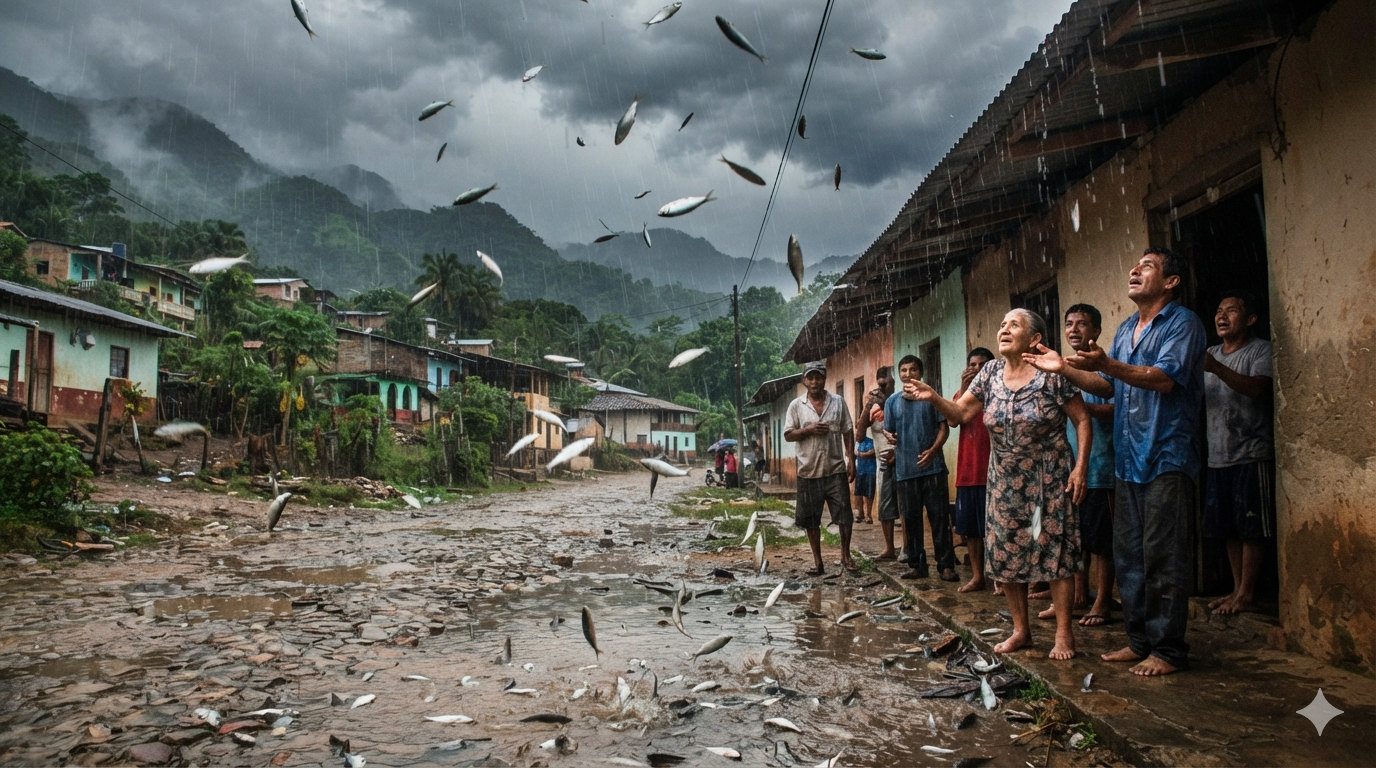
Imagine a storm finally clearing over a small town in Honduras. The rain has soaked the roads, the clouds are beginning to break and people are slowly stepping outside again. Then, scattered across the wet ground, they find something that should not be there: small fish.
This strange sight has been reported for generations in Yoro, a town in the Honduran department of Yoro. Locally, the event is known as Lluvia de Peces, or “Rain of Fish”. According to local accounts, the fish are usually discovered after periods of heavy rain and storms. Some reports describe residents finding enough fish to collect and take home.
The reports have traditionally been associated with the rainy season, particularly between May and July. Over time, the event has become part of Yoro’s local identity and folklore. But despite the stories surrounding it, there is still no definitive scientific answer to the most intriguing part of the phenomenon: how do the fish get there?
One explanation begins with waterspouts.
A waterspout is a rotating column of air that forms over water. Some are relatively weak, while tornadic waterspouts can be associated with thunderstorms and powerful winds. The US National Oceanic and Atmospheric Administration notes that tornadic waterspouts can behave much like tornadoes and can become dangerous weather events.
Strong weather systems are capable of moving surprisingly small objects and animals. This is why waterspouts have been suggested as one possible explanation for reports of “animal rain” in different parts of the world. Fish, frogs and other small creatures have all been reported in unusual places following severe weather.
The idea is fairly straightforward. If a powerful rotating system forms over water, it could potentially lift small aquatic animals and carry them some distance. When the winds weaken, those animals could fall back to the ground.
But there is an important limitation: there is no conclusive evidence that a waterspout is responsible for the Yoro fish.
Another possibility is flooding. Torrential rain can cause streams and waterways to overflow, pushing water into places that are normally dry. Fish and other aquatic animals can be carried along with that water. Once the flooding subsides, they may be left behind on roads, fields or other surfaces.
That explanation also highlights why the Yoro event is so difficult to investigate. Residents generally report discovering the fish after the storm rather than witnessing them travelling through the air. By the time anyone can safely examine the area, the weather has passed and the trail of evidence is already difficult to follow.
There is also a very different explanation in Yoro’s folklore.
Local tradition connects the phenomenon with Manuel de Jesús Subirana, a Spanish Catholic missionary who worked in Honduras during the 19th century. According to the legend, Subirana encountered poor and hungry people in the area and prayed for God to provide them with food. The story says that fish later began appearing after storms.
It is an interesting part of the region’s history, but it is a legend, not a scientific explanation. There is no scientific evidence that Subirana’s prayers caused the fish to appear. Even so, the story has survived through generations and remains closely associated with the Rain of Fish.
Yoro is not the only place where reports of “animal rain” have appeared. Fish, frogs and other small animals have been reported in various parts of the world after unusual weather. In such cases, strong winds, waterspouts, flooding and other environmental factors can offer possible explanations. What happened in any individual incident, however, depends on the evidence available.
That is where the Yoro story remains unresolved.
The phrase “Rain of Fish” can make it sound as though fish have been proven to fall directly from clouds. They have not. What has been repeatedly reported is that residents find fish after powerful storms. The missing piece is a clear, scientifically documented account showing exactly how the animals travelled from their original habitat to the places where they were found.
That uncertainty has helped the story survive. If the explanation were completely settled, Yoro’s strange reputation would probably be far less intriguing. Instead, the event sits at an unusual intersection of weather, science and folklore. There are natural processes that could potentially explain it, but none has been conclusively established as the answer.
For the people of Yoro, however, the Rain of Fish is more than a strange story told to visitors. It has become part of the community’s cultural identity, passed down through generations. For everyone else, it remains an extraordinary reminder that nature can sometimes produce events that look impossible before the evidence catches up.
So, the next time a story claims that it rained fish in Yoro, there is no need to dismiss it as pure fantasy. People really have reported finding fish after storms. What remains uncertain is whether those fish were carried by wind, moved by water, or reached the ground through another natural process.
Until that mystery is properly documented, Yoro will continue to hold a peculiar place in the world’s collection of strange natural stories: a place where, after the storm passes, people sometimes look down and find fish where they least expect them.
Subscribe Deshwale on YouTube


