











Have you heard about Sentinel Island and Sentinelese?
A tiny, lush island lost in the Bay of Bengal, where a small group of people live like they have stepped out of a time machine. They are the Sentinelese Tribe, Andaman and Nicobar Tribes, and they have called North Sentinel Island home for 60,000 years. These folks want nothing to do with the outside world, and they have fought hard to keep it that way. From ancient roots to a heartbreaking clash in 2018 with an American missionary, their story is one of grit, mystery, and fierce independence. Who are they? Why do they hide? And what’s life like on their secret island? Let me take you there.
Ancient roots that run deep
The Sentinelese are one of the world’s oldest surviving tribes. Experts believe their ancestors left Africa around 60,000 years ago, crossing land bridges or shallow seas to reach the Andaman Islands. North Sentinel, a 60-square-kilometre island surrounded by coral reefs, became their sanctuary. They hunt wild pigs, catch fish, and gather fruits and roots. Their language is a mystery, even to nearby tribes like the Onge or Jarawa. This shows just how isolated they have been, not just from us but from everyone. Their way of life is not stuck in the Stone Age, it’s evolved to suit their island perfectly.
First encounters: A rocky start
The first recorded mention of the Sentinelese came in 1771. An East India Company ship spotted lights on the island, likely campfires. No contact happened. In 1867, a merchant ship, the Nineveh, crashed on the island’s reefs. Survivors reached the shore, but on the third day, the Sentinelese attacked with iron-tipped arrows. The Royal Navy rescued the group, but the message was clear: this was their land. In 1880, a British officer, Maurice Vidal Portman, tried to ‘befriend’ them. His attempt was grim. He kidnapped six Sentinelese, including an elderly couple and four kids. The couple died from mainland diseases, and the children were sent back, likely carrying illnesses. This betrayal sowed deep distrust.
Curiosity and gifts: The 20th century
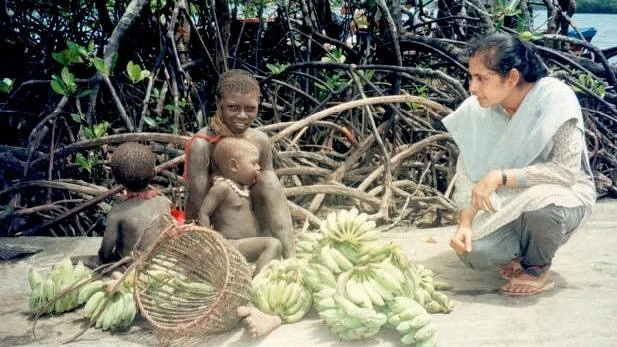
By the 1960s, anthropologists were fascinated by the Sentinelese. In 1967, Triloknath Pandit led a team to the island, hoping to connect. The Sentinelese vanished into the jungle, leaving empty huts and warm campfires. The team left gifts like clothes and sweets. In the 1970s and 80s, India tried regular ‘gift drops’, coconuts, metal tools, even live pigs. The Sentinelese accepted some, rejected others. Once, they speared a pig and buried it with plastic buckets but kept the coconuts. In 1974, a National Geographic team was attacked, with an arrow hitting the director’s thigh. A breakthrough came in 1991 when anthropologist Madhumala Chattopadhyay joined a trip. The Sentinelese did not raise weapons and took coconuts by hand… a rare moment of peace.
Hands-off policy: Protecting their way
By 1996, India stopped gift drops. Contact risked wiping out the Sentinelese, as diseases had decimated other Andaman tribes. Now, the policy is ‘leave them alone, but keep an eye out.’ Boats and helicopters monitor from a distance. A 1956 law bans entering within five nautical miles of the island. Still, incidents happen. In 2004, after the Indian Ocean tsunami, a helicopter checked on the tribe. They fired arrows at it, proving they’d survived. In 2006, two fishermen illegally near the island were killed and buried by the Sentinelese.
The tragedy of John Allen Chau
In 2018, a 26 year old American missionary, John Allen Chau, made headlines. He wanted to bring Christianity to the Sentinelese. Ignoring India’s ban, he bribed fishermen to take him near the island. His diary, later found, revealed his zeal, “Lord, is this island Satan’s last stronghold?” On his first try, an arrow pierced his Bible. On the second, one grazed his leg. Undeterred, he kayaked alone to the shore on 17 November. The Sentinelese killed him and buried his body. India didn’t recover it, prioritising the tribe’s safety. The incident sparked debate, some called Chau a martyr, others a reckless intruder. It highlighted the clash between personal freedom and indigenous rights.
Life on North Sentinel
The Sentinelese, numbering about 100–150, are master hunters and gatherers. They hunt pigs, fish, and collect crabs, fruits, and turtle eggs. Their slim canoes glide through shallow waters. They sharpen washed-up metal into knives and arrowheads. Their huts are lightweight, and they use ochre and clay for body art, possibly telling stories or marking traditions. One report suggests they bury their dead in buckets, seated, a unique ritual. Their small population is stable, with no signs of malnutrition. But their genetic similarity makes them vulnerable to diseases like measles. Their language, beliefs, and social rules remain unknown, yet their survival through disasters like the 2004 tsunami shows their resilience.
Why they stay apart
The Sentinelese’s isolation stems from history. Colonial-era diseases and violence nearly wiped out other Andaman tribes. The Sentinelese likely witnessed or heard of this. Anthropologist Triloknath Pandit calls their hostility ‘self-defence.’ They see outsiders as threats. Their weak immunity to modern diseases makes contact dangerous. This is not just stubbornness, it’s survival.
The future: A delicate balance
The world is split on the Sentinelese. Groups like Survival International say leave them be, contact could destroy their culture. Others argue isolation denies them modern medicine or legal protections. Most experts, and India, agree their autonomy comes first. In 2025, a YouTuber, Mykhailo Viktorovich Polyakov, was arrested for leaving items like Diet Coke on the island. It shows India’s commitment to protection. But climate change looms. Rising sea levels could threaten North Sentinel’s low-lying shores. The Sentinelese remind us that sometimes ‘progress’ means letting people live as they choose.


