



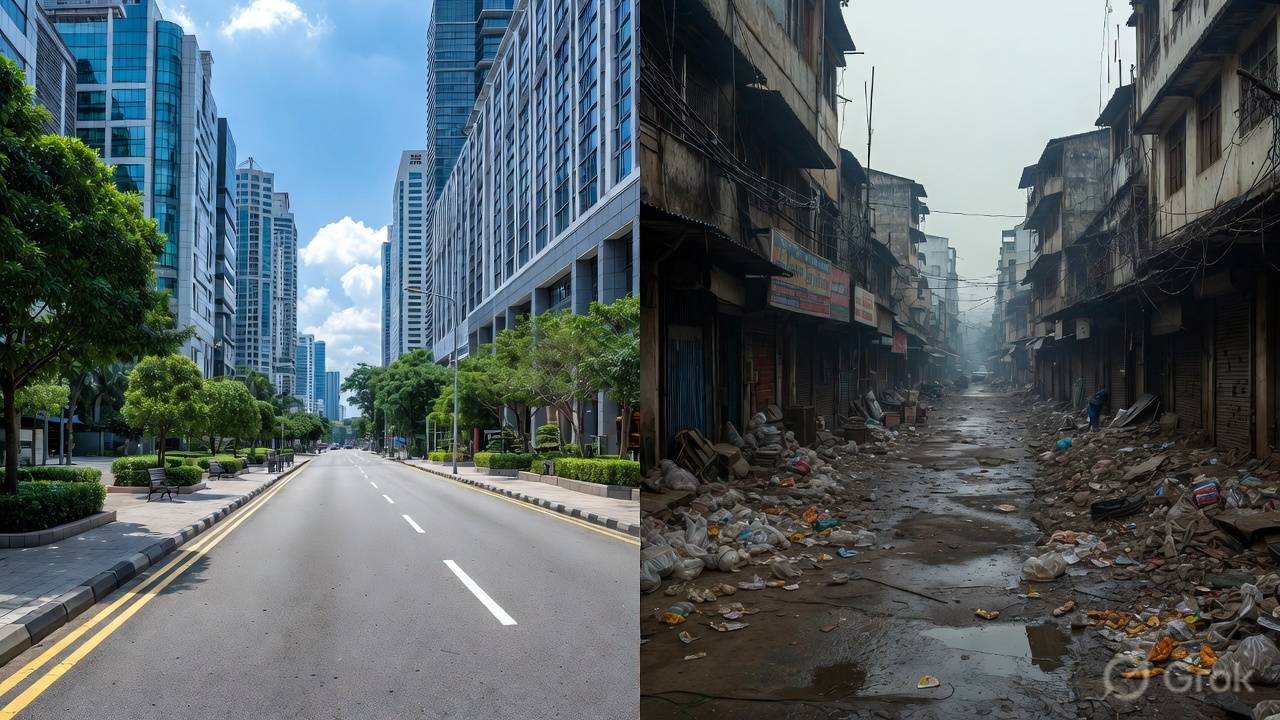
There is a particular kind of exhaustion that settles over you after years of covering Indian cities. You have walked the same footpaths in Mumbai, Kolkata, Chennai and Delhi. You have filed the same stories about the same open drains, the same pan stains on heritage walls, the same plastic bags floating past the same municipal signboards that say “Keep Your City Clean.” You have interviewed the same civic officials who speak with great conviction about transformation, and you have returned the next morning to find the same cigarette butts at the same corner. After 25 years of this, you stop being angry. You just start asking different questions.
The question worth asking now is not whether Indians can change. They can. The question is what it actually takes.
The Singapore Experiment: Force, Not Persuasion
In the late 1960s, Singapore was not the gleaming city-state it is today. It was crowded, dirty, and deeply poor. Spitting on streets was routine. Urinating in lifts was common enough that the government installed urine-detection devices that triggered alarms and locked the doors until authorities arrived. Littering was ordinary behaviour across all income groups. The city had the habits of a poor colonial port, because that is precisely what it had been.
Lee Kuan Yew, Singapore’s first Prime Minister and its most formidable personality, decided that none of this was acceptable. In a now widely circulated interview, he spoke about how changing deeply ingrained public behaviour required more than persuasion. It required law, enforcement, punishment and political will applied without apology. The Keep Singapore Clean campaign, launched in 1968, was not a soft awareness drive. It came with fines. Real fines. Fines that hurt.
By the 1970s and 1980s, the legislative framework had hardened. Littering was a fineable offence with amounts that escalated sharply for repeat violators. In 1992, Singapore introduced the Corrective Work Order, which required convicted litterbugs to clean public spaces in bright orange vests, in public view. The visible shame was deliberate. The government understood something that polite public messaging rarely acknowledges: humiliation, when applied fairly and at scale, works.
What made Singapore different was not just the law. It was the credibility of enforcement. When Lee Kuan Yew said you would be fined, you were fined. There were no exceptions for connections or status. That consistency, over decades, changed behaviour. Today Singapore is one of the cleanest cities in the world. Its streets, parks and public transport systems are maintained at a standard that most Indian cities cannot approach even in their most ambitious imaginings.
It is also important to say this plainly: Singapore was, for most of Lee Kuan Yew’s tenure, an authoritarian state dressed in democratic clothing. Elections happened, but outcomes were largely predetermined. The press was controlled. Dissent was managed. This gave the government a freedom that no Indian administration has: the freedom to be deeply unpopular in the short term because it was not threatened by electoral consequences.
India Tries. India Keeps Trying.
India has not been indifferent to the problem. The Swachh Bharat Mission, launched on October 2, 2014, by Prime Minister Narendra Modi, was the most ambitious sanitation and cleanliness drive in Indian history. The first phase, which ran from 2014 to 2019, had a combined outlay of approximately Rs. 62,009 crore for rural India and Rs. 14,623 crore for urban India. The second phase, running from 2021 to 2026, expanded the scope significantly, with an allocation of approximately Rs. 1,40,881 crore.
These are not trivial sums. The programme built over 100 million toilets in rural areas, reduced open defecation dramatically, and generated genuine behavioural change in large parts of rural India where the infrastructure simply had not existed before. In many villages, particularly across Uttar Pradesh, Rajasthan and Bihar, the shift away from open defecation has been measurable and significant.
But urban India is a different story. Walk through Dharavi or Kurla in Mumbai. Walk through any railway station in any Indian city after 9 pm. The evidence of what the Swachh Bharat Mission could not fix is everywhere. Walls stained with paan. Gutters choked with packaging. The smell of urine in underpasses. These are not new problems. And they are not problems that posters and jingles have solved.
The honest assessment is that the Mission achieved more in rural India, where new infrastructure genuinely changed what was physically possible, than in urban India, where the problem was never primarily about infrastructure. In cities, the problem is behaviour. And behaviour, in a country of 1.4 billion people across every possible income group, language, religion and caste background, is ferociously hard to change through campaigns alone.
The Budget Gap and What It Tells You
Singapore spends roughly SGD 110 million to SGD 130 million annually on public cleaning and waste management for a population of about 5.9 million. Per capita, that works out to somewhere around SGD 20 (approximately Rs. 1,250) per resident per year, just on cleaning. Municipal enforcement is funded separately.
India’s urban local bodies, taken together, spend roughly Rs. 4,000 crore to Rs. 5,000 crore annually on solid waste management for approximately 500 million urban residents. That is less than Rs. 10 per urban resident per year in many cities. The underfunding of municipal governance in India is not a governance gap. It is a political choice. Property taxes are kept low because raising them costs votes. User fees are resisted for the same reason. The result is a chronic deficit in the basic operational capacity of Indian cities.
Mumbai’s Brihanmumbai Municipal Corporation is one of the wealthiest urban bodies in India. Yet anyone who has spent time on the Harbour Line during monsoon, or tried to walk along the creek-facing streets of Bandra or Mahim, knows that wealth and cleanliness are not automatically connected. The BMC’s sanitation budget is substantial by Indian standards but the returns remain uneven. Infrastructure is there. Will is patchy. Enforcement is nearly absent.
What Mumbaikars Actually Say
Ask people on the street in Mumbai, and you get a surprisingly direct set of answers. A vegetable vendor near Dadar market said something that stuck: he knows throwing waste on the road is wrong, but almost everyone does it and almost nobody stops anyone. He also said that he has seen some Mumbaikars adhering to high standards of public cleanliness. A college student from Chembur said she avoids littering but gets genuinely annoyed and demoralised when she sees others doing it freely with no consequence. A retired government employee in Borivali said, somewhat philosophically, that Indians respect authority when it is present in front of them and disregard every rule the moment it is not.
This is not a moral failing unique to Indians. It is human. It is what Singapore’s enforcement model understood and addressed. Presence and consistency matter far more than campaigns. The issue isn’t awareness. Everyone in an Indian city knows that spitting is unhygienic. They know. They do it anyway, because nothing happens.
The Celebrity Campaign Debate: Politeness Has Its Limits
India has run celebrity-fronted cleanliness campaigns before. Amitabh Bachchan and Sachin Tendulkar appeared in Swachh Bharat spots. The ads were well-produced. They were polite. They asked people nicely to change.
The results, in urban India, were marginal.
There is a growing and uncomfortable argument that polite messaging aimed at deeply normalised behaviour simply does not work at the required scale. Some urban commentators, and quite a few frustrated Mumbaikars if you ask them honestly, believe that aggressive public shaming, even through celebrity voices, might register more effectively. Imagine a campaign where a prominent cricketer or film star addresses a spitter or a litterer directly and with contempt. Not gently. With visible disgust.
Would it cause offence? Probably. Would it work better than the current approach? That is the question. The evidence from Singapore and even from some Indian road safety campaigns suggests that emotional intensity and social shame are more effective behavioural levers than gentle encouragement.
Indian politicians know this. And they almost uniformly avoid it. The calculation is straightforward. Harsh messaging aimed at public behaviour risks alienating voters, particularly in lower-income communities where sanitation infrastructure is most lacking and where the behaviour is most visible. No elected municipal councillor in Mumbai or Delhi will stand up and humiliate his constituency’s voters, however warranted the humiliation might be.
This is the fundamental democratic constraint that Singapore never had. Lee Kuan Yew could be blunt because his political survival did not depend on the approval of the man he was telling off. Indian politicians cannot afford that luxury. It is easy to say they should be braver. It is harder to design a political system where bravery about unpopular truths is actually rewarded.
Where Does This Leave Indian Cities
The comparison with Singapore is useful but it can only go so far. Singapore is a city-state of under six million people. It has no federal structure, no competing political parties with serious power, no linguistic or cultural diversity at a scale that complicates governance. India is none of those things.
What India can borrow from Singapore is not its political model. It is the operational logic: enforcement must be consistent, consequences must be real, and the law must apply to everyone regardless of who they are. A fine that is actually collected. A Corrective Work Order equivalent that is actually implemented. A municipal enforcement officer who cannot be bribed because the system records every interaction.
Technology makes some of this possible now in ways it was not in the 1960s. CCTV-linked enforcement, mobile reporting apps, publicly visible offender registries: these are not fantasy. Some Indian cities have begun experimenting with pieces of this. The results are modest but they exist.
The deeper problem is political will. Not the will to launch a campaign, but the will to sustain enforcement long after the launch event, long after the minister has moved on, long after the press has stopped covering it. That kind of institutional patience is, frankly, rare in Indian governance. It is not impossible. But it requires a city leadership that treats cleanliness as infrastructure rather than optics, and that is willing to be boring about it for twenty years.
Singapore was not built in a day. It was built in a generation, by people who had the authority and the nerve to be consistently unpopular. India’s cities are waiting for someone willing to make that trade.
Subscribe Deshwale on YouTube
