








On the morning of June 16, 2026, millions of Indians woke up to find Telegram gone. The app used daily by freelancers, journalists, students, small business owners, and creators was simply inaccessible. No warning. No grace period. Just a blank screen where a working app used to be.
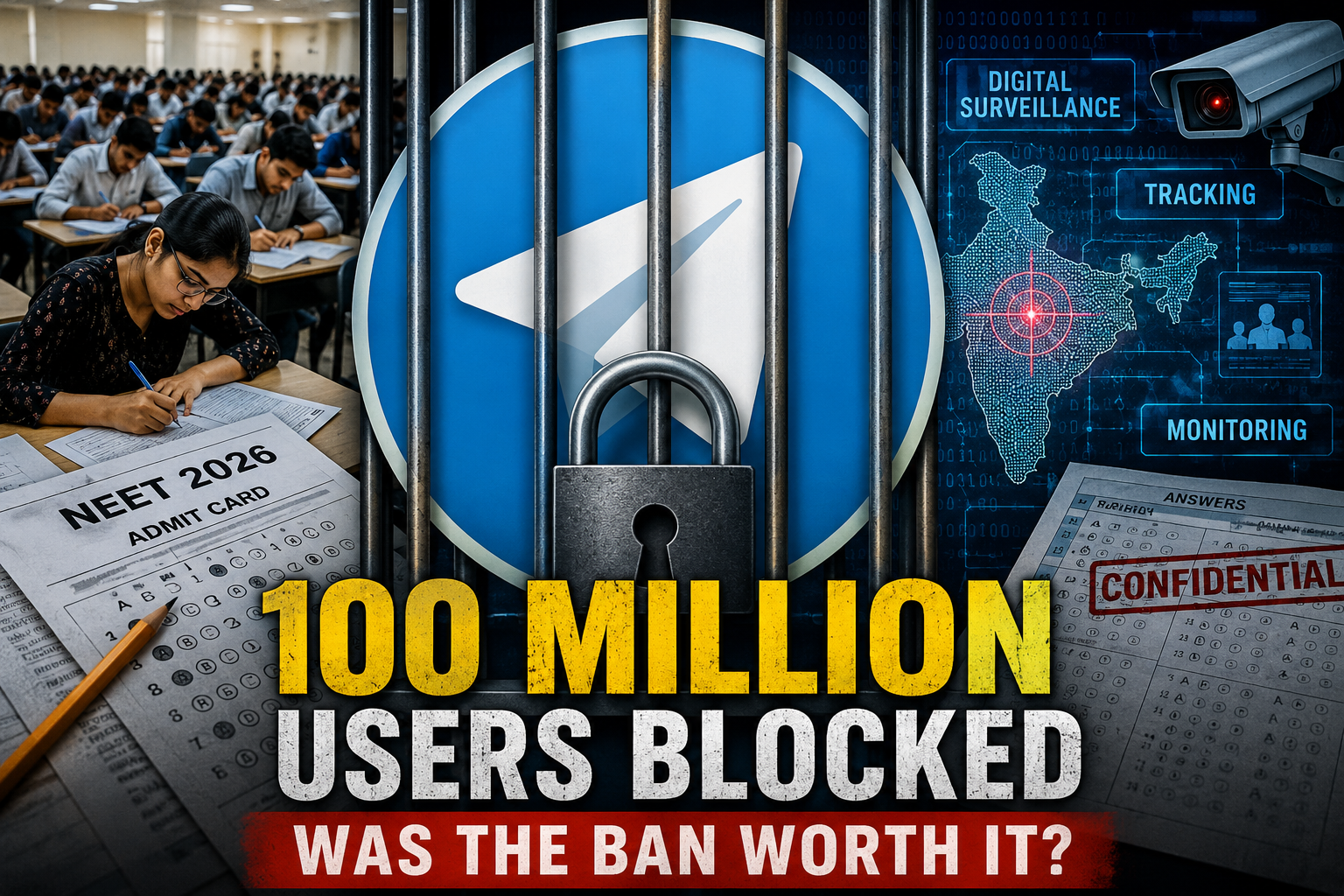
The reason? The Indian government blocked Telegram across the entire country until June 22, one day after the NEET UG 2026 re-examination scheduled for June 21. The move was made under Section 69A of the Information Technology Act, 2000, the same law that once banned TikTok, PUBG Mobile, and dozens of Chinese apps. This time, the target was not a foreign adversary. It was a messaging platform used by an estimated 100 million Indians, in a country where Telegram is the single largest national market for the app.
The government’s reasoning is not without merit. The NEET 2026 re-examination is already under a cloud. The original exam, held on May 3, was cancelled on May 12 after investigations revealed suspicious overlaps between a pre-circulated guess paper and the actual question paper. A CBI probe was launched, arrests were made, and 22.79 lakh candidates, the largest pool in the exam’s history, were left in limbo. The stakes could not be higher.
As the re-exam approached, the NTA said it detected organised fraud operating through Telegram. Channels with names like “Paper Leaked NEET,” “Re-NEET 2026,” and “Private Mafia” were openly demanding payments from a few thousand rupees to several lakhs in exchange for supposed access to the question paper. The Indian Cyber Crime Coordination Centre (I4C), under the Ministry of Home Affairs, took down several of these channels and bots. But the government concluded that wasn’t enough. And so, for nearly a week, all of Telegram India went dark.
There is another dimension to this ban that deserves equal attention. The NTA revealed that Telegram’s message-editing feature had been weaponised to fabricate fake “paper leak” evidence. The method is chillingly simple: a fraudster posts an old, meaningless message in a Telegram channel. After the exam concludes, they edit that message and insert the actual question paper while the original timestamp remains unchanged. Screenshots of the edited message then go viral as proof that the paper was circulated before the exam. It is misinformation manufactured with a single tap. To address this, Telegram has also been directed to disable the message-editing feature in India until June 30.
But here is the question that nobody in an official press release wants to answer: was blocking 100 million users the right way to stop a few thousand fraudsters?
India’s Telegram user base is not a niche community. It includes working journalists who use channels to receive breaking news, independent content creators who have built communities of thousands, small business owners who coordinate with suppliers and customers through group chats, students who rely on free educational content shared across subject-specific channels, and rural communities where Telegram’s ability to share large files without data cost barriers makes it uniquely valuable. For all of these people, the ban is not an inconvenience, it is a disruption to work, income, and information access.
Section 69A of the IT Act allows the government to block platforms in the interest of sovereignty, security of the state, or public order. Its constitutional validity has been upheld by the Supreme Court. But legal permissibility is not the same as proportionality. For a ban of this scale to be justified, the government must demonstrate that blocking the entire platform was the only available solution and not just the easiest one.
That argument is hard to make here. The fraudulent channels had already been identified and taken down by I4C. Individual bots and groups operating under the NEET fraud umbrella were traceable and removable. A platform-wide block applied uniformly across every user, every community, every legitimate use case suggests a blunt instrument was chosen over a precise one. It is the digital equivalent of shutting down an entire highway because a few drivers were speeding.
This also raises a broader pattern worth examining. India has repeatedly reached for the app-ban lever in moments of pressure TikTok in 2020, thousands of X accounts in 2025, and now Telegram in 2026. Each time, the immediate rationale is genuine. But each ban also normalises the use of Section 69A as a first response rather than a last resort. Digital rights experts have consistently argued that blocking orders under Section 69A are issued without adequate transparency, without public notice, and without a meaningful mechanism for ordinary users to appeal or even know why their access was removed.
The students appearing for the NEET re-examination on June 21 deserve every possible measure to ensure a fair, fraud-free exam. Nobody disputes that. But the 100 million Indians who were locked out of their Telegram accounts this week also deserved a government that first exhausted every targeted option account takedowns, coordinated law enforcement, real-time monitoring before reaching for a week-long blanket ban.
The Telegram ban will lift on June 22. The editing feature restriction will remain until June 30. NEET will be conducted, results will come, and this episode will fade from headlines. But the question it raises will not go away: in a country with one of the world’s largest and most active digital populations, at what point does protecting an exam become disproportionate to the cost borne by everyone else?
That is not an anti-government question. It is a democratic one.
Subscribe Deshwale on YouTube


