








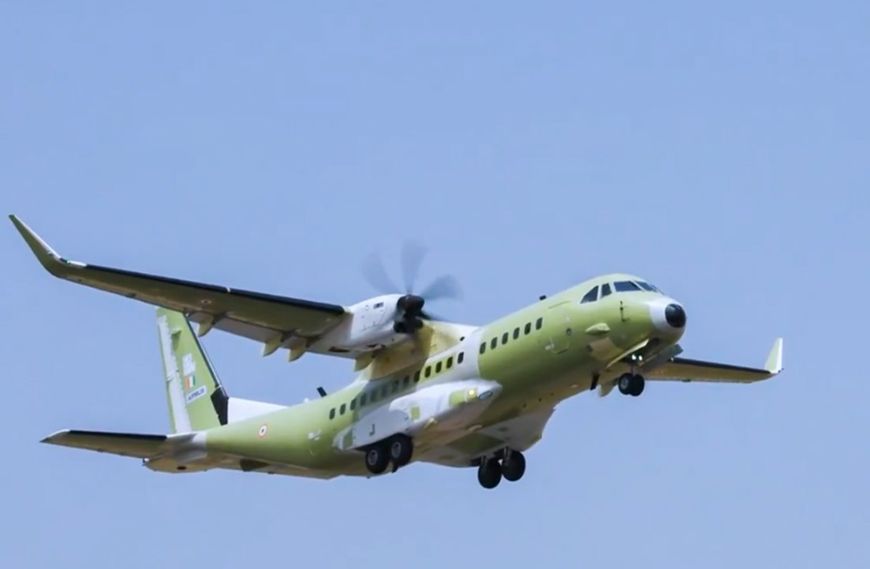
On June 10, 2026, something quietly extraordinary happened on a runway in Vadodara, Gujarat. A military transport aircraft lifted off the ground and it wasn’t imported, it wasn’t assembled abroad, and it didn’t arrive in a crate from Europe. It was built right here, in India, by Indian hands. The first Made-in-India Airbus C-295 completed its maiden test flight from the Final Assembly Line (FAL) at the Tata-Airbus facility in Vadodara marking a landmark moment in the country’s defence manufacturing journey.
But beyond the milestone lies a bigger question: what exactly is the C-295, and why does it matter so much to the Indian Air Force?
A workhorse built for the real world
The Airbus C-295 is a medium tactical transport aircraft, the kind of plane that doesn’t make headlines for its speed or stealth, but quietly does the heavy lifting that keeps military operations running. It was originally developed by Spanish aerospace firm CASA in the 1990s and is now produced under Airbus Defence and Space.
Think of it as the Swiss Army knife of military aviation. On any given mission, the C-295 can carry 71 troops or 50 paratroopers, transport cargo, perform medical evacuations (MEDEVAC), conduct maritime patrol, support disaster relief, and even perform mid-air refuelling of fixed-wing aircraft and helicopters. Not many aircraft can do all of this and that’s exactly the point.
Built to go where others can’t
One of the most important things about the C-295 is where it can fly or more precisely, where it can land. India’s geography is uniquely challenging. From the snow-bound mountain passes of Ladakh to remote island chains in the Andamans, the Indian Air Force regularly needs to reach places that have no proper airstrips.
The C-295 was designed for exactly this. It has Short Take-Off and Landing (STOL) capability, meaning it can operate from grass, soft, or unpaved surfaces. It can take off from an airstrip as short as 2,200 feet. For comparison, a typical commercial runway is around 8,000 to 13,000 feet long. This gives the IAF the ability to deploy troops and supplies rapidly to forward areas close to India’s borders, a capability that has become even more strategically important in recent years.
The numbers behind the aircraft
The C-295 is powered by two Pratt & Whitney Canada PW127G turboprop engines and can carry up to 9 tonnes of payload (corrected from 8). It cruises at a maximum speed of 260 knots (around 480 kmph) and can stay in the air for up to 11 hours (corrected from “over 11 hours”) long enough for sustained surveillance, patrol, or extended transport missions.
The India-specific variant comes fitted with an indigenous Electronic Warfare Suite developed natively, along with a Fully Integrated Tactical System (FITS) state-of-the-art technology that gives the aircraft enhanced situational awareness during tactical operations. It also features bubble windows, a rear loading ramp, and touchscreen navigation.
Globally, the C-295 has built an outstanding track record. With more than 300 aircraft under contract worldwide, C-295 operators have collectively logged over 600,000 flight hours in various conditions. It is widely considered the world’s most versatile and efficient multi-role tactical airlifter.
Replacing the old guard
The C-295 is stepping into the shoes of the Avro HS-748 fleet aircraft that have been serving the IAF for over six decades. While these old workhorses have had a long and proud career, they are long past their operational prime. The C-295 brings dramatically improved capability, reliability, and mission flexibility to fill that gap.
In September 2021, India signed a Rs 21,935-crore contract with Airbus to procure 56 C-295 aircraft. Under the agreement, 16 aircraft were to be delivered in fly-away condition directly from Airbus’s assembly facility in Seville, Spain and all 16 have already been delivered to the IAF, two months ahead of schedule. The remaining 40 aircraft are to be manufactured in India by Tata Advanced Systems Limited (TASL) at the Vadodara facility.
The make in India story and why it goes deep
The Vadodara test flight wasn’t just a technical milestone it was a statement. This is the first-ever Make in India project in the defence aircraft sector led by a private-sector consortium. The Tata Aircraft Complex was inaugurated in October 2024 by Prime Ministers Narendra Modi and Spain’s Pedro Sanchez, and has since moved swiftly into production.
What makes this truly significant is the scale of indigenisation. The C-295 airframe comprises over 14,000 components, of which around 3,500 parts are being industrialised annually by Tata. According to Jorge Tamarit, head of the C-295 India programme at Airbus, indigenisation is measured by labour hours and by the 32nd aircraft, it will reach 98%. The last eight aircraft (from aircraft 32 to 40) will carry the maximum indigenous content.
The Vadodara facility is expected to assemble 12 aircraft every year. Several Indian public sector companies are also contributing key systems: Bharat Electronics Limited (BEL) developed the indigenous radar warning receivers and missile approach warning systems, while Bharat Dynamics Limited (BDL) manufactured the countermeasure dispensing system.
According to Tata, the entire programme is expected to create more than 15,000 skilled direct and indirect jobs across India’s aerospace ecosystem. All 40 aircraft are slated for delivery between 2026 and 2031.
When the first Made-in-India C-295 lifted off from Vadodara on June 10, it carried more than its 9-tonne payload capacity. It carried the aspirations of an industry that has long struggled to build complex military hardware domestically. It proved that India doesn’t just have to buy aircraft, it can build them.
The delivery of the first aircraft to the Indian Air Force is expected later this year. And with 39 more to follow over the next five years, the skies above India are about to look a little more self-reliant.
Subscribe Deshwale on YouTube


