








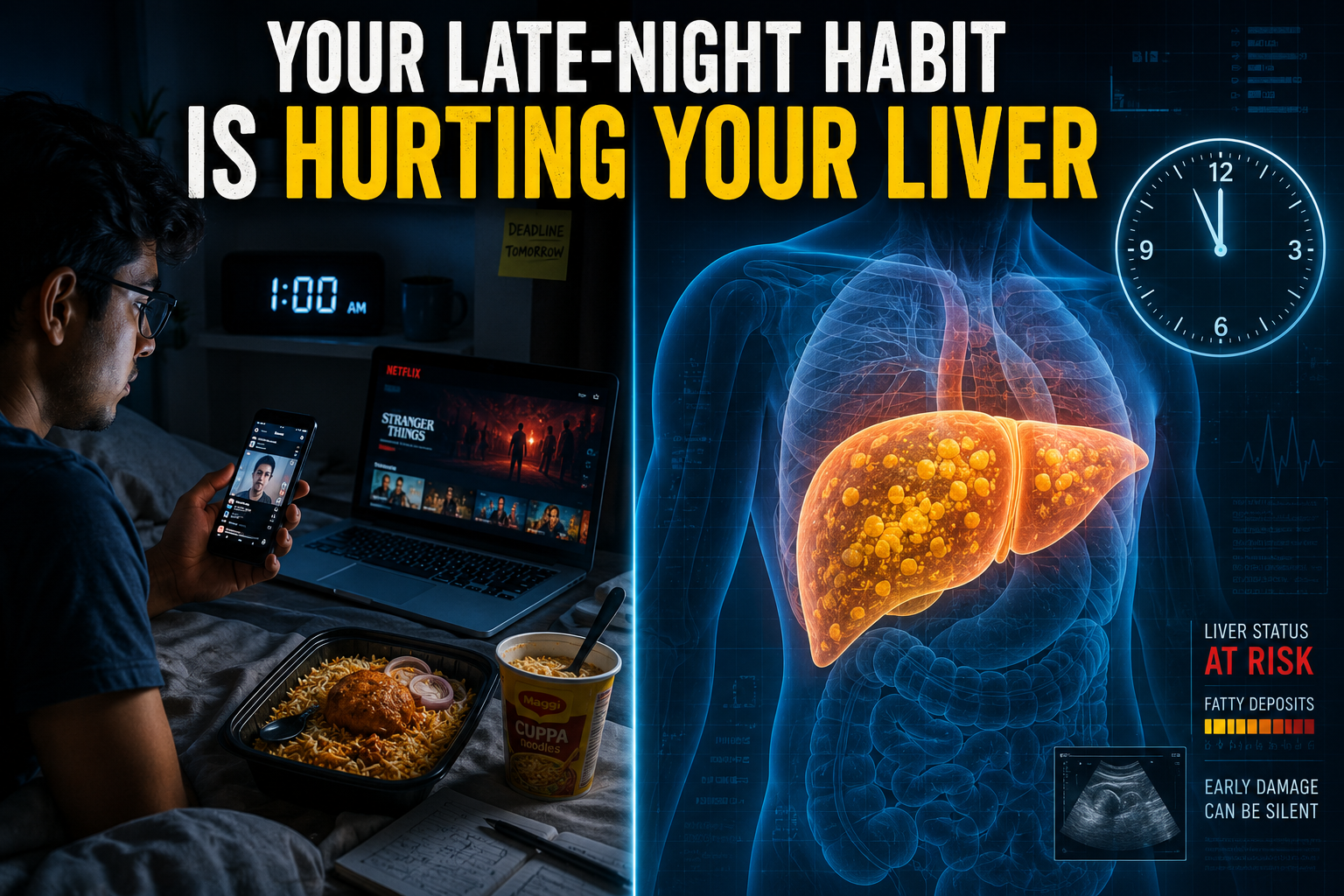
It’s midnight. You’re three episodes deep into a new Netflix series, your phone buzzes with Instagram reels, and somewhere in the kitchen, last night’s leftover biryani is calling your name. This is not an unusual Tuesday in urban India. For millions of young professionals from Bangalore’s IT corridors to Mumbai’s financial districts staying up past midnight has simply become normal.
But here’s what nobody is talking about: this late-night lifestyle is quietly setting the stage for one of India’s fastest-growing health crises, fatty liver disease. And you won’t feel a thing until it’s too late.
India’s liver problem is already alarming
The numbers are hard to ignore. A landmark study published in The Lancet Regional Health Southeast Asia in early 2026 screened 7,764 adults across 27 Indian cities and found that nearly 4 in 10 had metabolic dysfunction-associated steatotic liver disease (MASLD) the updated medical term for non-alcoholic fatty liver disease (NAFLD), a condition where excess fat builds up in liver cells in people who drink little to no alcohol. The age-adjusted prevalence came in at around 39%.
This isn’t a disease of heavy drinkers anymore. It is a metabolic disease driven by how we eat, move, and increasingly, how we sleep.
A study published in Scientific Reports (2025) specifically examined India’s IT workforce and found that the work culture in the sector, sedentary jobs, shift work, irregular hours, and sleep deprivation were significant contributors to fatty liver risk. The irony is painful: the very industry powering India’s economy is quietly undermining the health of the people running it.
Your liver has a clock and you’re messing with it
Here’s the biology that most health articles skip.
Your liver is not just a passive fat-processing machine. It runs on a precise internal clock, a circadian rhythm that tells it when to metabolize fat, regulate blood sugar, and repair itself. This clock is synchronized with the natural light-dark cycle. When you stay up late, binge on screens, and eat at midnight, you don’t just disrupt your sleep, you throw your liver’s internal schedule into chaos.
A 2024 study published in Preventive Medicine found that even people with a normal total sleep duration had a higher risk of NAFLD if their sleep timing was consistently late meaning they were habitual “late chronotypes” who go to bed and wake up significantly later than average. It’s not just about how much you sleep. It’s about when you sleep.
When you eat late at night, your liver receives nutrients at a time when it’s biologically programmed to be in rest-and-repair mode. Research from 2025 shows that late-night eating acts as what scientists call a “mistimed zeitgeber” , a false timing signal that uncouples the liver’s peripheral clock from the body’s master clock in the brain. The result: impaired glucose processing, disrupted lipid metabolism, and accelerated fat accumulation in liver cells.
A well-known Northwestern University study (Arble et al., 2009) illustrated this starkly: nocturnal mice fed a high-fat diet only during their normal sleeping hours gained 48% more body weight compared to a 20% gain in mice eating the exact same diet during their natural waking hours despite both groups consuming identical calories and doing the same amount of physical activity. The only variable was when they ate.
The night shift multiplier
For India’s millions of IT and BPO workers who work US or European time zones, the damage is compounded. A 2024 review published in Hepatoma Research found that night shift work is directly linked to the initiation and progression of NAFLD, and may even increase the risk of hepatocellular carcinoma liver cancer over time. When the body’s sleep-wake cycle is consistently reversed, the internal rhythms of the liver fail to fully synchronize, leading to excessive fat accumulation and abnormal liver enzyme levels.
Sleep deprivation makes things worse in another way too. Animal research from Toho University (Shigiyama et al., 2018) found that even a single six-hour sleep deprivation session impaired the liver’s ability to produce glucose normally and increased liver triglyceride content by nearly 68% in mice on a high-fat diet pointing to a clear link between disrupted sleep and the biological conditions that lead to hepatic steatosis. While this was a mouse study, it highlights the mechanisms that are increasingly being observed in human metabolic research as well.
And when you’re sleep-deprived, your hunger hormones go haywire: leptin (which signals fullness) drops, while ghrelin (which triggers hunger) rises. You feel less full, crave more high-calorie food, and are far more likely to reach for chips or Maggi at 1 a.m.
It’s a vicious loop. Late nights → hormonal disruption → late-night eating → liver fat accumulation → repeat.
The silent disease nobody sees coming
What makes this particularly dangerous is the absence of symptoms. Fatty liver disease in its early stages causes no pain, no jaundice, no obvious warning signs. You feel completely fine while fat quietly accumulates 5%, 10%, 20% of your liver’s weight. Medical guidelines define steatosis (the earliest stage) as fat accounting for more than 5–10% of liver weight. By the time most people are diagnosed, the damage has been building for years.
Left unchecked, NAFLD can progress to non-alcoholic steatohepatitis (NASH), then to liver fibrosis and cirrhosis conditions that are largely irreversible. Doctors note that fatty liver disease has become one of the leading indications for liver transplantation in India.
What you can actually do
The good news: early-stage fatty liver is reversible. The bad news: it requires changing habits that feel most “normal” to urban India right now.
Science points toward a few practical interventions. Eating your last meal well before bedtime helps keep your liver’s clock aligned with your body’s natural rhythm. Time-restricted eating limiting food intake to a 6–10 hour window during daylight hours has shown strong metabolic benefits. Even catching up on sleep over weekends helps: a 2025 study found that weekend catch-up sleep of more than one hour was associated with a meaningfully lower probability of hepatic steatosis, though it cannot fully undo the damage accumulated through the week.
For those who cannot avoid night shifts, the priority is minimizing late-night eating, keeping the feeding window consistent, and getting blood work done annually including liver enzyme tests (ALT, AST) and an abdominal ultrasound.
The culture shift we need
India’s urban culture has glamorized the late-night grind. “Hustle,” “night owl,” “burning the midnight oil,” these are worn as badges of productivity. But the liver doesn’t care about your work ethic. It runs on biology, not ambition.
The Netflix series will be there tomorrow morning. The biryani can be breakfast. But the window to protect your liver health before silent damage becomes a serious disease is one you don’t get back.
It might be time to close the laptop, put the phone down, and let your liver do its job in peace.
Subscribe Deshwale on YouTube


