







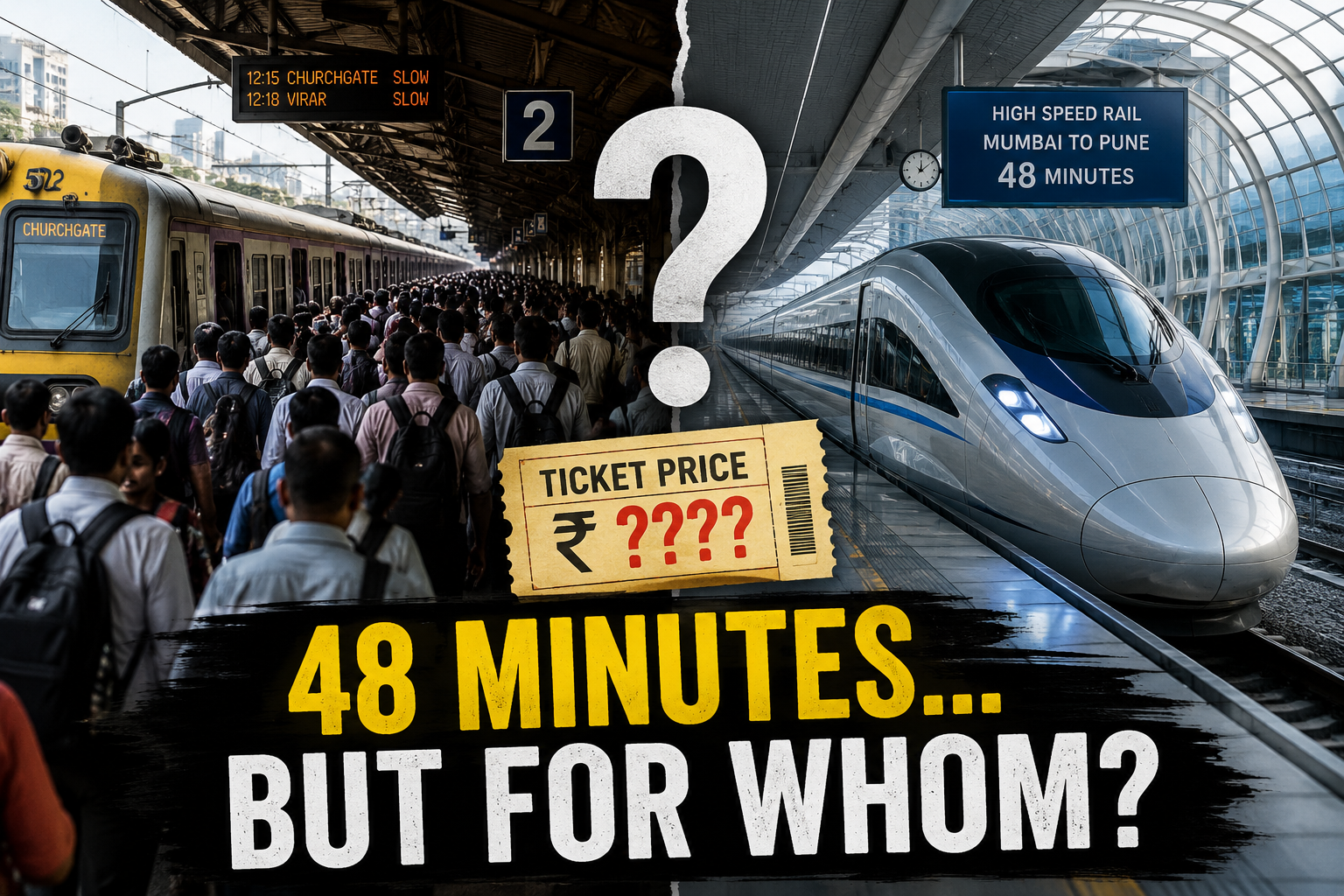
The idea sounds almost futuristic. Leave Mumbai in the morning and arrive in Pune in less than an hour. According to Railway Minister Ashwini Vaishnaw, the proposed Mumbai-Pune high-speed rail corridor could cut travel time between the two cities to just 48 minutes. The announcement has generated excitement, particularly among frequent travellers who know all too well the long hours often spent on roads and railways connecting Maharashtra’s two largest urban centres.
Faster travel is easy to celebrate. Yet beyond the promise of speed lies a more important question. If the project eventually becomes a reality, who will actually use it?
That question matters because transport projects are not judged only by engineering achievements. Their success ultimately depends on whether they improve everyday life for the people they are meant to serve.
Mumbai and Pune share one of India’s busiest travel corridors. Business executives travel between the cities for meetings. Students move between educational institutions and their homes. Patients visit hospitals. Families travel for social occasions. Thousands of people rely on this connection every day, making it one of the most important economic and social links in western India.
A journey of 48 minutes would undoubtedly transform travel expectations. It could make same-day business trips easier and reduce the burden of long commutes. It could also strengthen economic ties between the two cities, allowing people and businesses to operate more seamlessly across the region.
However, travel time is only one part of the equation.
For most passengers, the real measure of convenience is not how fast a train moves between stations but how long it takes to complete the entire journey from door to door. A traveller must still reach the departure station, board the train, and travel onwards after arrival. If these stages remain time-consuming, some of the advantages of high-speed travel may be reduced.
This is why station locations will be crucial whenever detailed plans emerge. Well-connected stations linked to local transport networks can significantly improve passenger experience. Poor connectivity, on the other hand, can make even the fastest train feel less convenient than expected.
Another major question concerns affordability.
At present, no official ticket pricing has been announced for the proposed corridor. Until fares become clear, it is difficult to predict how different groups of travellers will respond.
If ticket prices are positioned at a premium level, the service may appeal primarily to business travellers, corporate professionals and passengers willing to pay more in exchange for saving time. If fares are more accessible, the corridor could attract a broader range of commuters and become part of everyday travel for many people.
This distinction is important because the vision of high-speed rail often extends beyond tourism or occasional travel. Supporters of such projects frequently argue that they can reshape how people live and work. A significantly shorter journey could make it easier for someone to live in one city and work in another. It could influence housing choices, employment opportunities and even business investment patterns.
Yet these benefits depend on more than speed alone. Regular commuters make decisions based on cost, reliability and convenience. A service that is fast but expensive may attract a different audience from one that is designed for mass use.
The discussion surrounding the Mumbai-Pune corridor also reflects a broader debate about India’s transport future. As cities grow and economic activity expands, the demand for faster and more efficient connectivity continues to rise. Policymakers face the challenge of balancing ambition with accessibility. Infrastructure projects must not only showcase technological progress but also address the practical needs of ordinary citizens.
India’s railway network has long been recognised as a lifeline that connects people across regions, income groups and communities. Any future high-speed service will inevitably be measured against that tradition of accessibility. Travellers will want to know whether the benefits extend beyond a limited section of society and reach those who depend on public transport most.
For now, many details about the Mumbai-Pune high-speed rail proposal remain to be announced. Questions about fares, station locations, service frequency and operational timelines are still unanswered. Those details will ultimately shape public perception far more than headline travel times.
There is no doubt that a 48-minute journey between Mumbai and Pune captures the imagination. It represents a vision of a faster and more connected India. But the real test of the project will not be whether the train can cover the distance in under an hour. The real test will be whether the average traveller can realistically afford, access and benefit from it.
Until those answers emerge, the most interesting story is not how fast the train might run. It is who gets to ride it.
Subscribe Deshwale on YouTube


