









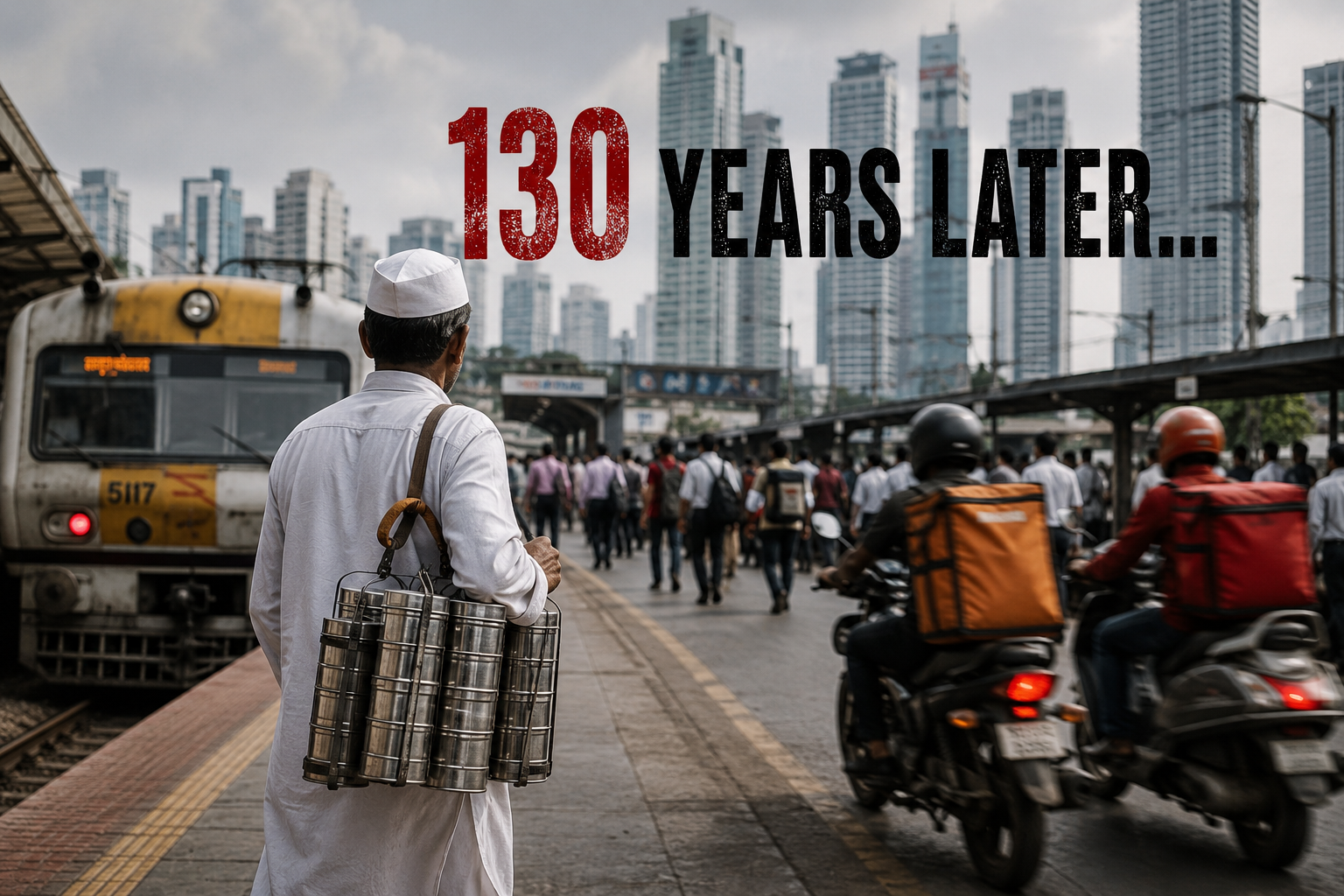
Every weekday morning, long before the city’s traffic thickens into its usual chaos, a group of men in white kurtas and Gandhi caps are already on the move. They wheel their bicycles onto Mumbai’s suburban railway platforms, stacking steel tiffin boxes high on wooden crates. The trains fill up with commuters and lunchboxes alike, and by the time office workers settle into their chairs, a hot home-cooked meal is already on its way.
These are Mumbai’s dabbawalas and for over 130 years, they have been one of the city’s most quietly remarkable institutions. Today, that institution is fighting for its life.
A system that Harvard studied
The dabbawala network traces its roots to the late 19th century, when Bombay, then under British colonial rule, was transforming into a bustling commercial hub. Office workers flooded the city each morning but had few options for a decent midday meal. Restaurants were scarce, and food was deeply tied to family, culture, and religion. The solution was simple but ingenious: bring the meal from home.
The story goes that a Parsi banker first hired a man to collect his lunch from home each morning and deliver it to his office. The idea spread quickly. By 1890, a man named Mahadeo Bachche had organised the system with around 100 workers. Over the following decades, what began as a small errand service grew into a precision logistics operation that would one day be studied at Harvard Business School as a masterclass in low-cost supply chain management.
At its peak, nearly 4,500 dabbawalas delivered around 50,000 lunchboxes across Mumbai every single day. Each dabba the Marathi word for a metal tiffin box is marked with an alphanumeric code that tells a dabbawala everything he needs to know: where the box came from, which office it belongs to, which floor to go to, and how to get it back. No smartphones. No GPS. Just a system passed down through generations, held together by memory, trust, and an intimate knowledge of Mumbai’s streets and trains.
In 2003, even the then Prince Charles now King Charles spent time with dabbawalas during a visit to Mumbai, marveling at the network’s efficiency. For a long time, the dabbawalas were not just a service. They were a symbol of something Mumbai was proud of: that beneath the noise and the rush, some things worked with quiet, unshakeable precision.
Then the pandemic hit
When COVID-19 forced offices to shut in 2020, the dabbawala’s world collapsed overnight. Workers who had been delivering 20 to 25 lunchboxes a day suddenly found themselves with one or two customers, sometimes none at all. With little in the way of savings or social safety nets, many left the trade entirely. Some never came back.
Balu Bhagu Shinde spent 20 years as a dabbawala. At his best, he was earning around Rs 20,000 a month, enough to run a household of five in one of India’s most expensive cities. By the end of 2020, only two customers remained. He waited for offices to reopen. They did, but his customers didn’t return in the same numbers.
“There are no customers, no money, what should we do?” says Shinde, who is now 41. “We are struggling to survive. I am cutting down on household expenses, but I have three children whose education matters the most. At times I have had to borrow money.”
Eventually, Shinde gave up and became a tuktuk driver. He now earns around Rs 15,000 a month less than what he made delivering lunchboxes, but with few other options available to him.
Hybrid work and the rise of food apps
The pandemic alone did not kill the dabbawala trade but the world it left behind has made recovery almost impossible. Hybrid work models mean that many office-goers now come in only two or three days a week, making a daily dabba subscription impractical. According to Kiran Gavande, secretary of the Mumbai Tiffin Box Suppliers Association, this shift has fundamentally changed the economics of the service.
At the same time, food delivery apps like Swiggy and Zomato have reshaped how Mumbai eats. Where dabbawalas once had little competition offering home-cooked meals for just Rs 2,000 a month they now compete with cloud kitchens churning out restaurant-quality food at low prices, delivered at the tap of a screen. The dabbawala’s greatest asset, the reliability of a home-cooked meal is no longer the only option for a working Mumbaikar.
The numbers tell a stark story. The number of registered dabbawalas has fallen from around 4,500 in 2018 to roughly 1,500 today, according to the association.
Fifteen hours a day, hundred kilometres a day
For those who have stayed, survival means working far beyond what the trade was ever designed to demand. Mauli Bachche, 40, has been a dabbawala for two decades. His day starts at 7am. By 10:30am, he had collected lunchboxes from homes across his neighbourhood and loaded them onto trains. By early afternoon, the deliveries are done. Then the return cycle begins.
But Bachche didn’t go home after that. He heads straight to a second job collecting daily savings deposits from shopkeepers for a small finance company. By the time he reaches home, it is 10pm. He has worked for 15 hours and covered more than 100 kilometres across the city.
“Before Covid, I used to deliver 25 dabbas. Some of those people are now working from home, some have lost their jobs, only 15 customers remain,” he says. “Income from dabbawala work is very low. Everyone is doing more than one job.”
His daughter is in her final year of school. His son is in Grade 10 and dreams of becoming a cricketer. Like many dabbawalas still in the trade, Bachche is not working for himself anymore he is working for what comes next.
A tradition without a future?
The older generation of dabbawalas carries a different kind of worry. Baban Kadam has spent 35 years in the trade. He has seen the network at its most powerful and is now watching it slowly hollow out.
“In our time, we managed to survive,” Kadam says. “But with today’s cost of living, the younger generation will not come into this work. Everyone wants a better-paying job or business.”
Ramdas Baban Karvande, president of the Mumbai Tiffin Box Suppliers Association, acknowledges that the network no longer covers all parts of the city as it once did. The association is exploring shift-based work arrangements so dabbawalas can hold part-time jobs alongside their morning deliveries a practical solution, but also an admission that the traditional model alone can no longer sustain a family.
“We are continuing for now,” Karvande says quietly. “But we cannot say what will happen in the future.”
Each morning, Mumbai’s trains still carry men with stacks of steel lunchboxes, weaving through crowded platforms with the ease of people who have done it a thousand times. The precision is still there. The dedication is still there. But the city that once made them famous has moved on to the next thing and the dabbawalas, for the first time in 130 years, are being left to figure out whether there is still a place for them in it.
Subscribe Deshwale on YouTube


