



From AIIMS Ward to UPSC Rank One: Anuj Agnihotri and the Anatomy of India’s Toughest Exam
On some nights during his internship at AIIMS Jodhpur, Anuj Agnihotri would finish stitching a patient’s wound, wash his hands, and return to a different kind of case file. That was, ‘The Indian Constitution’. In the quiet hours after emergency rounds, between ward calls and exhaustion, he revised polity, economy, and ethics. The scalpel and the syllabus shared his time.
Three years later, on Friday, 6 March, the Union Public Service Commission (UPSC) announced the Civil Services Examination results. Agnihotri, 26, from Rawatbhata near Kota in Rajasthan, stood first in the country. The moment capped a journey that moved from medical wards to India’s most competitive recruitment system. Agnihotri completed his MBBS at AIIMS Jodhpur in 2023, finished his internship, briefly joined the Delhi, Andaman and Nicobar Islands Civil Service (DANICS) on probation, and cleared the exam in his third attempt.
Second rank went to Rajeshwari Suve M, an engineering graduate. Her preparation followed a different route but demanded the same discipline. Their stories underline a central truth about the Civil Services Examination: talent matters, but endurance matters more.
Let us know in detail about one of India’s most competitive as well as rewarding exams.
The Civil Services Examination remains India’s most demanding gateway to public service. Each year, more than 10 lakh candidates submit applications. Only a fraction actually appear for the first stage, and fewer still survive the successive rounds.
The exam works like a narrowing pyramid. In recent cycles, roughly five to six lakh candidates have appeared for the preliminary examination. Around 14,000 qualify for the written Mains. Approximately 2,800 reach the interview stage. In the end, fewer than 1,000 receive recommendations for appointment across the Indian Administrative Service (IAS), Indian Police Service (IPS), Indian Foreign Service (IFS) and allied services.
The numbers are stark. The success rate hovers around 0.1–0.2%. What the exam filters, however, is not merely information. It tests judgement, balance, clarity of thought, and the ability to think under pressure about problems that rarely have neat answers.
The Preliminary Examination acts as the exam’s first sieve. Conducted on a single day, it consists of two objective papers totalling 400 marks.
General Studies Paper I, the decisive paper, contains 100 questions drawn from history, geography, polity, economy, environment, science and current affairs. Each carries two marks, with a one-third negative marking for incorrect answers.
The second paper, CSAT, tests comprehension, reasoning and basic numeracy. It is qualifying in nature, requiring a minimum score of 33 percent.
Although the official cut-off varies each year, the general category threshold for GS Paper I usually falls in the 90-100 range out of 200.
For many aspirants, this stage proves decisive. Months, sometimes years, of preparation can end on the strength of a few marks. Those who clear Prelims enter the written Mains examination, widely considered the real test.
Nine descriptive papers stretch across several days of writing. Seven of these count toward the final merit list, carrying a combined weight of 1,750 marks.
Two papers, English and one Indian language, are qualifying, ensuring that candidates possess basic linguistic competence. The remaining papers examine a candidate’s intellectual breadth.
The Essay paper evaluates clarity of argument and depth of reflection. Four General Studies papers explore different dimensions of governance:
• GS I: Indian heritage, history, geography and society
• GS II: governance, polity, international relations
• GS III: economy, science, environment, security
• GS IV: ethics, integrity and aptitude
Candidates also write two papers in an optional subject of their choice, anything from anthropology to zoology. For Agnihotri, that subject was medical science. Years spent understanding human anatomy now helped him analyse policy, ethics and public health.
Mains answers are judged not by length but by structure and clarity. Successful candidates present balanced arguments, support them with examples, and demonstrate the ability to weigh competing priorities – a skill administrators must exercise daily.
The final stage is the Personality Test, commonly known as the interview. For about 20-30 minutes, a panel of senior administrators and experts probes a candidate’s thinking. Questions rarely test memory. Instead they explore judgement.
A candidate may be asked to evaluate a policy dilemma, interpret a news event, or respond to a hypothetical administrative crisis. For someone with a medical background, the transition is not as dramatic as it appears. Clinical decisions require similar qualities: calm analysis, empathy, and the ability to act when information is incomplete.
Behind every rank lies a routine that few people see. Agnihotri reportedly studied eight to nine hours a day during preparation. His schedule was simple: early mornings, long reading blocks, regular answer writing practice. The foundation came from NCERT textbooks and standard reference works, while newspapers and government reports supplied contemporary context.
Many aspirants join coaching institutes for structure, but the exam ultimately rewards self-discipline. Thousands prepare independently each year, building their own reading plans and writing practice.
Optional subjects often become strategic decisions. Disciplines such as medical science, anthropology and public administration have gained popularity because they allow candidates to apply structured academic training.
But every topper eventually reaches the same conclusion: consistency outweighs brilliance.
A Test of Endurance
The Civil Services Examination is as much a test of patience as intellect.
Recent selection numbers have remained broadly stable. Around 761 candidates were recommended in 2021, 933 in 2022, and roughly similar numbers in subsequent cycles as vacancies fluctuated between 800 and 1,100.
The competition remains intense. Yet the profile of successful candidates continues to diversify engineers, doctors, humanities graduates, working professionals and first-generation learners.
Women’s representation has also grown steadily, with candidates like Rajeshwari Suve M securing top ranks in recent years.
Beyond the Rank
For Agnihotri, the journey from a small Rajasthan town to the top of the civil services list reflects more than personal ambition.
Medicine offered certainty a defined profession, clear responsibilities. Administration offers something different: the chance to influence systems that affect millions.
That transition is not uncommon among UPSC aspirants. Many professionals leave stable careers because the civil services promise a wider canvas.
Yet the exam rarely rewards impulse. It favours those who treat preparation not as a gamble but as a long discipline.
The Long Road Up
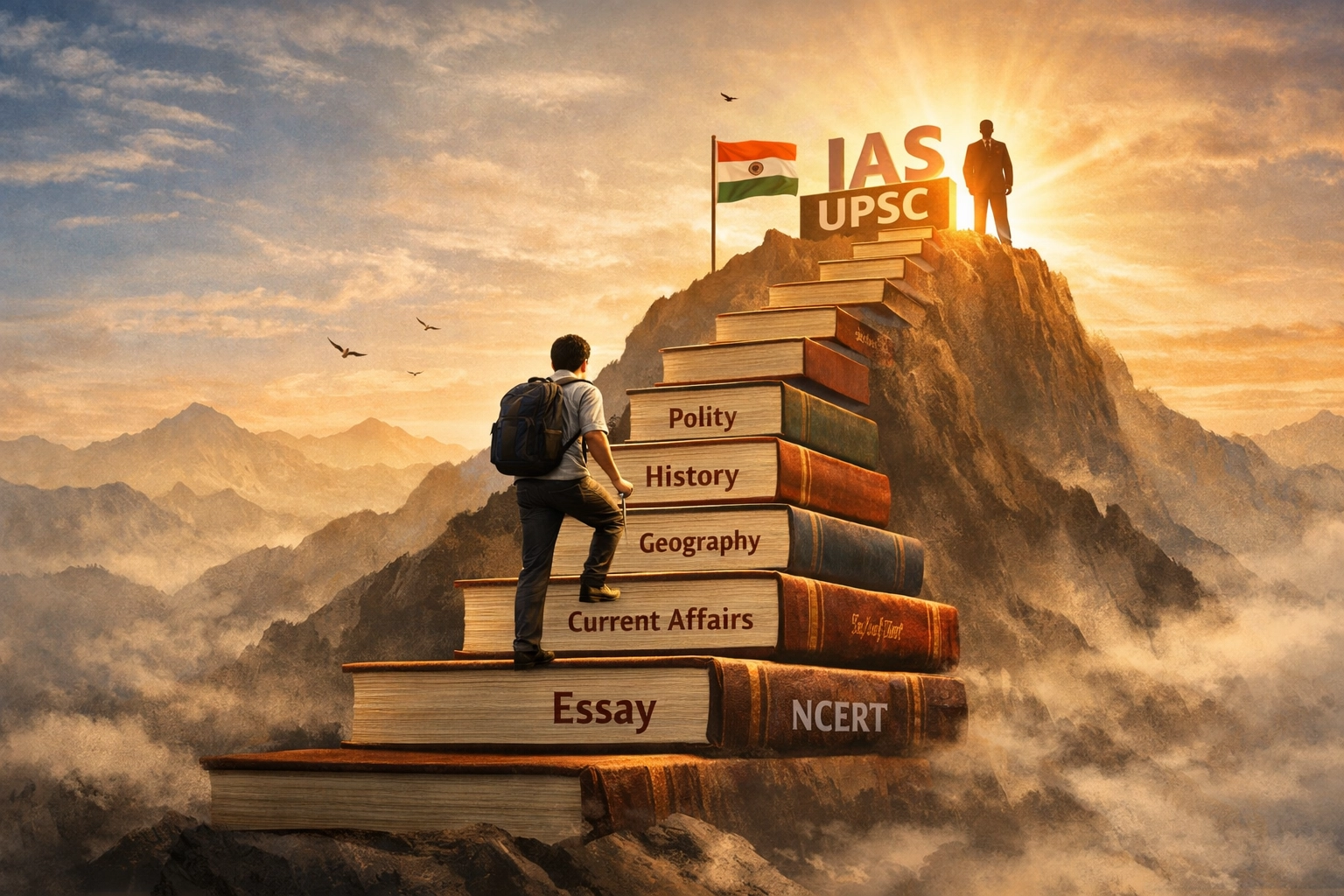
The Civil Services Examination has often been described as a mountain. The metaphor is fitting.
The summit is visible to millions. Only a few reach it.
But the stories that emerge from that climb, doctors revising policy notes between hospital rounds, engineers solving governance puzzles, students studying under dim hostel lamps reveal something larger than competition.
They show that public service in India still attracts those willing to trade comfort for responsibility.
When Anuj Agnihotri first walked into the wards of AIIMS Jodhpur, he trained to heal individual patients.
Today, standing at the top of the civil services list, he prepares for a different responsibility helping administer a country of more than a billion people.
The scalpel has been set aside.
The work of governance begins.
Subscribe Deshwale on YouTube
