











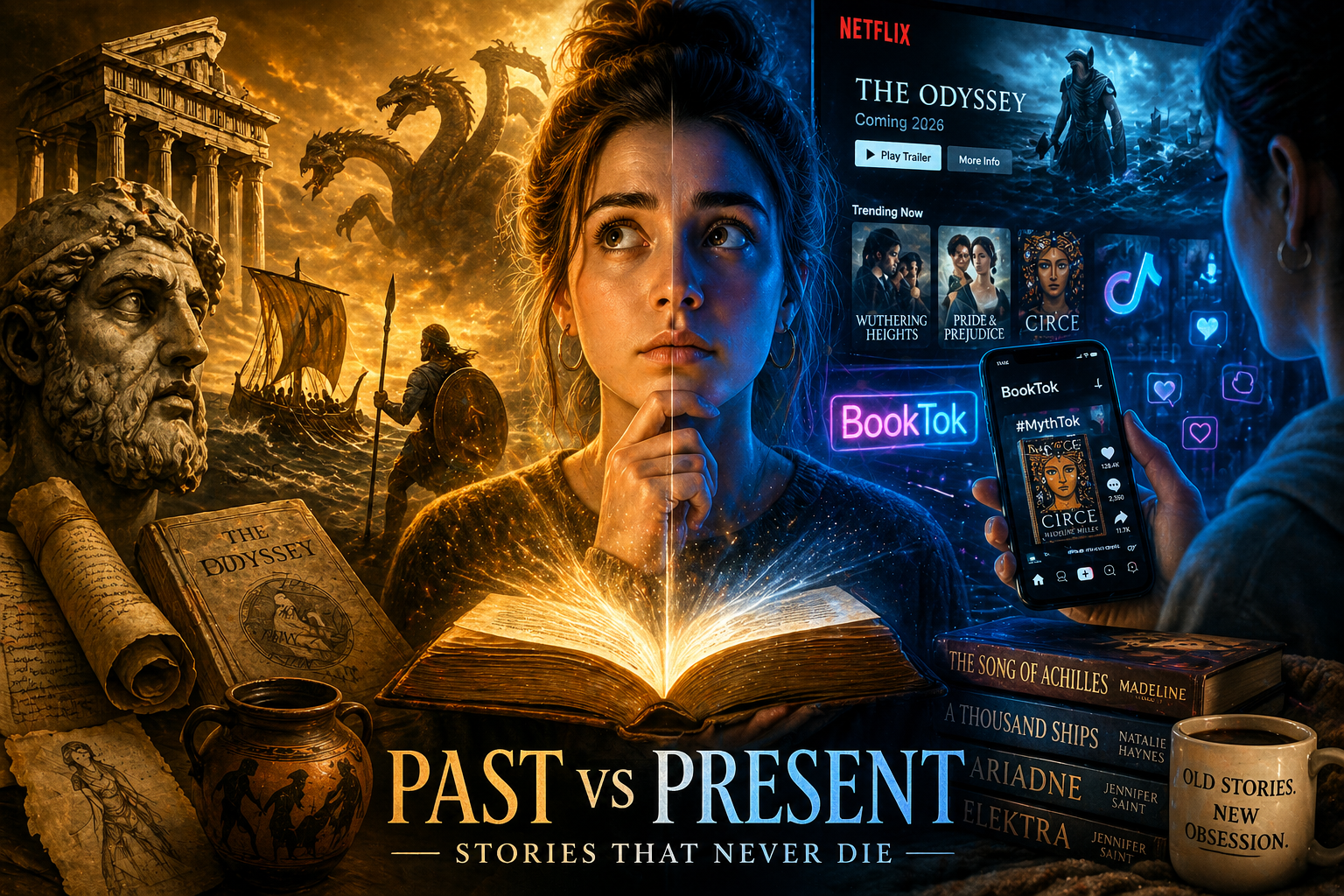
Walk into any bookshop right now and something will strike you immediately. The shelves are not full of stories about the future. They are full of stories about the very distant past.
Gods and monsters. Tragic heroes. Doomed love on the Yorkshire moors. Epic journeys across cursed seas. Stories that were first told hundreds in some cases, thousands of years ago are suddenly, urgently, everywhere.
This is not a coincidence. And it is not simply a publishing trend. Something deeper is happening, and it is worth understanding.
What is actually going on?
The evidence of this cultural moment is all around us, and it is striking in its scale.
On February 13, 2026 Valentine’s Day weekend director Emerald Fennell released her bold new adaptation of Emily Brontë’s Wuthering Heights, starring Margot Robbie and Jacob Elordi. The film, now streaming on HBO Max, is only the latest in a long line of adaptations of a novel first published in 1847. But the appetite for it was extraordinary; the film’s teaser trailer, released in September 2025, became the most viewed film trailer of that year, racking up 181.5 million views.
That is not a niche audience. That is a cultural moment.
And it is not alone. Christopher Nolan, the director behind Oppenheimer, Inception, and The Dark Knight is bringing Homer’s The Odyssey to cinemas on July 17, 2026. The film, which stars Matt Damon as Odysseus, alongside Tom Holland, Anne Hathaway, Zendaya, Robert Pattinson, and Charlize Theron, carries a budget of $250 million, making it the most expensive film of Nolan’s career. It was also the first film in history to be shot entirely on IMAX 70mm cameras. Its official trailer, released in December 2025, accumulated 121 million global views within its first 24 hours.
Meanwhile, a new adaptation of Jane Austen’s Sense & Sensibility opens in cinemas in September 2026, and a six-part Pride & Prejudice series is heading to Netflix later this year. On the literary side, bookshop shelves are lined with myth retellings: Madeline Miller’s Circe and The Song of Achilles, Natalie Haynes’ A Thousand Ships and Stone Blind, Jennifer Saint’s Ariadne and Elektra. The TikTok community known as BookTok has driven enormous sales for these books, with users sharing passages from the Iliad rewritten as feminist manifestos and building passionate communities around stories that originated before the printing press existed.
The question is: why now?
This has happened before and It tells us something
To understand what is happening in 2026, it helps to step back about 600 years.
In the 15th century, Europe was in the grip of political turmoil, religious upheaval, and rapid and deeply unsettling change. Scholars and thinkers of the Renaissance responded by turning back to ancient Greece and Rome. They called it imitatio creative imitation of classical forms. Their goal was not to replicate the ancient world, but to use it as a mirror for their own. Erasmus and Petrarch did not cling to old stories because they were afraid of the new world. They returned to them because those stories held something the new world had not yet figured out: a language for the complexity of human experience.
We are doing the same thing now.
Scholars at Oxford University’s Cherwell publication made this connection in a widely cited essay in 2025. Our current obsession with myth retellings, they argued, is not escapism. It is “a confrontation with modernity.” Through ancient stories, we are trying to understand our own chaotic present using the past to define, and in some sense, survive the now.
The psychology of why old stories never die
There is a more fundamental explanation for why ancient myths hold such enduring power, and it comes from psychology rather than publishing trends.
The Swiss psychiatrist Carl Jung spent much of his life studying myths from cultures around the world. His conclusion, after decades of research, was that myths are not simply old stories, they are expressions of what he called the collective unconscious: patterns of thought, feeling, and experience that are buried deep in the human mind and shared across all cultures and all eras.
Jung called these patterns archetypes of recurring symbolic figures and situations that appear in myths, dreams, and stories everywhere, from Ancient Greece to medieval Japan to modern Hollywood. The wise mentor. The trickster. The hero on an impossible journey. The woman was punished for a power she did not ask for. These figures show up in Homer’s Odyssey, in Norse mythology, in Shakespeare’s plays, and in the latest Netflix series because they represent something real and universal about being human.
Jung believed these archetypes persist because they represent essential aspects of human experience wisdom, chaos, heroism, and transformation allowing myths to remain psychologically relevant across time.
This is why Odysseus’s journey home after a decade of war feels as emotionally real to a cinema audience in 2026 as it did to an Ancient Greek listener 2,700 years ago. The specific details change. The emotional core, the longing to return to something you love, the obstacles that keep getting in the way, the question of whether you will recognise who you once were when you finally arrive never does.
The hero’s journey: The story structure that never fails
In 1949, the American writer and mythologist Joseph Campbell published a book called The Hero with a Thousand Faces. In it, he argued that beneath all the world’s myths regardless of culture, era, or geography there is a single underlying story structure. He called it the Hero’s Journey.
The structure is simple: a hero leaves home, faces a series of trials that push them to their limits, and returns transformed. That is it. That is the skeleton of The Odyssey, of the Mahabharata, of Norse mythology. It is also the skeleton of Star Wars, Harry Potter, and The Lord of the Rings.
Odysseus in The Odyssey embarks on a long and dangerous journey, overcoming trials before returning to Ithaca as a changed man, the same structure that appears in stories like Star Wars, where Luke Skywalker is called to adventure, faces trials, and grows into a hero. The reason these stories continue to resonate is that they mirror the universal human experience: every challenge we face in life follows a similar structure of struggle, growth, and transformation.
This is also why we keep coming back to stories like Wuthering Heights, even though it has already been adapted for the screen at least 21 times. The story’s emotional architecture, love that destroys, class that divides, passion that turns poisonous is not specific to Victorian England. It is a story about what it costs to want something too much. That story does not expire.
How social media changed everything
Something new has happened in this particular revival, and it is worth paying attention to: for the first time in history, ancient myths are going viral.
BookTok, the book-loving corner of TikTok, has been a major driver of the mythology boom. Users who may never have encountered Madeline Miller’s novels in a traditional bookshop discovered Circe or The Song of Achilles through short videos, aesthetic reading vlogs, and emotional reaction clips. The popularity of Madeline Miller, both as a bestseller and then a BookTok sensation, has been a motivating factor for the resurgence of love for Ancient Greek myth and the rise of feminist retellings.
What BookTok has done and this is remarkable is made ancient literature feel participatory. Readers are not just consuming these stories passively. They are arguing about them, writing modern versions, creating fan art, filming themselves reading in candlelight. They are treating 2,700-year-old stories with the same intensity that previous generations reserved for pop music or sports. From BookTok to aesthetic Bookstagram photos, reading has taken on an exciting new fandom. Limited edition books with artistic covers have made collecting a hobby akin to shoes or bags.
This matters because it means the mythology revival is not being driven by nostalgia among older readers who studied these texts in school. It is being driven by young people who came to them fresh and found, to their surprise, that they were gripping.
Why these stories speak to right now
Here is the part that is easy to miss if you focus only on the publishing numbers and the box office projections.
We are living through a period of unusual uncertainty. Geopolitical instability, rapid technological change, economic anxiety, a lingering sense that the world is moving faster than our ability to make sense of it — these are the defining feelings of the mid-2020s. And historically, this is precisely the kind of moment when people turn to ancient stories.
Jung and his followers recognise that myths are valuable for their explanatory, restorative, transformational, compensatory, therapeutic, and personal potential. Jung saw the vital importance of myths in their ability to explain “to the bewildered human being what was going on in his unconscious mind and why he was held fast.”
In simpler terms: ancient myths are full of people dealing with forces beyond their control. Gods who cannot be reasoned with. Fates that cannot be escaped. Journeys with no guaranteed ending. And yet the heroes of these stories Odysseus, Circe, Heathcliff, Elizabeth Bennet find ways to keep going anyway. In an age of information overload, when everything feels urgent and nothing feels resolved, there is something steady about that.
The stories also offer something the modern media diet rarely provides: moral weight without easy answers. Odysseus is not a clean hero. He lies, he cheats, he loses his entire crew. Heathcliff is not a romantic ideal; he is a man warped by injustice into something destructive. Circe is not just a villain, she is a woman given power she did not ask for and punished for existing. These stories do not tell us how to feel. They show us the full, complicated texture of being human, and leave us to work out what to make of it. In a world of hot takes and five-second videos, that feels radical.
The writers doing it best right now
Not all myth retellings are created equal, and the ones that have broken through are the ones that do something genuinely new with old material rather than simply retelling the familiar story with updated language.
Madeline Miller’s Circe published in 2018 but enjoying a new wave of readers in 2025 and 2026 took a character who appears in The Odyssey as a minor antagonist and rebuilt the entire story from her perspective. The shelves are lined with new voices reanimating old gods Madeline Miller’s Circe and The Song of Achilles, Natalie Haynes’ A Thousand Ships and Stone Blind, Jennifer Saint’s Ariadne and Elektra. What these writers share is a commitment to asking the question the original myths never bothered to ask: what did this feel like for the person who wasn’t the hero?
Emerald Fennell’s approach to Wuthering Heights is similarly radical. Rather than reverently recreating Brontë’s gothic world, she described her goal as making something that felt the way she felt when she first read the novel as a teenager “primal, sexual.” Her film is a reinterpretation, not a reproduction. Brontë’s novel has already been adapted 21 times. Fennell knew she was not competing with history. She was having a conversation with it.
Christopher Nolan, meanwhile, has described his Odyssey as a “mythic action epic” and has been deliberately vague about how closely it follows Homer’s poem. What is clear from the production details is the scale of his ambition: 91 shooting days, 60,000 meters of film, real locations in Morocco, Greece, Italy, Scotland, Iceland, and Western Sahara, with practical effects wherever possible. Nolan spent months shooting at sea with his cast on real ships in real waves. He wanted the audience to feel the terror and beauty of an unmapped, uncharted world because that is what it would have felt like.
What this actually tells us about ourselves
There is a temptation to dismiss the classics revival as another aesthetic cycle, like the return of vinyl records or the popularity of cottagecore. But that reading misses what is actually being said.
When millions of people turn to a story that is nearly 3,000 years old and feel that it speaks directly to their lives it is worth pausing and asking why. The answer, when you sit with it, is both humbling and reassuring.
It is humbling because it suggests that the problems we face power and powerlessness, love and loss, and the struggle to find meaning in a world that does not always cooperate are not modern problems. They are human problems. They have always been human problems. The Greeks were writing about them before most of the world’s major religions existed.
And it is reassuring for exactly the same reason. If these stories have survived for 2,700 years copied by hand, translated across dozens of languages, adapted for the stage, the page, and now the IMAX screen they are not surviving because of marketing campaigns or algorithm recommendations. They are surviving because they are true. Not factually true. But true in the way that only the best stories can be: emotionally, psychologically, humanly true.
The world is obsessed with old books and ancient myths right now because the world needs them. It always has. It always will.
Subscribe Deshwale on YouTube


