



AI Generated image
The history of extinct religions becomes even more complicated when we look beyond the famous civilisations. Carthage, the Hittite Empire, ancient Anatolia and the pre-Zoroastrian Iranian world all developed religious traditions that eventually disappeared or were transformed beyond recognition.
Carthage worshipped gods including Baal Hammon and Tanit as part of the wider Phoenician and Punic religious world. The Carthaginian system developed its own characteristics and remained closely connected to the city’s political and social institutions. When Rome destroyed Carthage in 146 BCE, its political foundations were shattered. Some Punic religious practices survived for a time under Roman rule, but the original Carthaginian religious system eventually disappeared. Today, Tanit and Baal Hammon are known primarily through archaeology and inscriptions.
The Hittite Empire created another extraordinary religious world in Anatolia during the second millennium BCE. Its rulers adopted and integrated gods from different Anatolian and Syrian traditions, creating a pantheon so extensive that scholars have sometimes referred to it as a “thousand gods”. When the Hittite political system collapsed around the end of the Bronze Age, its institutions disappeared with it. Even its cuneiform writing tradition was forgotten for centuries before archaeology recovered the evidence.
Anatolia remained a major crossroads of religious change. Hittite, Luwian, Phrygian, Greek and Roman traditions existed there at different periods. The goddess Cybele originated in Anatolia and later became important across the Mediterranean, including in Rome. Yet the original religious world surrounding her was eventually transformed and absorbed into later traditions.
The ancient Iranian world also contained religious traditions that existed before the fully developed Zoroastrian system. Some Indo-Iranian religious concepts shared similarities with early Vedic traditions, while certain gods and rituals disappeared, were reinterpreted or were incorporated into later Zoroastrian theology. This demonstrates another way religions can vanish: their followers may survive, but the religion itself can transform until its original identity is no longer recognisable.
How a religion actually dies
There is no single reason why religions disappear. Political support is one of the most important factors. Ancient religions were often dependent on kings and states that financed temples, supported priests and protected sacred institutions. When a state collapsed, the economic foundations of its religion could collapse with it.
Conquest could accelerate the process. New rulers might destroy temples, suppress priesthoods or introduce another religious system. Conversion could gradually remove the community required to maintain older rituals. Institutional collapse could be equally devastating because religions depend on people who know their prayers, ceremonies, sacred stories and traditions.
Language is another factor that is often overlooked. If sacred rituals depend on a language that eventually dies, religious knowledge can become inaccessible. Migration can weaken communities, while cultural assimilation can gradually merge one religion into another.
Syncretism makes religious extinction especially difficult to define. Two traditions can merge, allowing parts of an older religion to survive inside a newer one. This happened in many parts of the ancient and medieval world. A god might become associated with a saint, a sacred site might become part of a new religion and an old festival might continue after its original meaning has been forgotten.
Religions therefore rarely disappear like governments. A kingdom can fall on a specific date, but a religion usually fades over generations. A temple closes, then another. A priest dies without a successor. Children are raised in a different faith. An old ritual is forgotten. A festival survives but loses its original meaning. Eventually, a god may become a character in literature rather than a deity worshipped by a community.
There is no scientifically defensible number for how many religions humanity has lost. If every local cult and village belief is counted, the number could run into the thousands or far beyond. Among the major extinct or historically transformed traditions are Sumerian religion, Akkadian, Babylonian and Assyrian temple religions, ancient Egyptian religion, Hittite religion, classical Greek and Roman religion, Etruscan religion, Punic religion, Mithraic mystery religion, Manichaeism, ancient Celtic and Germanic religious systems, Norse religion, many pre-Christian Slavic traditions and numerous pre-Islamic Arabian and Iranian traditions.
But these are only the traditions history can see. Countless smaller religions left almost no evidence. A community may once have worshipped a sacred grove, a mountain deity or a rain god. A seasonal ritual may have been performed for centuries before the community migrated, disappeared or converted. No scripture recorded its beliefs, no historian documented its ceremonies and no monument survived. The religion vanished without even leaving its name.
When mythology survives the gods
The strange irony is that many extinct gods are experiencing a cultural afterlife. Young people read about Norse mythology, Greek gods appear in films and novels, Egyptian deities fill museums and video games, and Mesopotamian stories continue to be studied.
But knowing the story of Osiris is not the same as worshipping Osiris. Reading the Epic of Gilgamesh does not mean entering a Mesopotamian temple, just as admiring Greek mythology does not recreate ancient Greek religion.
Myth can survive religion.
The history of extinct religions therefore tells us more than the stories of forgotten gods. It shows how human institutions survive or fail across generations. Egypt’s religion survived for thousands of years before disappearing. Rome’s religious system accompanied one of history’s greatest empires and eventually vanished. Manichaeism crossed continents but disappeared as a major independent faith. Norse religion produced a mythology that remains famous, yet its original religious institutions are gone.
Other ancient traditions survived because they adapted, travelled, maintained strong communities or developed institutions that could function without a particular empire. Zoroastrianism survived despite losing its former political dominance, while Maya and other Indigenous traditions demonstrated remarkable continuity by adapting to enormous historical pressures.
Perhaps that is the greatest lesson of all. Civilisations can leave monuments behind, but monuments do not guarantee the survival of the beliefs that created them. Temples can become ruins, priests can become historical figures, sacred languages can become dead languages and gods can become names in textbooks.
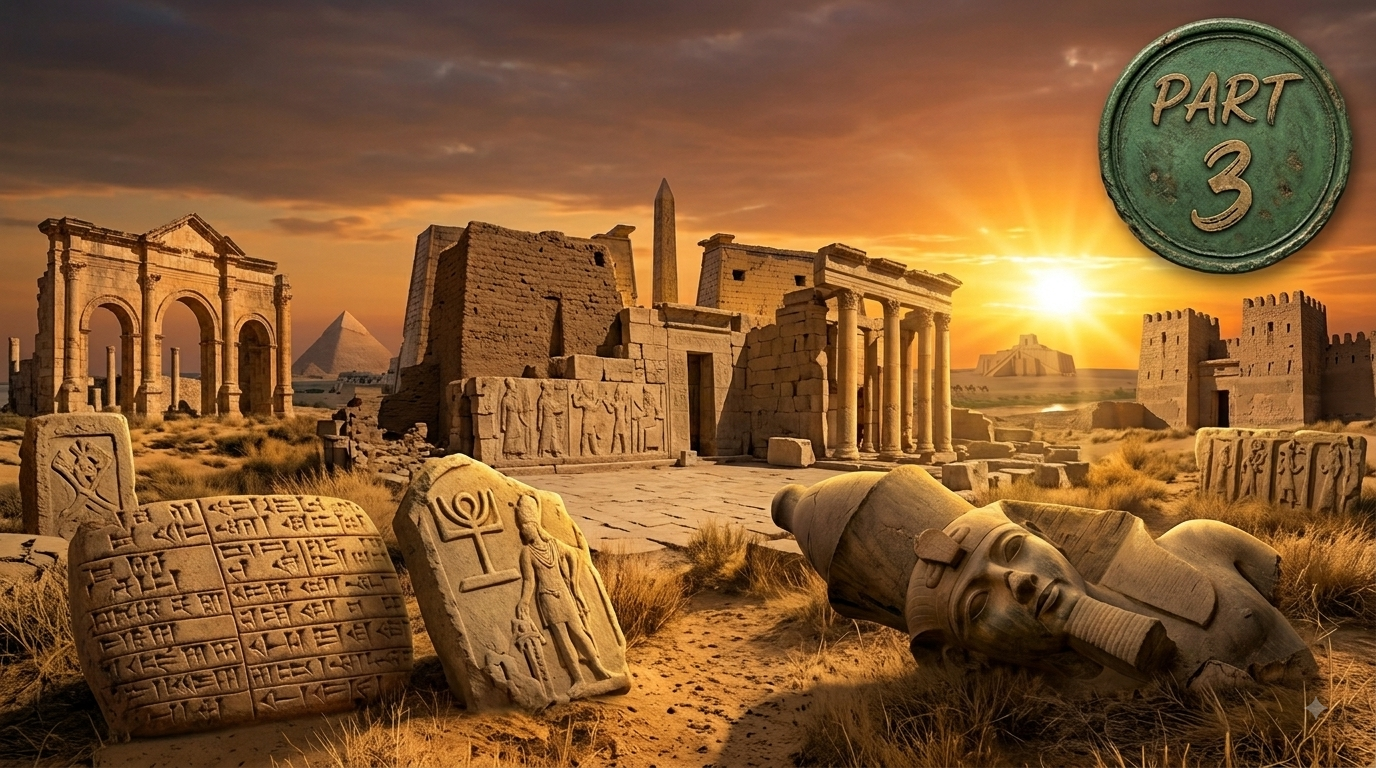
Sometimes the only evidence that millions of people once prayed to those gods is a broken statue, a piece of stone or a line of writing buried beneath the earth.
Civilisations leave monuments behind. Religions leave memories behind. But neither is guaranteed to survive forever.
Subscribe Deshwale on YouTube
