










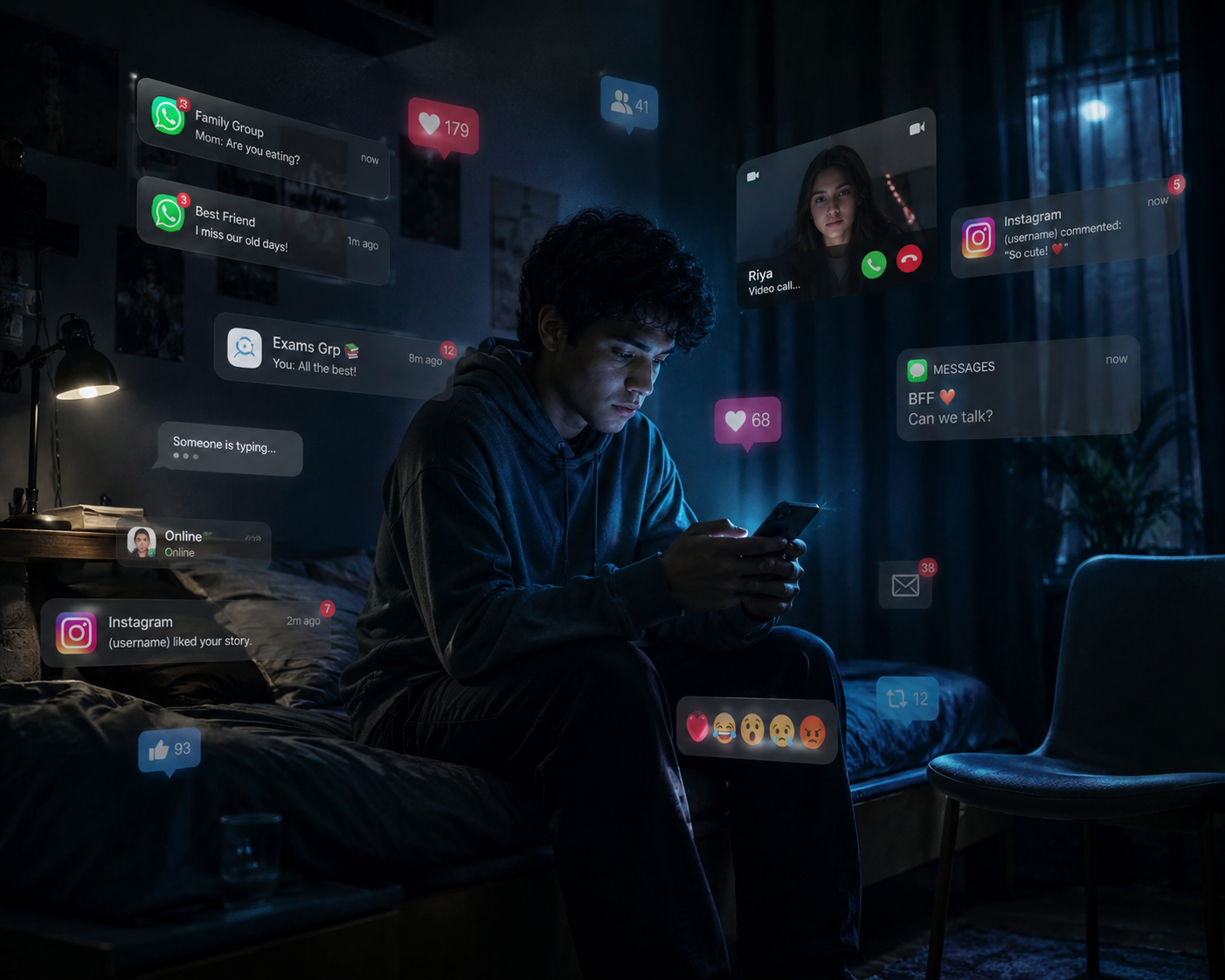
Right now, you can video call someone in Japan, text a friend in London, and get a reply from a stranger in New York all within minutes. We have more ways to reach people than any generation before us. Our phones never leave our hands. Our notifications never stop. And yet, millions of people go to bed every night feeling completely alone.
How is that possible?
This is the great paradox of our time. We are the most connected generation in human history and also one of the loneliest.
The numbers don’t lie
Loneliness is not just a feeling. It is a growing global crisis backed by real data.
A 2023 report by the World Health Organization declared loneliness a serious threat to public health worldwide. In the United States, former Surgeon General Dr. Vivek Murthy called loneliness an epidemic, stating that about half of American adults report feeling measurable levels of loneliness. Studies in the UK found similar results one in four adults reports feeling lonely some or all of the time.
India is not far behind. A joint Meta-Gallup survey found that 57% of Indians feel very, fairly, or somewhat lonely. That is more than every second person around you on the metro, in the office, at a family gathering.
And this is happening at a time when WhatsApp has over 3 billion users, Instagram has over 3 billion active accounts, and the average person spends nearly 7 hours online every single day.
Something is clearly not adding up.
Connection vs. Real connection
Here is the problem. We have confused being connected with actually connecting.
Sending someone a meme is not a conversation. Liking someone’s photo is not checking in on them. Having 800 followers does not mean you have 800 friends. Social media gives us the feeling of being around people without any of the depth that real relationships require.
Think about the last time you had a conversation that went deep where you talked about your fears, your failures, or what you actually want from life. For most people, those conversations are rare. But the number of messages they send in a day? Hundreds.
We are communicating more and saying less.
Why social media makes it worse
Social media was built to connect us. But over time, it has quietly done the opposite.
Every platform is designed to show us the best version of other people’s lives — the holidays, the promotions, the happy couples, the glowing skin. We scroll through these highlights and compare them to our own behind-the-scenes. Our ordinary Tuesday against someone else’s perfect Saturday. And without realising it, we feel worse about ourselves and more distant from others.
Research from the University of Pennsylvania found that reducing social media use to 30 minutes a day led to significant reductions in loneliness and depression. The less time people spent online, the better they felt. That alone tells you something important.
There is also the issue of what screens replace. Every hour spent on a phone is an hour not spent on a walk with a friend, a family dinner without distractions, or a quiet conversation that actually matters.
The modern lifestyle plays a role too
It is not just social media. The way we live today makes deep connection harder.
People move cities for jobs and leave behind their support systems. Nuclear families have replaced joint families. Neighbours no longer know each other’s names. Work from home while convenient has removed the small, everyday human interactions that used to fill our days without us noticing.
We are more independent than ever. But independence, taken too far, can quietly become isolation.
What real connection actually needs
Here is what no app can replace time, presence, and vulnerability.
Real friendships are built through shared experiences, honest conversations, and showing up for each other during difficult times. They require effort. They require putting the phone down. They require asking someone “how are you really doing?” and actually waiting for the answer.
Research by Harvard University, from one of the longest studies on human happiness ever conducted, found that the quality of our relationships, not wealth, not fame, not success is the single biggest predictor of how happy and healthy we are throughout our lives.
Not the number of contacts in our phone. The quality of the people in our lives.
The solution is not to delete every app and disappear from the internet. Technology is not the enemy. How we use it is the problem.
Call someone instead of texting. Make plans and actually show up. Put your phone away during meals. Have one real conversation a week that goes beyond small talk.
We do not need more connections. We need better ones.
In a world that is louder and busier than ever, the most radical thing you can do is slow down, look someone in the eye, and truly be there.
That is where real connection begins.
Subscribe Deshwale on YouTube


