



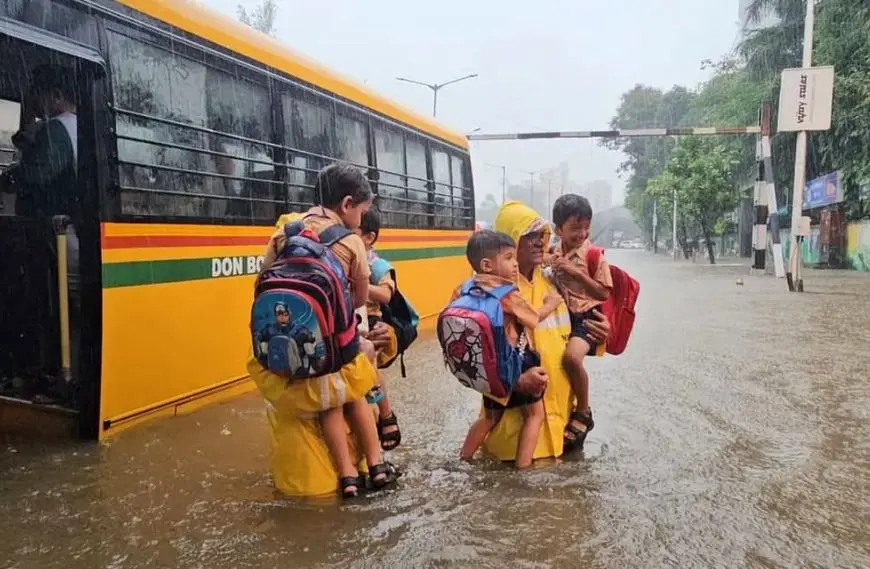
When the skies open up over Mumbai, the city often bends but rarely breaks. Yet Tuesday’s relentless downpour has once again shown how easily Mumbai’s daily rhythm can be thrown off. With government offices shut, private firms told to work from home, and trains and traffic struggling under the weight of the rain, the city is caught in a familiar but frustrating monsoon drama. This time, warnings from the India Meteorological Department (IMD) and the Brihanmumbai Municipal Corporation (BMC) have been loud and clear: stay indoors unless you must head out.
What happened?
The BMC announced on Tuesday morning that all government and semi-government offices, excluding essential services, would remain closed. The decision followed a ‘red alert’ warning from the IMD, which predicted extremely heavy rain across the city and its suburbs. Private companies were urged to allow staff to work from home, with officials stressing that unnecessary travel could be dangerous.
By 8 am, Mumbai’s three main regions had recorded staggering amounts of rainfall: 186 mm in the island city, 208 mm in the eastern suburbs, and 238 mm in the western suburbs. Strong winds added to the chaos, with gusts reaching 55 kmph in some areas. The IMD also warned that high tides—3.75 metres in the morning and 3.14 metres in the evening—could worsen waterlogging.
Why it matters
Mumbai is no stranger to heavy monsoon showers, but the city’s infrastructure still struggles to keep pace with the rain. On Tuesday, commuters faced significant delays as railway tracks in low-lying areas such as Dadar, Matunga, Parel, and Sion saw water collecting rapidly. While railway authorities insisted trains were not stopped, they admitted services were delayed. On the Central line, services between CSMT and Thane were suspended due to flooding, with shuttles running only between Thane, Karjat, Khopoli, and Kasara. The Harbour line was also hit, with services between Chunabhatti and CSMT suspended.
Western Railway suburban services fared slightly better, though trains were running late by 10 to 15 minutes. Officials blamed poor visibility and technical snags in signalling equipment between Ambivali and Shahad stations for the disruptions.
Streets underwater
If rail travel was messy, the city’s roads were not any better. By 10 am, Mumbai Police had issued alerts for waterlogging across more than a dozen locations. Areas such as Gol Deul, Hindmata Junction, Byculla, Shivdi, and Wadala were under up to two feet of water. Malad and Andheri subways had to be closed, forcing traffic onto alternative routes. Commuters faced painfully slow movement on major arteries like the Eastern Express Highway, Mumbai–Gujarat highway, and Eastern Freeway.
At Aarey Road in Dindoshi, a bus breakdown worsened the jam. In several other places, from Gandhi Market in Matunga to Trombay and Antop Hill, vehicles crawled at walking speed because of flooded roads.
The bigger picture
This was not just about a day of inconvenience. For many in Mumbai, the rain meant being stranded away from work, losing daily wages, or spending hours stuck in traffic and trains. While middle-class employees could log in from home, countless street vendors, taxi drivers, and small business owners had little choice but to brave the flooded streets. The BMC’s decision to close offices may have eased pressure on public transport, but it also highlighted how vulnerable the city remains every monsoon.
Despite years of promises about better drainage systems and flood control, waterlogging continues to paralyse the city during heavy showers. High tides compound the issue, pushing backwater into storm drains and leaving large swathes of Mumbai submerged.
The IMD has warned that heavy rain could continue through the night, especially during high tide. Authorities are urging people to stay indoors, avoid flooded areas, and keep updated through official alerts. Rail and road services are expected to improve only if the rainfall intensity reduces.
For now, Mumbai does what it always does—keeps moving, slowly but steadily, in the face of nature’s fury. But the day’s events underline once again that while the city may be resilient, it is also fragile. Each year, the monsoon tests its limits, and each year, the people of Mumbai pay the price.
The downpour that has brought Mumbai to a near standstill is not just another monsoon story. It’s a reminder of how quickly the city’s systems can unravel when nature pushes too hard. Government offices are closed, trains are patchy, traffic is crawling, and yet life continues, because in Mumbai it must. Still, the question lingers—how long can a city of millions continue to depend on resilience alone, without lasting solutions?
Also Read: How Mumbai’s 238 Metro-Style AC Locals Will Change Daily Travel
