



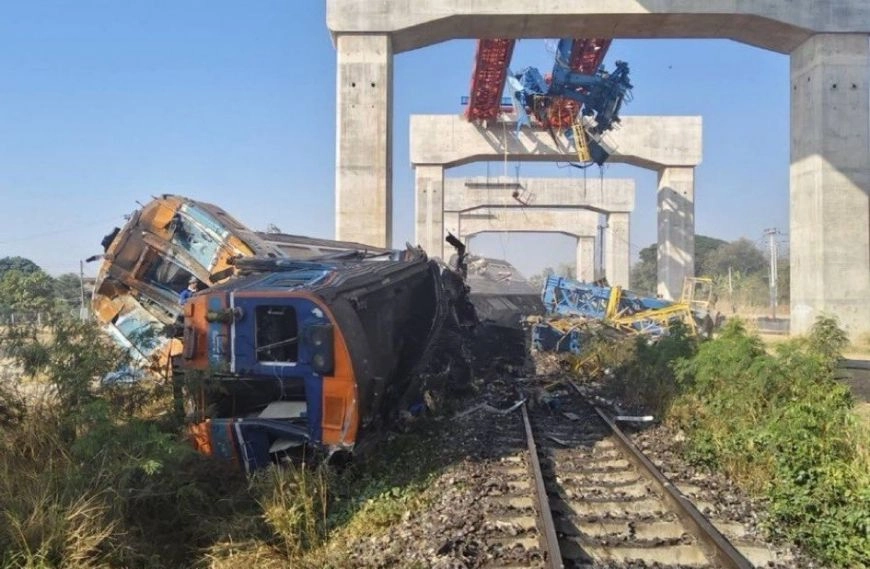
At least 22 people have been killed and several others injured after a construction crane collapsed onto a moving passenger train in northeastern Thailand, triggering one of the country’s deadliest rail accidents in recent years.
The Thailand train disaster unfolded on Wednesday morning in the Sikhio district of Nakhon Ratchasima province, around 230 kilometres northeast of Bangkok. The train was travelling from the capital towards Ubon Ratchathani when the crane fell from an elevated construction site onto the tracks below.
Authorities said the crane was part of an ongoing high speed railway project being built above the existing rail line. As the structure gave way, it struck the train mid journey, forcing several carriages off the rails. A fire broke out immediately after the impact, adding to the scale of destruction before emergency crews brought the blaze under control.
Rescue teams rushed to the scene within minutes, working through twisted metal and smoke filled carriages. Officials confirmed that more than 30 passengers were injured, many of them seriously, and were transported to nearby hospitals for treatment. Search and recovery operations continued for hours as responders checked for anyone trapped inside the wreckage.
Police officials warned that the death toll from the Thailand train disaster could rise as investigations continue and all sections of the derailed train are fully examined. Heavy machinery was deployed to lift debris and stabilise damaged carriages, allowing rescue workers to access hard to reach areas.
Eyewitnesses described hearing a loud crash followed by flames and thick smoke, causing panic among passengers and nearby residents. Several survivors reportedly escaped through shattered windows before emergency services arrived.
The crane was reportedly being used for overhead construction on a major rail expansion project designed to modernise Thailand’s transport infrastructure. The accident has raised urgent questions about construction safety standards, particularly where large scale infrastructure projects operate above active passenger routes.
Transport officials have ordered a temporary suspension of work at the site while a full inquiry is carried out. Investigators will examine whether safety procedures were followed and if any mechanical or human failures contributed to the collapse.
As Thailand mourns the victims, the tragedy has renewed calls for stricter oversight of infrastructure projects to prevent similar disasters in the future.
Subscribe Deshwale on YouTube
