



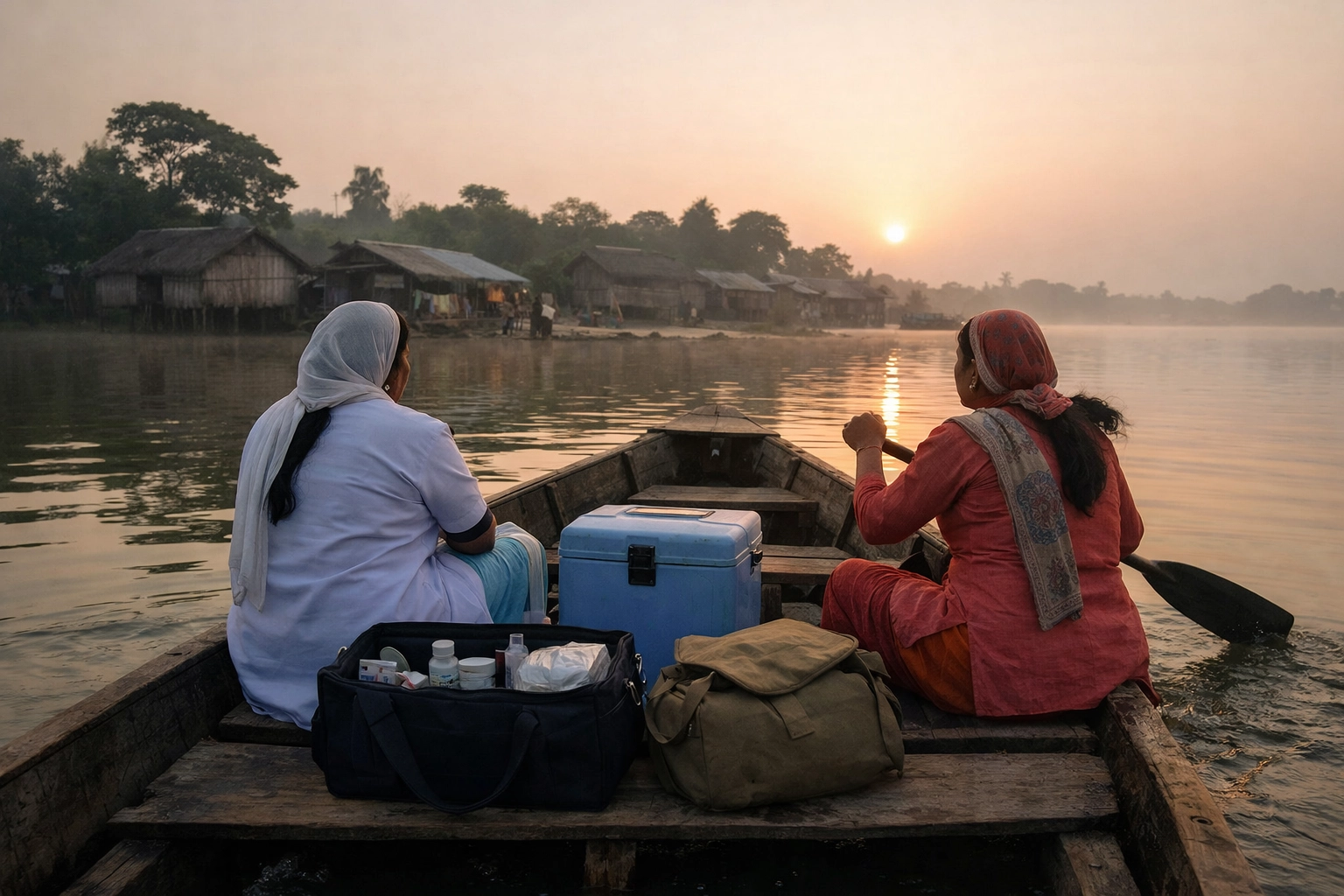
In parts of India where paved roads fade into mud tracks and rivers cut off entire habitations during monsoon months, healthcare cannot wait for perfect infrastructure. Instead, it travels on motorcycles, bicycles, boats and sometimes on foot.
In a flood-prone region, a nurse and a health worker begin their day before sunrise. Medical kits are packed carefully: basic medicines, vaccines in cold boxes, pregnancy testing supplies, blood pressure monitors. Their destination is a cluster of villages accessible only by boat for several months each year. For expectant mothers, elderly patients and young children, their arrival is not routine it is essential.
Elsewhere, in hilly tribal terrain, a young paramedic rides a motorcycle equipped with a first-aid kit and communication device. He responds to calls relayed by community volunteers, providing initial treatment and arranging transport when needed. In emergencies where time is critical, this early intervention can make the difference between recovery and tragedy.
Mobile medical units are becoming a familiar sight in underserved districts. Vans fitted with basic diagnostic equipment travel on fixed schedules, offering check-ups, screening for common diseases and referral support. For many patients, this is the first time a healthcare provider has come close to their homes rather than the other way around.
Community health workers often women from the same villages form the backbone of this system. They track pregnancies, ensure immunisations, educate families about nutrition and hygiene, and act as a bridge between formal healthcare services and local households. Their work is quiet but foundational, reducing preventable illnesses through awareness and early detection.
Technology, too, is playing a growing role. Telemedicine centres in remote areas allow patients to consult doctors in towns and cities via video links, with local staff assisting in examinations. While not a substitute for full hospital care, such services help manage chronic conditions and provide timely advice that would otherwise require costly travel.
These grassroots models share a common principle: healthcare must go where people are, not the other way around. They acknowledge geographic realities and adapt accordingly, using mobility and community engagement to overcome distance.
Challenges remain staffing shortages, funding constraints, difficult terrain. Yet the persistence of these initiatives reflects a broader truth about India’s healthcare landscape: innovation often arises from necessity. When conventional systems struggle to reach the last mile, local solutions step in to bridge the gap.
Behind each mobile clinic or travelling health worker is a network of coordination, training and community trust. Together, they form a lifeline for millions who might otherwise remain beyond the reach of regular medical care.
Their work may not always be visible to the wider world, but in the villages they serve, it is remembered by healthier mothers, vaccinated children and lives quietly saved.
Subscribe Deshwale on YouTube
