



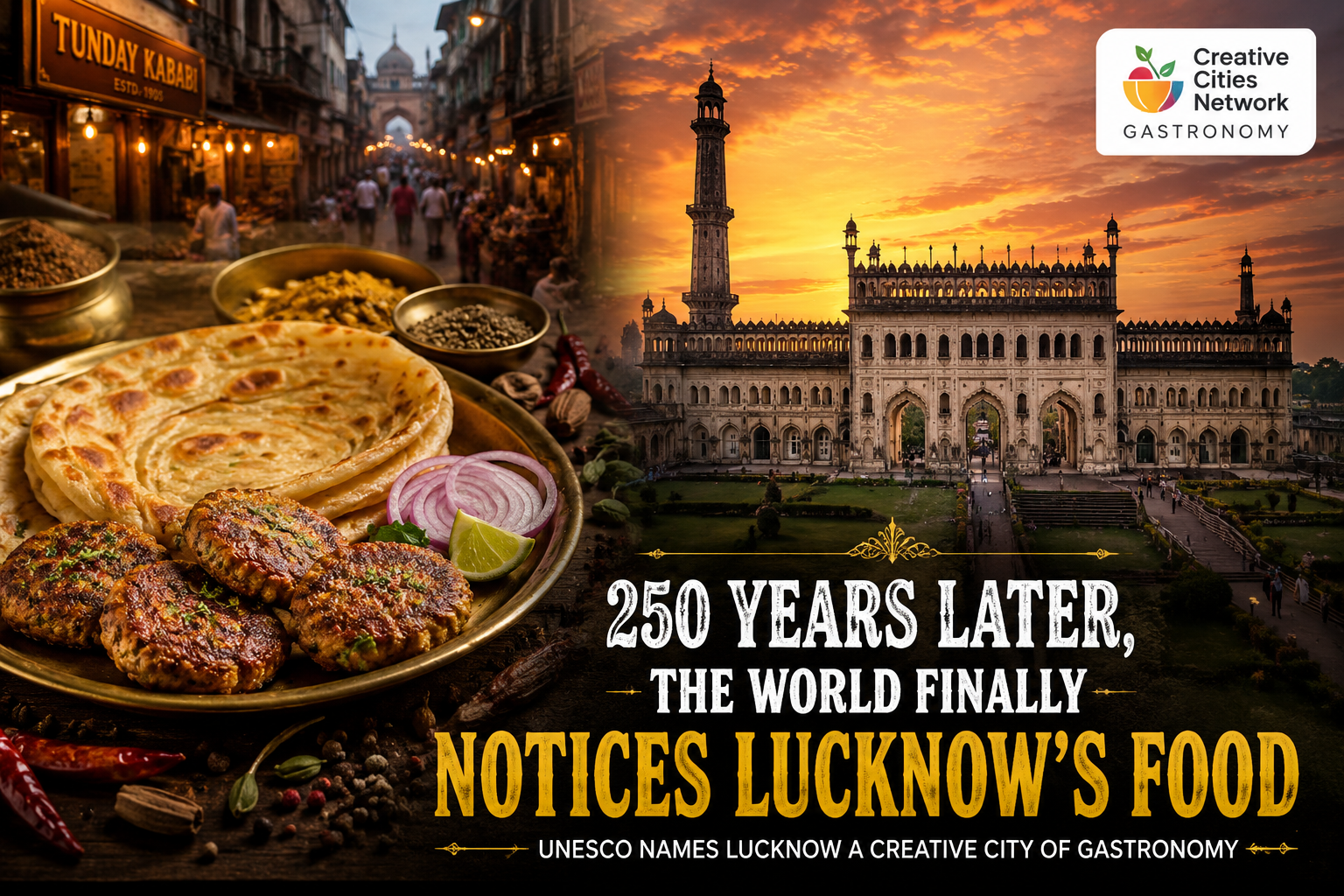
At Tunday Kababi, tucked inside a narrow lane called Phool Wali Gali in old Lucknow, cooks have been shaping and frying the same kebabs every single day for generations.
The galawati kebab arrives soft enough to fall apart with a torn piece of paratha, no knife needed. This has been happening for decades, quietly, without fanfare, while the rest of the world talked about Delhi’s street food and Mumbai’s vada pav.
That changed in October 2025, when UNESCO named Lucknow a Creative City of Gastronomy. It’s only the second Indian city to get this recognition, after Hyderabad in 2019, and it puts Lucknow in a club of over 400 cities across 100-plus countries.
But here’s the real story hiding behind the headline: it took a UN agency to do what India’s own tourism machinery couldn’t manage in 250 years to put Lucknow on the global food map.
A cuisine born in royal kitchens
To understand why this recognition matters, you have to go back to the 18th century. Awadhi cuisine, the food Lucknow is now globally known for, takes its name from Awadh, a region that today falls in Uttar Pradesh.
It was once part of the Mughal Empire, but as Mughal power weakened, Awadh became increasingly independent. In 1775, Nawab Asaf-ud-Daula moved the capital from Faizabad to Lucknow, turning it into the seat of power until the British took over in 1856.
It was inside the royal kitchens of these Nawabs that Awadhi cuisine truly took shape. The cooks borrowed techniques already present in the Mughal court, which itself carried Persian influences, and combined them with local ingredients grown in the fertile plains around the Ganga.
The result was food that felt royal but stayed rooted in the region, slow-cooked, fragrant, and deeply technical.
The biggest myth about Awadhi food
Ask most people outside Lucknow what Awadhi food is like, and they’ll probably say “heavy” or “rich.” Chef Ranveer Brar, restaurateur and a judge on MasterChef India, says that’s exactly the problem.
According to him, the biggest misunderstanding about Awadhi cuisine is that people think it’s heavy, when actually the opposite is true. He describes it as delicate, built on layered spicing rather than loud, aggressive flavours precisely the quality that makes it travel well outside India.
That balance between richness and restraint is part of why Awadhi food never became a global sensation the way, say, Punjabi or South Indian food did. It doesn’t announce itself. You have to sit with it.
More than kebabs and biryani
Most people associate Lucknow with just two things: kebabs and biryani. But that’s only a fraction of what the city offers.
Visitors are often caught off guard by the range of aromas and dishes that go far beyond these two categories, turning a simple meal into something closer to a cultural experience.
Walk through neighbourhoods like Chowk and Aminabad, and you’ll still find cooks using methods that haven’t changed in generations: meat slow-cooked over charcoal, spices hand-ground rather than machine-processed, recipes that exist nowhere in writing because they were never meant to be written down.
The real keepers of Awadhi cuisine: home kitchens
Here’s the part of the story that rarely gets told. While restaurants get all the credit and the Instagram posts, much of Awadhi cuisine has actually survived inside ordinary homes, not commercial kitchens.
Chef Sheeba Iqbal, who runs a home-dining experience called Aab-o-Daana, put it simply: home kitchens were and still are the real heartbeat of Awadhi cuisine.
Women passed recipes down through generations, adjusting and improving them along the way, turning cooking into an act of love while keeping the culture alive without anyone noticing from the outside.
In recent years, a few small, curated dining experiences have started spotlighting this home-cooked side of Lucknow’s food dishes that never made it onto restaurant menus but represent the cuisine at its most authentic.
What UNESCO’s tag actually changes
A UNESCO title doesn’t build restaurants or fund marketing campaigns. What it does is far simpler and, in some ways, more powerful: it forces global food writers, chefs, and travellers to finally pay attention to a city they’d overlooked for centuries.
Lucknow didn’t need to reinvent itself to earn this recognition. It didn’t need a food festival makeover or a viral dish. The city was simply doing what it has always done, cooking food shaped by 250 years of history, passed down through hands that never asked for credit.
Now the world is catching up. The only question is whether Lucknow’s food scene stays true to what UNESCO actually recognised living traditions in ordinary kitchens or whether global attention pulls it toward the kind of polished, restaurant-friendly version that’s easier to sell to tourists but easier to lose.
Subscribe Deshwale on YouTube
