




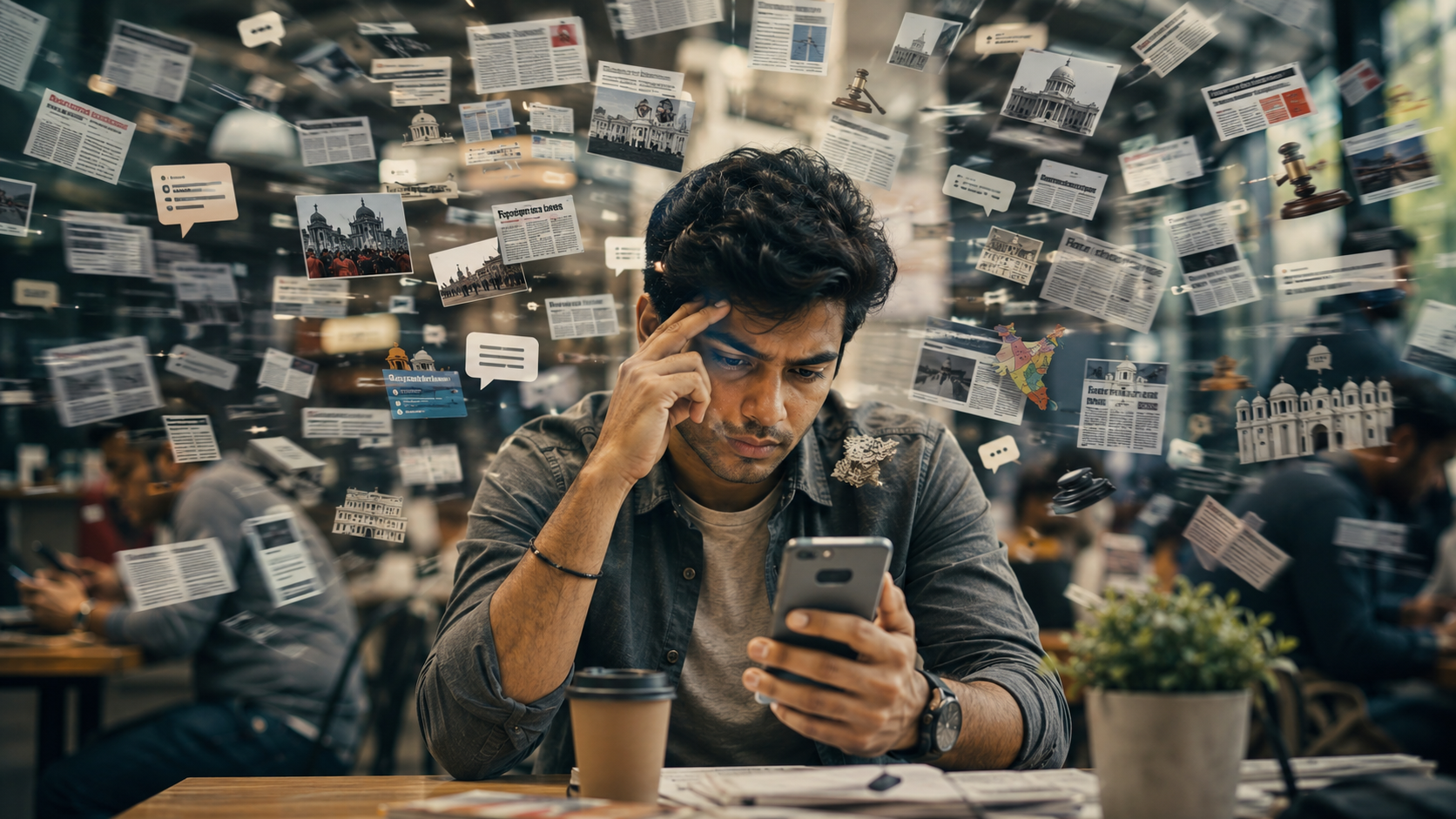
Open your phone right now. Chances are, in the last 24 hours, you scrolled past a headline about a political statement, a court order, a protest, or a policy change. You probably didn’t read the full story. You read the headline, maybe the first line, and moved on.
This is how most Indians now consume news. And recent global data on news habits suggests we should be worried about what that’s doing to our understanding of the country we live in.
Where Indians actually get their news
Around 58% of Indians rely on YouTube for news, while WhatsApp is the second biggest platform at 56%, up 10 points since 2021. Nearly half of Indians, 47%, say they share news through social media, messaging, or email.
In other words, most of us aren’t going to a newsroom’s website and reading a full report. We’re getting news secondhand through a YouTube video, a forwarded WhatsApp message, or a clip someone shared in a family group. The news reaches us. We rarely go looking for it.
We’re consuming more, but trusting less
Here’s the part that should make you pause. Even as news consumption on these platforms rises, trust in news in India has actually fallen by 4 percentage points, now standing at 39%, down from 43% just a year earlier.
This isn’t unique to India. Globally, trust in news has dropped to 37%, the lowest level recorded in over a decade of tracking. And it isn’t that people have stopped caring. The proportion of people who describe themselves as extremely or very interested in the news has fallen by 13 percentage points since 2021, while the share of casual or passive news users has grown from 16% to 25%.
Put simply: more people are seeing news than ever before. Fewer of them are engaging with it seriously.
Why this matters more than it seems
Think about how a story actually reaches you now. A journalist reports something. A creator or influencer picks it up, condenses it into a 60-second video, adds their own spin, and posts it. That video gets forwarded on WhatsApp, stripped of context, sometimes with a misleading caption. By the time it reaches you, three or four rounds of simplification and interpretation have already happened.
You watched something about, say, a Supreme Court order or a new government policy. But did you understand why the order was passed, what it actually changes, or who it affects? Or did you just absorb a feeling outrage, relief, confusion without the substance behind it?
This gap between consumption and comprehension is quietly reshaping how Indians understand their own country. We increasingly know that something happened, without knowing why it happened, what led to it, or what happens next.
Nearly half of us are also just switching off
There’s a second, related problem. 52% of Indians say they sometimes or often avoid the news altogether. This mirrors a global pattern: people find the news exhausting, repetitive, or too negative, so they simply tune out.
This creates two very different groups of citizens. One group is overwhelmed by constant, fragmented news and switches off entirely. The other keeps consuming, but mostly in bite-sized, algorithm-fed clips that prioritise emotion over explanation. Neither group ends up with a clear, working understanding of how India is actually being governed, or why.
It’s not really about how much news you consume
None of this means you should read fewer headlines or stop watching YouTube news. The format isn’t the villain here. The real question is what you do after you see something.
Do you know why a policy was introduced, not just that it exists? Do you know both sides of an argument, or just the version that appeared first on your feed? Can you explain a major news story to someone else in two or three sentences, with the actual reasoning intact?
If the answer is often no, you’re not alone. This is not really a personal failing — it’s a structural one, built into how news now reaches most of us. But recognising it is the first step to fixing it.
What you can actually do about it
Before you share or react to a piece of news, pause for one extra minute. Ask what led to this. Ask what the other side is saying. Ask whether the clip you just watched gave you the full picture or just the loudest ten seconds of it.
Following the news every day feels like being informed. But real understanding takes a little more effort than a scroll and a forward. In a country as complex as India, that extra effort is what separates knowing the headlines from actually understanding the country.
Subscribe Deshwale on YouTube
