



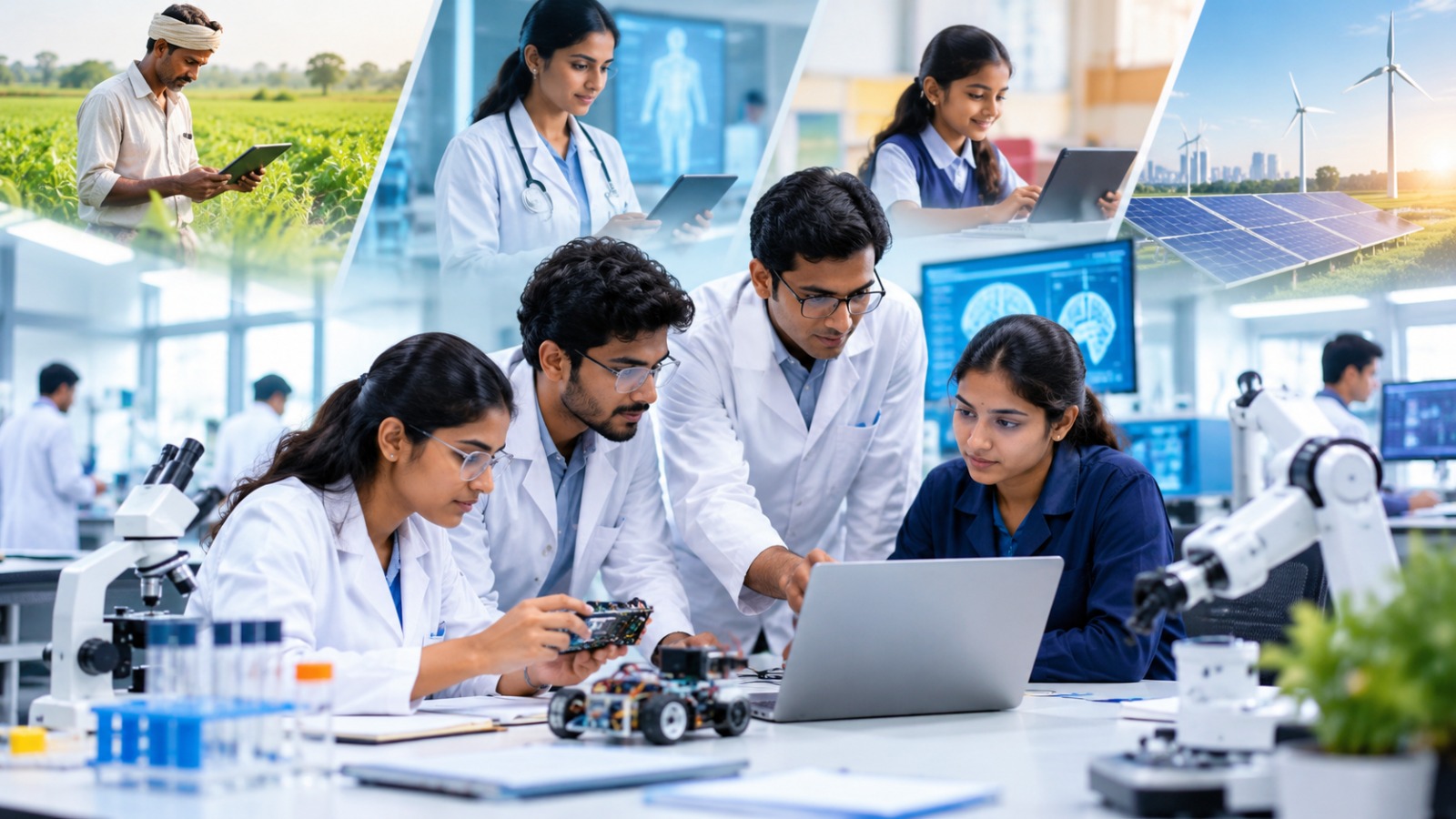
A farmer looking for a better way to protect crops, a doctor seeking more accurate diagnostic tools, or a student hoping to access quality education may seem far removed from a scientific laboratory. Yet, the solutions to many everyday challenges begin with a question asked by a researcher.
Connecting scientific discovery with people’s needs was a central theme of the Emerging Science, Technology and Innovation Conclave (ESTIC) 2026, inaugurated by Prime Minister Narendra Modi at Bharat Mandapam in New Delhi on 27 October.
Addressing researchers, industry leaders, start-up founders and young innovators, the Prime Minister called for measurable goals over the next three years. He encouraged participants to identify the technologies, prototypes, pilot projects or products they intended to develop, emphasising that the conclave should lead to tangible outcomes rather than remain limited to discussions.
His message brings an important question into focus: how can India’s scientific progress become useful in the everyday lives of its people?
When Scientific Ideas Meet Real-World Needs
Scientific research often begins with curiosity. A researcher investigates a problem, tests an idea and examines the results. Turning that discovery into something people can use, however, requires several more steps.
A promising technology may need further testing, funding, specialised equipment and collaboration with businesses or public institutions before it can be used widely. It must also work reliably under real conditions and meet the needs of the people it is intended to serve.
ESTIC 2026 aims to strengthen these connections by bringing together researchers, academic institutions, policymakers, businesses and start-ups. The three-day conclave, scheduled from 27 to 29 October, covers 12 thematic areas, including artificial intelligence, biotechnology, advanced manufacturing, healthcare, energy, climate science and ocean technologies.
The event also features an exhibition with around 150 deep-tech start-up stalls, providing a platform to showcase emerging technologies and their potential applications.
Innovation That Touches Everyday Life
The value of scientific progress becomes easier to understand when it addresses a familiar problem.
In agriculture, for example, research could support tools that help farmers make better-informed decisions about irrigation, crop health and changing weather conditions. In healthcare, improved diagnostic technologies could assist medical professionals in identifying conditions and planning treatment. In education, carefully designed digital tools could help students access learning resources beyond their immediate surroundings.
These are potential applications, not claims that every challenge has already been solved. Their success would depend on affordability, reliability, accessibility and how well the technology works in practice.
Research into energy systems, advanced materials and manufacturing could also contribute to more efficient use of resources and stronger domestic technological capabilities.
The important point is that innovation should not be measured only by the novelty of an invention. Its wider value also depends on whether it solves a genuine problem and can reach the people who need it.
Why Young Innovators Matter
India’s young researchers and entrepreneurs have an important role in this journey. A student developing a prototype, a scientist exploring a new material or a start-up testing an unfamiliar technology may each contribute to a much larger development.
ESTIC provides a meeting point for people working across research, industry and entrepreneurship. These connections can help innovators exchange knowledge, identify practical challenges and explore ways to take promising ideas beyond the laboratory.
For young people, the journey towards innovation need not begin with a major invention. It can start by observing an everyday difficulty and asking whether there is a better way to address it.
Turning that question into a useful solution requires patience, experimentation and a willingness to learn from unsuccessful attempts. It also requires an environment in which promising ideas can receive the support and testing they need.
Turning Three-Year Goals Into Progress
The Prime Minister’s call for measurable targets places the emphasis on what researchers and innovators intend to achieve next.
One team might aim to develop a working prototype. Another might focus on testing a technology through a pilot project, while a third could work towards producing a market-ready solution. Each stage needs clear objectives and a realistic assessment of progress.
The next three years can offer an opportunity to strengthen the connection between scientific ambition and practical results. Progress will depend not only on discoveries, but also on collaboration, careful testing and the ability to turn research into dependable applications.
India’s scientific future will be shaped by the curiosity of its researchers, the determination of its entrepreneurs and the willingness of institutions to work together.
The real achievement of innovation is not simply discovering what technology can do, but making it useful to people. When scientific knowledge helps a farmer make better decisions, supports a doctor’s work or opens new learning opportunities for a student, research begins to create a difference that people can experience in their daily lives.
Subscribe Deshwale on YouTube
