



Drive about 95 km north of Delhi, and you reach Panipat. Ask most people what the city is famous for, and they will talk about history or textiles. Three major battles were fought here, in 1526, 1556 and 1761. Today, Panipat is better known as the “Textile City”, a hub for textile manufacturing and the recycling of old clothes into yarn.
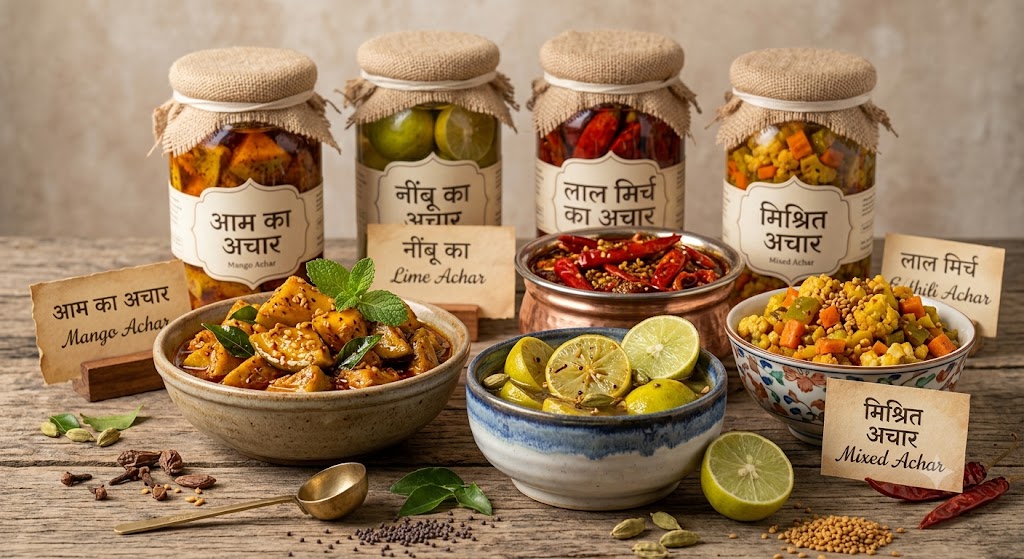
But stop by the highway, and a different Panipat comes into view. Shops are stacked with jars of mango, lime, chilli and mixed achaar. For many Indian families, these pickles represent the familiar taste of home. So, who is behind the jar?
The pickle trade may be small compared with Panipat’s textile industry, but it has built a reputation of its own. Figures reported in 2016 put the number of pickle factories at around 15 to 20, with approximately 100 shops along the highway. These businesses sold pickles under brand names such as Pachranga, Popular, Pooja and Anu. The factories reportedly provided employment to hundreds of people and generated an annual turnover of roughly ₹40 crore to ₹50 crore. Their products also reached international markets, including Europe, the United States, the United Kingdom and parts of West Asia. These figures describe the industry at that time; its current size and turnover have not been independently established.
The scale becomes clearer when compared with Panipat’s textile business. Earlier estimates put the city’s domestic textile turnover at around ₹40,000 crore annually. Although the two figures relate to different industries and may not refer to the same reporting period, they illustrate the difference in scale. Even so, Panipat is often described as India’s “achaar capital”. The nickname reflects the city’s reputation among pickle buyers, though it is an informal title rather than an official designation.
If this trade has a best-known name, it is Pachranga. The word means “five colours” and refers to a pickle associated with five vegetables. A seven-vegetable version is known as satranga. The brand’s history, however, begins outside India. Pachranga traces its origins to Kaloorkot, a village in present-day Pakistan, where Murli Dhar Dhingra established the pickle business. Accounts differ on the exact founding year, placing its beginnings in the 1930s. The family business was brought to India in 1943.
Anand Malik, associated with Pachranga Agro in Panipat’s Sector 25, has also described the brand’s roots in Pakistan and its move to India in 1943. According to his account, Murli Dhar Dhingra was his father’s maternal grandfather. The family history is central to Pachranga’s identity and helps explain its long-standing connection with Panipat’s pickle trade.
Earlier reports described about half a dozen factories in Panipat as being owned by members of the Dhingra and Malik families. However, this is a historical account, not a verified count of current ownership. The Pachranga name is also associated with multiple business listings, including Pachranga Foods, Pachranga International, Pachranga Foods International and Pachranga Sons International, all listed with Panipat addresses. The available listings do not establish whether these firms share ownership, have formal business links or operate under the same arrangement. This makes it important to distinguish the brand’s family history from the ownership of individual businesses.
Panipat’s pickle trade also extends beyond the domestic market. Trade-data listings record more than 100 US shipments associated with Pachranga Foods, a business based in Panipat’s Industrial Area. These records indicate a presence in the American market, although the exact contents and destinations of individual consignments should be confirmed from shipment-level details before making more specific claims. The broader picture is clear: at least some of the city’s pickle businesses have connections to international trade.
Behind every jar is a process that takes time. Pickle-making timelines vary according to the ingredients, preparation method and recipe. Earlier reporting on Panipat’s manufacturers described production periods ranging from about one to three months. Mango pickles could take around a month and a half, lemon pickles about two months, and green chilli pickles roughly a month. Before preparation, the vegetables are cut, sorted and handled according to the variety being made.
Mustard oil and ground spices are among the ingredients used by local manufacturers. The range of products is wide, including mixed, mango, lime, green chilli, amla, carrot, radish, turnip, garlic, onion and red chilli pickles. Some manufacturers have reported preparing at least 14 varieties. Differences in ingredients, spice blends and preparation methods help give each maker’s products their own character.
Yet factories and brand names alone cannot explain the city’s reputation. Customers play an important role, too. In one reported example, a buyer named Yogesh Kumar travelled from Kurukshetra to purchase pickles in Panipat. He said his family preferred the city’s pickles because of their distinct taste. Such individual accounts do not establish how all buyers behave, but they show why some customers are willing to travel for a product they know and enjoy.
So, who really runs the jar? There is no single king who controls Panipat’s entire pickle trade. The industry includes established family businesses, several manufacturers, shops along the highway, workers involved in preparation and packaging, and customers who keep returning for familiar flavours. Pachranga may be one of its best-known names, but the wider trade depends on many people and businesses.
One important detail remains unresolved: how much has the industry grown since the figures reported in 2016? The older estimates provide a useful snapshot, but a current count of factories, jobs, shops and sales would be needed to measure the trade’s present size. Until such figures are available, Panipat’s pickle crown is best understood as a shared one, built on family histories, local production and a taste that keeps customers coming back.
Subscribe Deshwale on YouTube
