



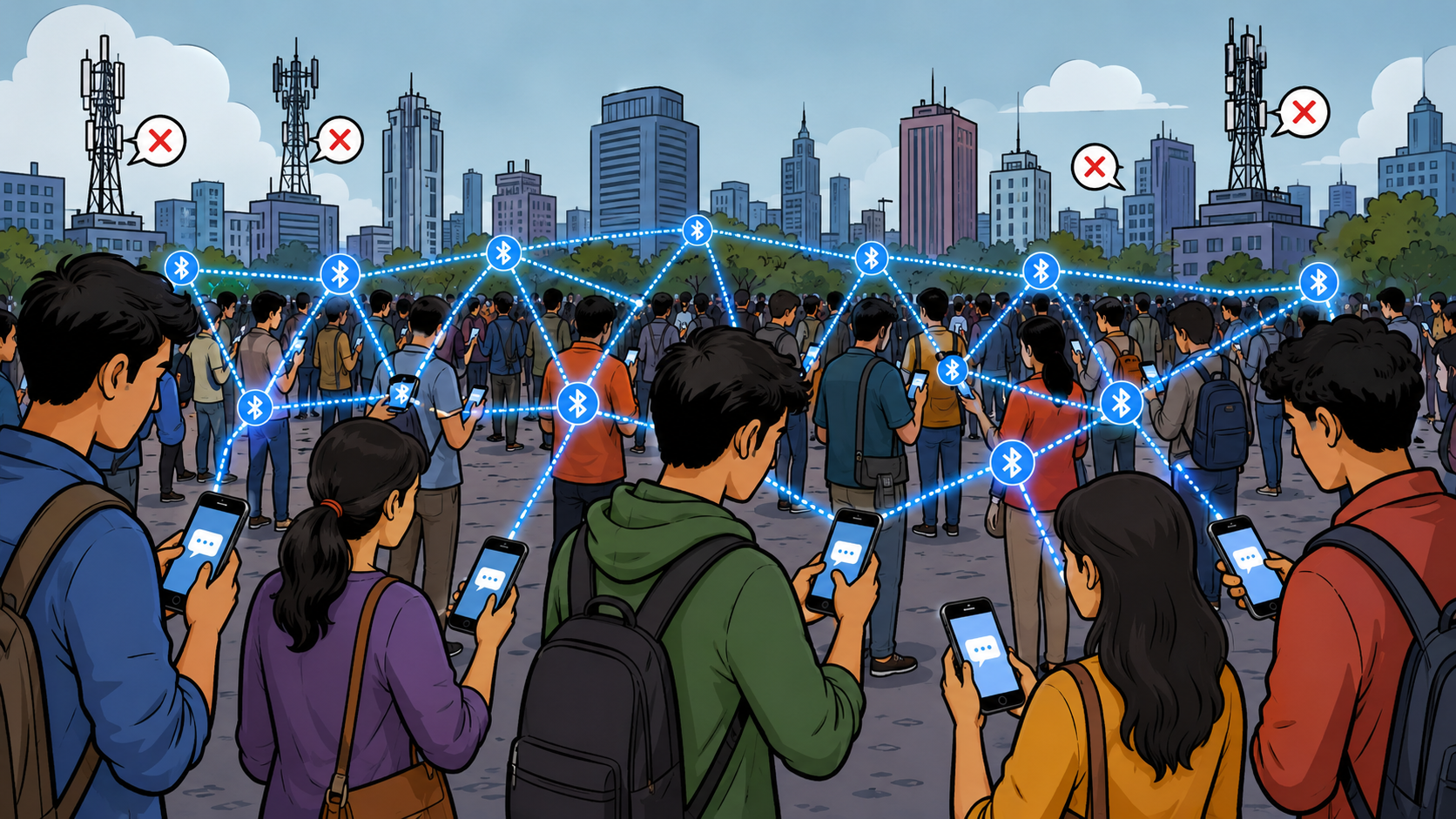
When Delhi Police cut mobile internet across central Delhi during the recent Cockroach Janta Party protests, the goal was simple: no internet, no coordination. Within hours, that assumption fell apart.
Protesters gathered near Connaught Place and Jantar Mantar kept messaging each other anyway. No 4G. No 5G. No Wi-Fi. Police reportedly began investigating how, and the answer turned out to be a piece of technology that has quietly become a favourite of protest movements across the world.
The tool in question is a Bluetooth-based messaging app. It does not need a SIM card, a phone number, or an internet connection to work, and that is exactly what makes it so hard to switch off.
How a phone becomes its own network
Every messaging app we normally use, from WhatsApp to Instagram, depends on a server somewhere. Your message travels to that server first, then to the other person. Cut the internet, and that entire chain collapses.
Bluetooth mesh apps skip the server altogether. Each phone acts as both a sender and a relay. When you send a message, it hops from your phone to the nearest phone running the same app, then to the next one, and the next, until it reaches its destination. Think of it as a whisper passed hand to hand through a crowd, except the crowd is made of phones.
Because there is no central point to shut down, blocking the network means physically disabling every phone in range, which is not something an internet blackout order can do. Messages can also wait. If the intended recipient is not nearby yet, the sender’s phone simply holds on to the message and forwards it the moment a connection becomes possible.
This sounds like magic, but it has real limits. Bluetooth’s range is typically around thirty metres, so the network only works where there are enough people carrying the same app close together. In a dense protest crowd, that condition is easy to meet. In a quiet neighbourhood, a message might sit on one phone for hours waiting for the next hop to appear. Delivery, in other words, is not instant. It is patient.
The app at the centre of it all
The best-known name in this space is Bitchat, launched in July 2025 by Jack Dorsey, the co-founder of Twitter. It runs on Bluetooth Low Energy, needs no account or phone number to use, and has already crossed a million downloads on the Play Store. For longer-distance reach, it also borrows an internet-based protocol called Nostr, but its core promise remains the same: a conversation that does not touch a mobile tower.
This is not the first blackout Bitchat has outlasted
What is happening in Delhi is not an isolated case. It fits a pattern that has repeated itself in several countries over the past year.
In Nepal, downloads of Bitchat crossed 48,000 during anti-corruption protests that coincided with a temporary social media ban. In Uganda, ahead of national elections, an opposition figure urged supporters to install the app in case of another shutdown, and downloads reportedly crossed four lakh. Ugandan officials claimed they had the technical means to disable it; the app’s developers publicly rejected that claim, arguing that a network with no central server has no single switch to flip.
The use case is not always political either. When Hurricane Melissa knocked out power and the internet across large parts of Jamaica, Bitchat briefly became the second most downloaded app in the country, right behind a weather-tracking app. People used it simply to stay in touch with family while the towers were down.
Bitchat is not alone
A handful of other apps work on the same principle. Briar is considered the most security-audited of the lot, adding Wi-Fi and Tor support on top of Bluetooth, though it is only available on Android and new contacts must be added in person. Bridgefy has been popular in crowd settings like protests and festivals for its simplicity. Meshtastic takes a different route entirely, using small LoRa radio hardware instead of a phone’s built-in Bluetooth for much longer range. An earlier app called FireChat did something similar during the 2014 Hong Kong protests, before eventually shutting down. Most of these apps, including Bitchat, are open source, which means anyone can inspect the code, and no single company can quietly switch it off from a head office either.
An internet shutdown used to be one of the most effective tools available to restrict communication during unrest. What is changing is that this tool now has a work-around that fits in someone’s pocket, needs no signal, and costs nothing to install.
Governments can still switch off towers. What they cannot do, at least not yet, is switch off a conversation that never needed a tower to begin with.
Subscribe Deshwale on YouTube
