



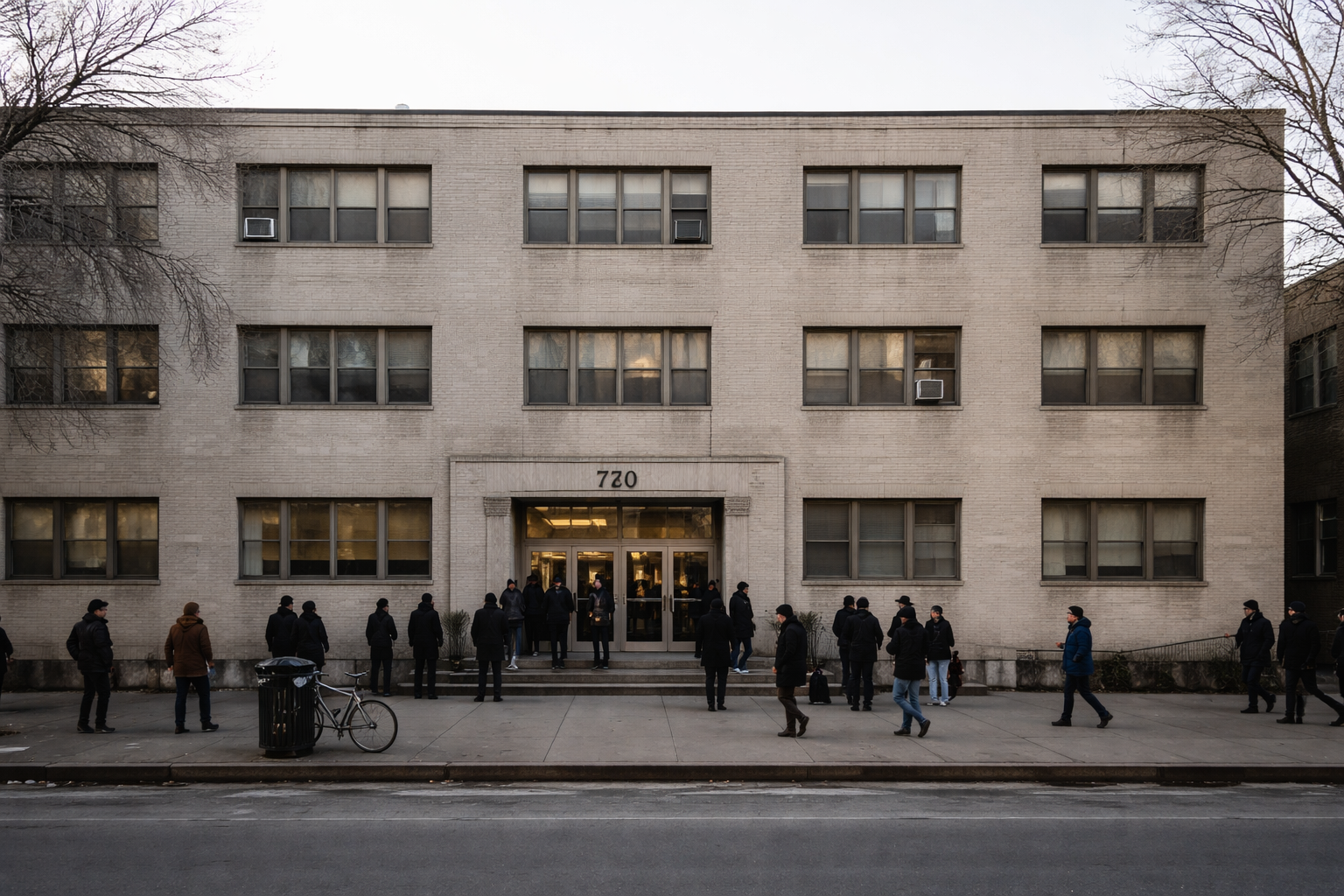
On March 5, 2026, Tucker Carlson posted a video to his subscribers that sent shockwaves through Jewish communities across the world. Carlson, who graduated from Trinity College in Hartford, Connecticut with a history degree in 1991 before building the highest-rated prime-time programme in American cable news history at Fox News, had by early 2026 become the most prominent critic within the MAGA movement of the United States and Israel’s military strikes on Iran. He had found a new target. It was not the government, not the generals, and not the politicians who had authorised the campaign. It was a Hasidic Jewish outreach organisation headquartered on a tree-lined street in Brooklyn, New York.
“This has been going on a long time in public through, in part, the efforts of a group called Chabad,” Carlson told his followers. “C-H-A-B-A-D.”
What followed was a cascade of claims. That Chabad was pushing, in Carlson’s words, “in a pretty subtle way, unless you look carefully,” for the reconstruction of the Third Temple on the site of the Al-Aqsa Mosque and the Dome of the Rock in Jerusalem. That key figures behind the Iran war believed the conflict would trigger the destruction of Islam’s third holiest site. That Christians were “dying disproportionately in these wars, which tells you something about their real motives.” He displayed photographs of Israeli soldiers wearing patches depicting the ancient Jewish Temple, claiming they were Chabad in origin. They were not. Rabbi Yaacov Behrman, a Chabad spokesman, promptly confirmed that the patches came from the Temple Institute in Jerusalem, an organisation entirely unaffiliated with Chabad.
Fellow commentator Candace Owens went further. She encouraged her followers to find out where their nearest Chabad House was, describing its members as dangerous. President Donald Trump, who has visited the grave of the Lubavitcher Rebbe and whose foundation has donated to Chabad institutions, condemned Carlson directly. “Tucker has lost his way,” Trump told ABC News correspondent Jonathan Karl. “He’s not MAGA.” Jewish organisations across the political spectrum added their condemnation. Within hours of the broadcast, Israeli security forces issued an alert recommending that Jews around the world exercise caution when visiting Chabad Houses that Shabbat. The NYPD announced increased patrols at Jewish sites across New York City.
None of this was the first time Carlson had positioned himself against the American intelligence and foreign policy establishment, a posture that carries a particular biographical irony. After graduating from Trinity College, his first instinct was not journalism. He applied to join the Central Intelligence Agency and was rejected. That rejection redirected him toward writing. His father, Richard Warner Carlson, was a journalist and diplomat who served as the longest-serving director of Voice of America under President Ronald Reagan from 1986 to 1991, running the US government’s primary international broadcasting operation at the height of the Cold War. Tucker has stated publicly that his father “worked in conjunction” with the CIA during this period. There is no evidence that Richard Carlson was ever a CIA operative. Tucker wrote in his father’s obituary, following Richard Carlson’s death in March 2025 at the age of 84, that the last 25 years of his father’s life were spent in work “whose details were never completely clear to his family, but that was clearly interesting.” It is a remarkable sentence for a son to write. It is an even more remarkable sentence for a man who built a career accusing powerful institutions of operating in the shadows.
The controversy the broadcast ignited prompted a question that Carlson himself, perhaps inadvertently, posed: what is Chabad exactly?
Origins: The Rational Mystics of Belarus
The movement was founded in 1775 by Rabbi Shneur Zalman of Liadi, born in 1745 in the small town of Liozna in the Grand Duchy of Lithuania, in what is now Belarus. Zalman was a student of Dov Ber of Mezeritch, who was himself the successor to Rabbi Israel Baal Shem Tov, the founder of the broader Hasidic movement. What distinguished Zalman from other Hasidic leaders of his era was his insistence on grounding mystical Jewish spirituality in rigorous intellectual study rather than in emotional experience alone.
The movement’s name reflects this orientation. Chabad is an acronym drawn from three Hebrew words: Chokmah, meaning Wisdom; Binah, meaning Understanding; and Da’at, meaning Knowledge. This framework, sometimes described as a form of Jewish rational mysticism, became the theological foundation of everything the movement built across the following two and a half centuries.
The movement took the name Lubavitch from the Russian town of Lyubavichi, where the second Rebbe, Dovber Schneuri, relocated the leadership in 1813. The sixth Rebbe, Yosef Yitzchak Schneersohn, led the movement through Bolshevik persecution, imprisonment, and exile, eventually arriving in the United States in 1940. He established the world headquarters at 770 Eastern Parkway in the Crown Heights neighbourhood of Brooklyn, an address that would become one of the most recognised sites in world Judaism. Zalman himself had been arrested twice by Tsarist authorities, in 1798 and again in 1800, on charges of sedition. His release from his first imprisonment on the 19th of Kislev, 1798, is still celebrated annually within the movement as the Rosh Hashanah of Chassidus, the new year of Hasidic teaching. A movement that marks a prison release as a holy day has never had any illusions about the relationship between religious conviction and state power.
The seventh and final Rebbe, Menachem Mendel Schneerson, assumed leadership in 1950 and transformed Chabad from a significant but bounded Hasidic movement into the global phenomenon it is today. Schneerson, who died in 1994, never claimed the title of Messiah for himself. He also, in a detail that has puzzled scholars and followers for decades, never once visited the State of Israel despite leading a movement whose entire spiritual architecture is oriented toward the Jewish homeland. The official position of Chabad is that the Rebbe was a human being who died and whose return from the dead as the Messiah is not expected. A minority within the movement holds otherwise, and a small number of soldiers in the Israel Defense Forces have been known to wear a yellow patch bearing a blue crown and the Hebrew word moshiach in his honour. That patch, not of Chabad’s making, is the image Carlson displayed to suggest an organised religious war.
The Network: 770 and Beyond
The world headquarters of Chabad-Lubavitch remains at 770 Eastern Parkway in Crown Heights, Brooklyn. Known universally within the movement simply as 770, the building is the spiritual and administrative nucleus of a global enterprise that has grown into one of the most expansive religious networks on earth. There are over 6,000 Chabad emissaries operating in more than 100 countries, with a presence extending across the United States, Europe, South America, Africa, Asia, Australia, and the post-Soviet states. The building’s hold on the movement’s imagination is so powerful that Chabad communities across the world have constructed architectural replicas of it, a phenomenon unique in modern religious life. There are functioning replicas of 770 Eastern Parkway in Sao Paulo, in Melbourne, in Milan, and in several locations across Israel. The address has been physically reproduced on five continents, which is either a remarkable testament to devotion or the most unusual form of franchise operation in the history of religion, depending on your disposition.
Every year, thousands of emissaries gather in New York for an annual conference, resulting in an iconic group photograph taken in front of 770 that has been produced every year since 1984. The organisational unit of the network is the shliach, or emissary: a married couple, trained at Chabad institutions in Brooklyn or Israel, who are sent to establish or sustain a Chabad House in a city or town that may have little or no existing Jewish infrastructure. The emissary couple builds a community centre, a synagogue, educational programming, and a welfare network essentially from nothing, funded through local donor relationships rather than from headquarters. Up to a million Jews attend Chabad services at least once a year.
Funding: The Decentralised Model and Its Consequences
Chabad headquarters in Brooklyn does not fund local centres. Each emissary couple is responsible for raising the money required to sustain their own operation, their salaries, their children’s schooling, and the costs of running a community space. This structure makes Chabad extraordinarily entrepreneurial and locally responsive. It also means that every emissary has a powerful financial incentive to cultivate relationships with the wealthiest and most prominent members of the communities they serve.
The Rohr family represents the most notable example of major Chabad philanthropy. Sami Rohr, the patriarch, donated at least $250 million to Jewish causes over his lifetime, with Chabad among his primary beneficiaries, particularly in the former Soviet Union. His son George Rohr continued and expanded the family’s commitment. The Rohr name now attaches to the movement’s adult education arm, the Rohr Jewish Learning Institute, and to campus outreach centres at universities around the world.
The Donald J. Trump Foundation donated $11,550 to three Chabad institutions. The foundation of Jared Kushner’s parents donated $342,500 to Chabad institutions and projects over a ten-year period, including $150,000 to the Chabad centre at Harvard University in 2007, where Kushner studied, and $78,000 to the Ohel visitors centre at the grave of the Lubavitcher Rebbe. When Chabad emissary Rabbi Zvi Kogan was abducted and killed in the United Arab Emirates in November 2024, Kushner and Ivanka Trump donated $1 million to the Chabad centre in the UAE where Kogan had worked. Joshua Kushner and Karlie Kloss matched that donation.
America: The Political Landscape
Chabad’s official position is that it does not engage in partisan political activity, and this has been maintained with reasonable consistency at the institutional level for most of its history. In practice, the sheer breadth of its network means that virtually every senior American politician has some documented connection to the movement.
Trump has visited the Ohel, the grave of the Lubavitcher Rebbe in Queens. Howard Lutnick, the Cantor Fitzgerald chief executive who served as co-chair of Trump’s transition team, accompanied Trump to the Ohel. New York City Mayor Zohran Mamdani has visited Chabad institutions. Rabbi Yehuda Kaploun, a Chabad-affiliated rabbi in Miami, organised and emceed a high-profile Trump event on combating antisemitism. The characterisation of Chabad as specifically a Republican or conservative organisation does not withstand scrutiny. Bernie Sanders’ closest friend and college roommate is a Chabad Hasid. Steven Spielberg dedicated a Chabad synagogue in Los Angeles. Former Obama Chief of Staff Jack Lew attended the same synagogue as the Kushners. The movement’s geographic reach makes it an inevitable gathering point for politicians seeking contact with Jewish communities, not a vehicle for any particular political programme.
It is worth noting at this point that Carlson’s Fox News contract was terminated in April 2023 in circumstances never fully explained by either party. He subsequently built one of the largest independent subscriber audiences in digital media history on the platform X, where his February 2024 interview with Russian President Vladimir Putin drew global attention. During that interview, Putin appeared to tease Carlson about his rejected CIA application, a detail that had by then become part of Carlson’s public biography and that lent a particular texture to his willingness to direct his audience’s suspicion toward an organisation that operates, as he framed it, in subtle and unaccountable ways.
Chabad and AIPAC: A Necessary Distinction
Any serious examination of Chabad’s political footprint must address its relationship, or more precisely its non-relationship, with the American Israel Public Affairs Committee. AIPAC is a registered lobbying organisation that operates through a 501(c)(4) social welfare entity, a traditional political action committee, and a Super PAC called the United Democracy Project. In the 2023 to 2024 election cycle, AIPAC’s combined political entities spent nearly $127 million, making it one of the most powerful lobby operations in Washington.
Chabad is none of these things. It files no lobbying disclosures. It operates no political action committee. It makes no electoral endorsements. The two organisations move in overlapping worlds of Jewish philanthropy and political access, and some donors give to both, but they serve structurally distinct purposes and operate through fundamentally different mechanisms. Conflating them is not analysis. It is the kind of category error that conspiracy theories depend on for their apparent coherence.
Israeli Politics: Where Apolitical Gets Complicated
Chabad’s self-presentation as apolitical has come under increasing strain as its relationship with Israeli politics has evolved. For decades the movement maintained a studied distance from Israeli electoral contests. That distance became harder to sustain as its Israeli membership drifted decisively toward the political right.
In the 2022 Israeli elections, Otzma Yehudit, the party led by Itamar Ben-Gvir, won 56.28% of the vote in Kfar Chabad, the Israeli town whose residents are exclusively from the Chabad movement. Ben-Gvir was a frequent presence at Chabad events. At the traditional Hakafot ceremony in Kfar Chabad in October 2022, two weeks before the Israeli elections, he received a warmer reception from the assembled Chabadniks than Benjamin Netanyahu himself. Netanyahu’s associates reportedly insisted that Ben-Gvir vacate the stage before Netanyahu would take it. The crowd’s response to that manoeuvre was not ambiguous.
Following the elections, Clause 165 of the coalition agreement that Ben-Gvir’s Otzma Yehudit signed with Netanyahu’s Likud stated that the government valued the work of the global Chabad movement, committed to passing a resolution to bolster and strengthen the movement, planned the expansion of Kfar Chabad, and committed to completing construction of the Lubavitcher Rebbe Heritage Centre. In April 2025, when Ben-Gvir made his first official visit to the United States, his itinerary was centred on Chabad-affiliated events. His visit culminated at 770 Eastern Parkway in Crown Heights, where he was received with song and dance. Outside, six people were arrested in clashes between protesters and Hasidim.
The Shomrim Centre for Media and Democracy, an Israeli investigative journalism organisation, concluded that Chabad was tempted by the money, jobs, and influence that political alignment could deliver, and that its rightist and messianic tendencies were coming to the fore alongside its alliance with Ben-Gvir and his party.
The Third Temple: What Chabad Actually Teaches
At the centre of Carlson’s accusations lies a specific theological claim: that Chabad is actively working toward the physical destruction of the Al-Aqsa Mosque and the Dome of the Rock in order to rebuild the Jewish Temple on the Temple Mount in Jerusalem. This claim collapses under examination.
Belief in the future coming of a Messiah and the rebuilding of the Temple is one of the thirteen foundational principles of Jewish faith, articulated by the medieval philosopher Maimonides and recited in Jewish prayer for two millennia. No mainstream Jewish denomination, including Chabad, advocates for the destruction of Al-Aqsa or the Dome of the Rock to bring this about. Current Israeli government policy forbids Jewish prayer on the Temple Mount.
Chabad’s own teaching on this subject is unambiguous. The way Chabad seeks to bring about the Third Temple is through acts of kindness and good deeds, not through the destruction of Islamic holy places and not through modern warfare. Rabbi Mordechai Lightstone, Chabad’s social media director, addressed the theological point directly: “It’s not so subtle that the building of the Third Temple and the Messianic era is central not just to Chabad, but to all of Judaism as one of the 13 Principles of Faith.” The belief is universal within Judaism, millennia old, and entirely unconnected to any programme of political violence or the desecration of Muslim holy sites.
The photographs Carlson displayed of soldiers wearing Temple patches were traced to the Temple Institute, a Jerusalem-based nonprofit whose goal is the construction of the Third Temple. The Temple Institute has no affiliation with Chabad. As Behrman noted, Carlson’s use of those images as Chabad evidence reflected either a basic failure of research or a willingness to conflate distinct organisations for rhetorical effect. In the world Carlson has built for his audience, the distinction between the two does not appear to have mattered very much.
The Cost of Careless Rhetoric
The January 2026 car ramming of 770 Eastern Parkway in Crown Heights happened when thousands of people had gathered inside to celebrate. Nobody was killed, but the building was damaged and the message was unmistakable. Two months later, Tucker Carlson broadcast to millions of people that the organisation headquartered at that address was the driving force behind a religious war. Behrman responded: “Reckless rhetoric like this is dangerous and irresponsible.”
The danger is not hypothetical. In November 2024, Rabbi Zvi Kogan, a 28-year-old Chabad emissary in the UAE, was abducted from the kosher supermarket he managed in Dubai and murdered. Three Uzbek nationals were convicted and sentenced to death by an Abu Dhabi court. In December 2025, two gunmen killed 15 people at a Hanukkah celebration on Bondi Beach in Sydney, among them Chabad rabbi Eli Schlanger, 41, a London-born father of five; Alexander Kleytman, an 87-year-old Holocaust survivor; and a 10-year-old girl named Matilda. In 2008, Chabad emissaries were murdered in a terrorist attack on the Mumbai Chabad House. These are not abstractions. They are the consequences that land on the bodies of the people whom rhetoric reaches before reason does.
There are legitimate questions to ask about Chabad. Its growing alliance with the Israeli far right represents a documented shift in a movement that long insisted on its own political neutrality. Its decentralised funding model creates dependencies on wealthy donors that complicate any claim to pure independence. The presence of a messianic minority within its ranks is a real theological current, whatever the official position of the movement. These are subjects for serious journalism.
What they do not add up to is a secret organisation directing American foreign policy and engineering a holy war to destroy the Dome of the Rock. That claim is not journalism. It is the oldest pattern in the history of antisemitism, updated for a podcasting format and detonated into a moment when Jewish communities worldwide are already living under elevated threat.
The question Carlson posed was a reasonable one. What is Chabad exactly? The answer is a 250-year-old religious movement, founded by a Belarusian rabbi who was twice arrested for his beliefs, built by an immigrant community that survived Soviet persecution and the Holocaust, and sustained today by thousands of couples who move to cities and towns across the world at their own expense to offer Jewish people a place to pray, eat, study, and belong. It is also a movement navigating the tensions between religious tradition and political reality that all large religious institutions navigate, imperfectly, in a world that does not hold still.
It is not what Tucker Carlson said it was. And the people who pay the price for that kind of claim are already known by name.
Subscribe Deshwale on YouTube
