



Chuck Norris died on 19 March 2026. He was 86, still training, still punching. The world lost the myth first, and only then realised how much of the man it had never actually seen.
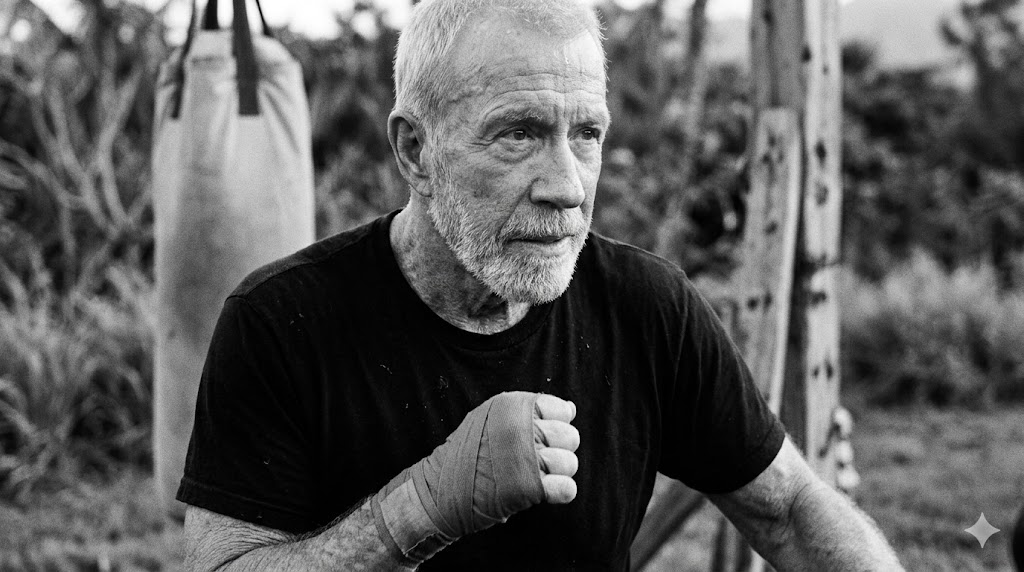
Nine days before he died, Chuck Norris posted a video to Instagram. He was on the island of Kauai, standing in sunlight in a black T-shirt, and he was sparring, properly sparring, not posing, with a boxing trainer who was giving him real combinations to answer. Norris was 86 years old. He slipped a jab, rolled a right hand, fired back. His footwork was not what it once was, but his hands remembered. The caption read: I don’t age. I level up. I’m 86 today. Nothing like some playful action on a sunny day to make you feel young. He signed it: God Bless, Chuck Norris. The post got millions of views. People shared it the way people share proof of something they need to believe in. And then, nine days later, he was hospitalised in Hawaii after a medical emergency, and on the morning of 19 March 2026, he died. His family asked that the circumstances remain private. He was at peace. He was surrounded by those he loved.
The internet, which had spent twenty years making him a god, spent twenty minutes making him a meme again. Chuck Norris doesn’t die, people typed. Death was afraid to tell him in person. It was affectionate, as such things go. It was also, in its way, a final refusal to let the man exist as what he actually was: a human being who started as nothing, built himself into something extraordinary through discipline and pain, spent his life fighting for things he believed in with a consistency that was sometimes admirable and sometimes troubling, and died on a Hawaiian morning at 86, nine days after being filmed still throwing punches at the sun.
That is worth more than any meme. But you have to be willing to look at the whole man to see it.
Carlos Ray Norris was born in Ryan, Oklahoma, in 1940, to a mother of Irish descent and a father of partial Cherokee ancestry who could not stay sober long enough to be a father. Ray Norris went on drinking binges that lasted months. Chuck grew up with his mother, Wilma Lee, raising three boys alone, poor, quiet, and by his own account so shy and internally withdrawn that the word nonathletic barely covers it. He was not a fighter. He was not a natural. He was a boy who kept his head down, moved schools when the family moved, and did not distinguish himself in any particular direction. The transformation did not come from talent. It came from a posting.
In 1958, Norris joined the United States Air Force and was sent to Osan Air Base in South Korea. It was there, in the spare hours between duties, that he encountered Tang Soo Do, a Korean martial art of sharp angles and exacting discipline, and something in him woke up that had never been awake before. He was not naturally gifted at this either, at first. He was beaten in his first two karate tournaments on returning to the United States, losing decisions to Joe Lewis and Allen Steen. He was knocked down at the International Karate Championships by Tony Tulleners. He kept training. He kept showing up. By 1967, he was winning. By the early 1970s, he was the six-time undefeated World Professional Middleweight Karate Champion, the holder of black belts across five disciplines, and a man who had built a chain of martial arts studios in California and was teaching a client list that included Steve McQueen, Priscilla Presley, the Osmonds, and Bob Barker, who went home from one session with cracked ribs.
This is the part of the Chuck Norris story that the myth swallowed and never properly told. Before he was an icon, he was an act of will. Before he was Walker, he was a shy, fatherless kid from Oklahoma who decided, with no particular natural advantage, to master the hardest discipline he could find, and did it by sheer, remorseless repetition. That is not a movie. That is something rarer and more instructive than a movie.
Steve McQueen told him to try acting. Norris thought about it. He applied himself to it the same way he had applied himself to everything else, as a problem to be solved through preparation and endurance rather than inspiration. His first real role was as Bruce Lee’s opponent in The Way of the Dragon in 1972. Lee was the fastest man alive with a film camera pointed at him, and Norris held his own, not by matching Lee’s speed, which was impossible, but by bringing a solidity and physical authenticity that the scene needed. Lee reportedly respected him enormously. The two had trained together for years. When Lee died in 1973, Norris was among those who felt the loss personally.
The film career that followed was not, in the critical sense, distinguished. Norris was not a subtle actor. He delivered dialogue as if reading it from a surface slightly above the audience’s heads, and he knew it, and he largely stopped trying to hide it. What he had instead was presence, the specific presence of a man who has spent his life earning the right to occupy space, and knows it, and is not apologetic. It read on screen in a way that technique cannot manufacture. In films like Lone Wolf McQuade and Code of Silence, when the script gave him something to do beyond walking through gunfire, he was genuinely compelling. In Missing in Action and its sequels, he made himself into a totem for a very specific American grief: the soldiers left behind in Vietnam, the families who never got answers, the national wound that the 1970s had covered with shame and the 1980s were reopening with rage. He dedicated those films to his younger brother Wieland, a private in the 101st Airborne, killed on patrol at Firebase Ripcord in Vietnam in 1970. Wieland was 26. Chuck was 30. He never talked about it in interviews with the ease that Hollywood demands. It was not that kind of loss.
Walker, Texas Ranger ran from 1993 to 2001, eight seasons on CBS, and it was not prestigious television. It was also not nothing. It was watched, week after week, by tens of millions of people who wanted a version of justice that arrived on time, was proportionate to the offence, and was delivered by a man whose moral code was legible at a distance. In a decade when American culture was becoming faster and more ironic and more comfortable with ambiguity, Walker was defiantly unfashionable, earnest, simple, and stubbornly certain that good and evil were distinguishable if you were willing to pay attention. People mocked it. People watched it anyway. People still watch it. There is something in that worth taking seriously rather than sneering at.
The meme arrived in 2005. A college student named Ian Spector launched a website generating satirical Chuck Norris facts, hyperbolic declarations of impossible toughness, absurdist in tone, affectionate in spirit. Chuck Norris can divide by zero. The chief export of Chuck Norris is pain. They wanted to put his face on Mount Rushmore but the granite wasn’t hard enough for his beard. That last one was Norris’s personal favourite, apparently. The phenomenon spread with a speed that the early internet had never quite seen before. It became the first truly global human meme, the first instance of a shared joke that crossed every language and culture and age group simultaneously. Six books. Two video games. Countless television appearances. Norris visiting troops in Iraq, partly because soldiers had been printing the facts on T-shirts and handing them around as morale-boosters.
He leaned into it publicly, reading the facts on Late Night with Conan O’Brien, publishing The Official Chuck Norris Fact Book, writing about it with what appeared to be genuine amusement. And yet. The meme did something to the cultural perception of the man that should be acknowledged honestly: it replaced him. The real Carlos Ray Norris, the shy Oklahoman, the fatherless boy, the disciplined craftsman, the man who lost a brother in Vietnam and spent decades trying to do something about it through his work and his charity and his faith, was replaced by a two-dimensional figure of impossible invulnerability. You cannot feel compassion for someone the internet has rendered immortal. You cannot engage with the contradictions of a human life when that life has been repackaged as a collection of jokes about roundhouse kicks.
The myth was warm, and funny, and ultimately a kind of affectionate dismissal. The man deserved more than that. Most men do.
There is a word that applies to Chuck Norris that his admirers rarely use and his detractors use too quickly, without precision. The word is conviction.
Norris had conviction the way very few people in public life actually have it: not as a brand, not as a performance, not as a calculated positioning exercise, but as an organising principle that cost him things. He was a conservative Christian in a Hollywood that has never made that easy. He wrote books about faith and patriotism and martial arts philosophy that were not bestsellers by accident. They sold because he meant them. He founded Kickstart Kids in 1990, a programme using martial arts training to build discipline and self-esteem in at-risk middle and high school students across Texas, and he supported it actively and financially for the rest of his life, with none of the fanfare that celebrity philanthropy usually demands. More than 3,300 Chuck Norris System black belts have been awarded worldwide. In 2007, he was made an honorary United States Marine. In 2010, he became an actual Texas Ranger. He was not collecting titles. He was honouring commitments.
But conviction, in a man who does not examine it, can also lead somewhere dark. Norris’s political views became more pronounced and more troubling as he aged. He endorsed Donald Trump with enthusiasm. He backed Roy Moore for the Alabama Senate, Moore who had been removed from the judiciary twice for misconduct and who faced credible accusations of sexual assault against minors. Norris wrote columns opposing LGBTQ+ rights with an absoluteness that caused real pain to real people. He was not a nuanced man, and on these questions his lack of nuance had consequences beyond his own life. This is the part of the obituary that polite remembrance asks you to soften. It should not be softened. A man of conviction is responsible for what his conviction does. Norris chose, consistently and deliberately, to use his platform in ways that made the lives of vulnerable people harder. That is part of the record, and it belongs in the reckoning alongside Kickstart Kids and the dedication to Wieland and the nine-day-old video of an 86-year-old man still refusing to stop fighting.
On 18 March 2026, the day before he died, a friend of his was on the phone with him in Hawaii. Norris had been training that morning. He was in good spirits. He was cracking jokes. Sometime in the next twenty-four hours, something happened, sudden, private, not disclosed. His family gathered. He was at peace. He died.
His first wife, Dianne Holechek, the high school sweetheart he married in 1958 when she was seventeen and he was eighteen, had died just three months earlier in December 2025, after a long illness. His mother, Wilma Lee, who had raised three boys alone through Oklahoma poverty on nothing but courage and necessity, had died in 2024, at 102. He had outlived so many of the people who made him. His brother Wieland he had outlived by 56 years, carrying that weight through every film, every season of Walker, every sparring session in Hawaiian sunlight.
The family statement on Instagram was brief and did not perform its grief. It said he was a devoted husband, a loving father and grandfather, an incredible brother, and the heart of their family. It said he lived with faith, purpose, and an unwavering commitment to the people he loved. It said he inspired millions and left a lasting impact on so many lives. All of this was true. None of it was the whole truth. The whole truth is bigger and more complicated and more human than any family statement can hold, and that is not a criticism. That is simply what it means to live for 86 years with full force, to build yourself from nothing into a myth and then to die as a man, surrounded, at peace, in the islands, nine days after posting a video that said: I don’t age. I level up.
He was Carlos Ray Norris. He was not invincible. He was, in the ways that actually matter, something harder to find and harder to lose: he was real.
Chuck Norris, born 10 March 1940 in Ryan, Oklahoma. Died 19 March 2026 in Hawaii. He is survived by his children and grandchildren, by the 450-odd episodes of Walker, Texas Ranger, by thousands of students he trained and never met, and by a meme that will almost certainly outlast everything else, which is, in its way, the final irony of a life that was always more serious than the world wanted it to be.
