



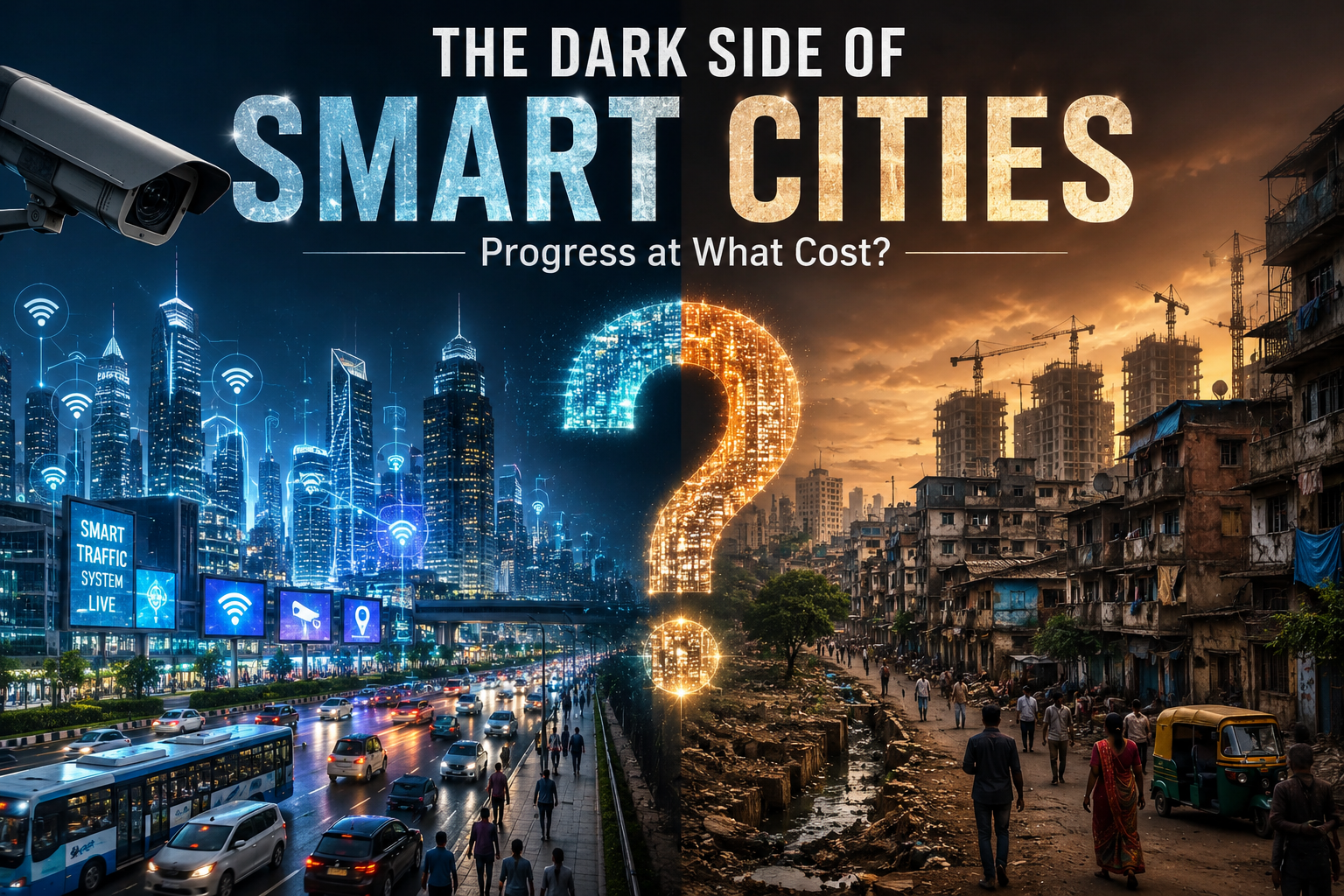
Smart cities are often presented as the future of urban living. They promise cleaner streets, smoother traffic, better public services and a higher quality of life. Across the world, governments are investing in technology to make cities more efficient and connected. In India, the Smart Cities Mission was launched in 2015 with the aim of improving urban infrastructure and public services through technology-driven solutions.
At first glance, the idea seems difficult to oppose. Who would not want better roads, reliable public transport and faster access to government services? Yet as cities become smarter, an important question is beginning to emerge: are we paying enough attention to the hidden costs of this transformation?
The debate is not about whether technology should be used in cities. Instead, it is about how that technology is used, who benefits from it and who may be left behind.
A city that watches everything
One of the most visible features of many smart cities is the growing use of surveillance technology. Cameras, sensors and data systems are increasingly being used to monitor traffic, manage public spaces and improve security.
Supporters argue that these tools can help reduce crime, improve emergency response and make city management more efficient. Technology can help authorities identify problems more quickly and respond to them effectively.
However, concerns about privacy are also growing. Every camera, sensor and digital service generates data. Questions are increasingly being raised about how this information is stored, who has access to it and how long it is retained. While most people appreciate safer streets, many also believe that privacy should not become the price of security.
As cities become more connected, finding the right balance between safety and personal freedom will become increasingly important.
When development leaves people behind
Urban development often brings visible improvements. Roads are widened, public spaces are upgraded and new infrastructure is created. Yet such projects can also have unintended consequences.
In many cities around the world, redevelopment has sometimes increased property values and living costs. While this can attract investment, it may also make certain areas less affordable for lower-income residents.
The challenge is not unique to smart cities, but technology-driven development can sometimes accelerate these changes. If city planning focuses only on economic growth, vulnerable communities may find themselves pushed to the margins.
A city cannot truly be called smart if its progress benefits only a section of its population.
The digital divide remains real
Smart city systems often rely on digital platforms. Citizens may be expected to access services through mobile apps, online portals or digital payment systems.
For many people, this offers convenience and speed. However, not everyone has equal access to technology. Reliable internet connections, smartphones and digital literacy cannot be taken for granted.
India has made significant progress in expanding digital access, but gaps still exist, particularly among elderly citizens, low-income households and some migrant populations living in urban areas.
When public services move online, there is a risk that some people may struggle to access them. The success of a smart city should not be measured only by the sophistication of its technology but also by how accessible that technology is to everyone.
Can technology solve social problems?
Technology is a powerful tool, but it is not a solution to every urban challenge.
Smart traffic systems can help reduce congestion. Digital platforms can improve service delivery. Sensors can monitor water usage and energy consumption. These are valuable improvements.
However, issues such as poverty, housing shortages, unemployment and social inequality require broader policy solutions. They cannot be solved simply by installing more cameras or collecting more data.
There is sometimes a tendency to view technology as a shortcut to complex problems. In reality, successful cities combine innovation with effective governance, social policies and community participation.
Many smart city projects include sustainability goals. Energy-efficient lighting, improved public transport and better waste management can all contribute to a cleaner urban environment.
At the same time, rapid urban development can place pressure on natural resources. Large infrastructure projects often require significant construction activity and increased use of materials such as concrete and steel.
Cities around the world are already dealing with rising temperatures, shrinking green spaces and growing concerns about water security. Technology can help address some of these challenges, but it cannot replace thoughtful urban planning.
A truly sustainable city must balance technological progress with environmental protection.
Smart for whom?
Perhaps the most important question is also the simplest: who is the smart city being built for?
A city includes people from every walk of life. Professionals working in offices, street vendors earning a daily income, students, senior citizens, migrant workers and small business owners all share the same urban space.
Some urban experts warn that if smart city projects primarily benefit those who are already digitally connected and economically secure, existing inequalities could become more visible. On the other hand, if technology is used to make cities more inclusive, affordable and accessible, it can become a powerful force for positive change.
Looking beyond the buzzword
The idea of the smart city is not inherently flawed. Better infrastructure, efficient public services and modern technology can improve everyday life in meaningful ways. The challenge arises when technology becomes the goal rather than the tool.
A truly smart city is not defined by the number of sensors it installs or the amount of data it collects. It is defined by how well it serves its people.
As cities continue to modernise, the challenge will be ensuring that progress remains inclusive, transparent and sustainable. After all, the smartest cities of the future may not be those with the most technology, but those that use technology wisely while keeping people at the centre of development.
Subscribe Deshwale on YouTube
