








A reported feature on the slow collapse of dating app culture and the words that helped push it over the edge
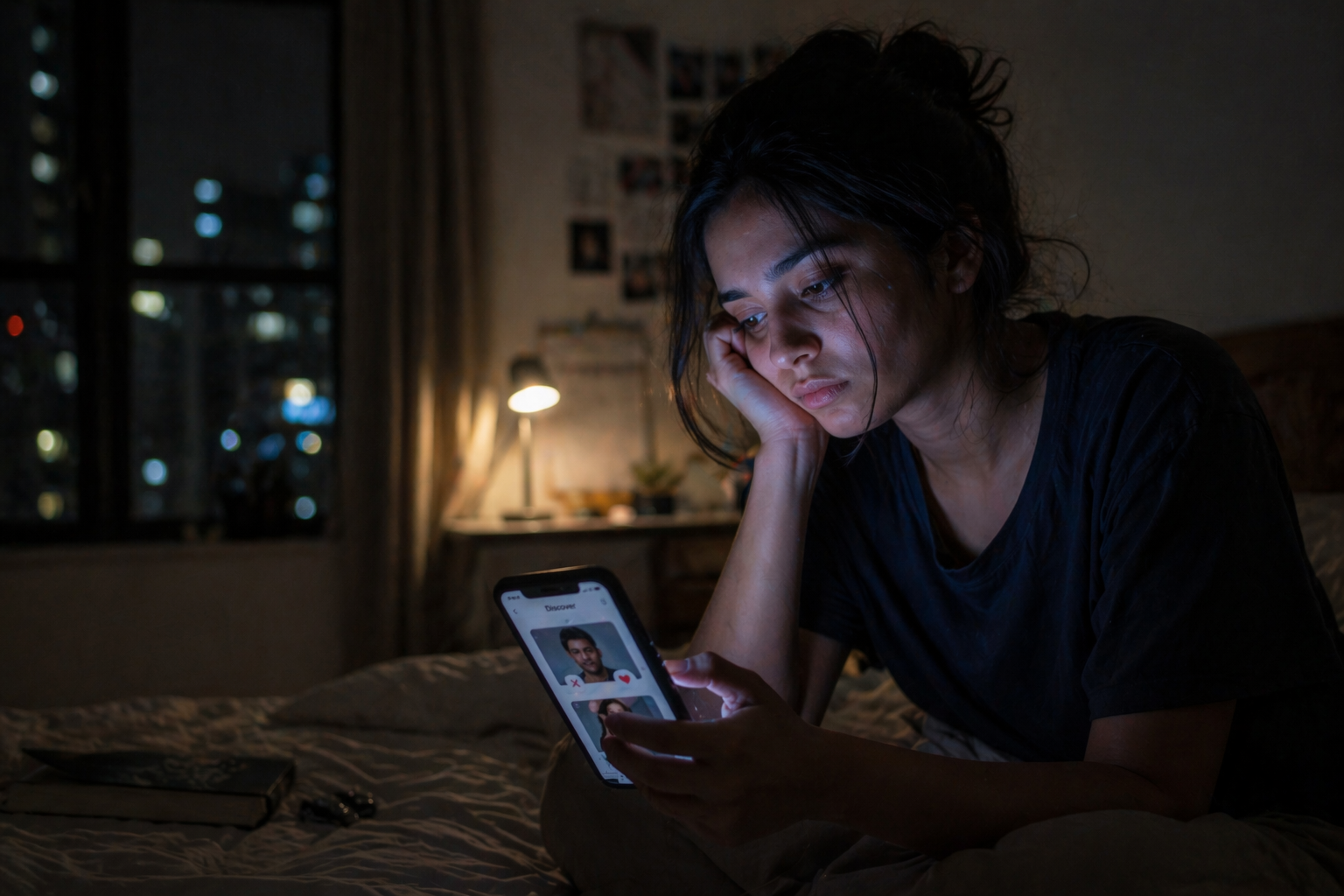
There is a profile on Hinge that a 24-year-old marketing executive in Mumbai described to me recently. She did not screenshot it. She did not need to. She had seen it so many times it had become a genre.
“Sapiosexual. Emotionally available. In my healing era. Green flags only. Sigma with a soft side. I don’t do situationships.”
She stared at it for a few seconds. Then she closed the app, put her phone face-down on her desk, and did not open it again for three weeks.
“I wasn’t upset,” she told me. “I was just… tired. Like I’d been handed a homework assignment I didn’t ask for.”
That tiredness, quiet, personal, hard to explain to anyone who isn’t feeling it — is now one of the most documented phenomena in the modern dating world. And the numbers behind it are, frankly, remarkable.
The numbers don’t lie
Let’s start with the business end of things, because it tells the story plainly.
Bumble, the dating app that once billed itself as the feminist answer to Tinder, the one where women made the first move, where respect was built into the design, went public on the Nasdaq in February 2021 at a valuation that made headlines. By mid-2025, its stock had lost over 90 percent of its value since that IPO. In June 2025, the company announced it was laying off 30 percent of its global workforce of 240 people, a move that would save it approximately $40 million annually. Its first-quarter 2025 revenue had already fallen 7.7 percent year-over-year. Premium subscribers were dropping.
Bumble did not collapse because of one bad decision. It collapsed because its users quietly stopped caring.
Match Group, the conglomerate that owns Tinder, Hinge, OkCupid, and several other apps, tells a similar story. Its market capitalisation has fallen from roughly $10 billion in 2021 to around $3.8 billion. Tinder, once the unchallenged king of dating apps, the app that invented the swipe saw its paying user base decline for six consecutive quarters. By Q1 2024, it had 10 million paying users, down 9 percent from the previous year. In the UK alone, a 2024 Ofcom report found that 1.4 million people left dating apps between May 2023 and May 2024. Tinder lost 594,000 of them. Bumble lost 368,000 more.
These are not rounding errors. This is a generation logging off.
The survey that should have alarmed everyone
In 2024, Forbes Health commissioned a survey of 1,000 Americans who had used a dating app at least once in the previous year. The results were striking. Seventy-eight percent said they felt fatigued by online dating sometimes, often, or always. Among younger users, the number climbed: 79 percent of Gen Z respondents and 80 percent of Millennials said they had experienced dating app burnout.
The most common reason? Not harassment. Not bad dates. Not the cost of a premium subscription.
The top answer, given by 40 percent of respondents, was simply this: the inability to find a good connection with someone else.
The second most common reason was getting rejected or ghosted 27 percent. Third was the exhaustion of having the same introductory conversation, over and over, with different people cited by 24 percent.
Rufus Tony Spann, a therapist on the Forbes Health Advisory Board who reviewed the findings, put it directly: “People who experience burnout with dating apps are exhausted from constantly meeting new people, failing opportunities, and lies. Over time, the unfortunate misgivings of being on a dating app can cause someone to lose hope in the dating process and finding the right person.”
Lose hope. That is a phrase worth sitting with for a moment.
The bio that became a barrier
Here is where the buzzwords enter the picture not as the sole cause of all this exhaustion, but as a very visible, very specific symptom of what has gone wrong.
Over the past three to four years, dating app bios have undergone a transformation. They began as simple, short self-descriptions: a few lines about what you liked, what you were looking for, maybe a joke. Then TikTok happened. Then therapy culture went mainstream. Then a certain vocabulary borrowed from psychology, from self-help, from internet subcultures began migrating directly into the bio box.
Today, a significant portion of Gen Z dating profiles read less like introductions and more like terms and conditions.
“Demisexual.” A legitimate term from the asexuality spectrum, meaning someone who only experiences attraction after forming an emotional bond. Now appearing in the bios of people who may simply mean they don’t like one-night stands.
“Sapiosexual.” Attracted to intelligence. Once a niche self-descriptor, now so overused that it has become almost meaningless and, many argue, a politely coded way of signalling class and educational status.
“Healing era.” A phrase drawn from the language of trauma recovery, now used to mean anything from “I recently broke up with someone” to “I am not emotionally available but I want company anyway.”
“Green flags only.” The logical endpoint of a culture that has spent years cataloguing relationships red flags a pre-emptive demand that any prospective partner arrive already certified as healthy and uncomplicated.
“Sigma.” Originally internet slang for a man who operates outside social hierarchies, now used in bios with a frequency that suggests either a lot of sigma males are on dating apps, or nobody actually knows what it means anymore.
Each of these terms, in isolation, communicates something. Together, packed into a five-line bio alongside an aesthetic photo and a playlist link, they do something else entirely: they signal that the person behind the profile has done a great deal of thinking about how they want to be perceived. And they quietly, politely, ask the person reading to match that energy to show up already fluent in the vocabulary, already sorted into the right category, already pre-approved.
That is not a connection. That is an entrance exam.
The homework problem
Jana Madern, a 19-year-old student quoted in a December 2025 piece by The New School Free Press, captured something that many people feel but struggle to articulate. While building her profile, she caught herself asking: “What can I say to make me more attractive to the boys?” She eventually deleted the app. “The more I think about it, the more it seems like a market,” she said, “and you’re shopping, but, like, for a guy. It’s kind of weird.”
That observation that dating apps have turned people into products to be browsed, and bios into product descriptions is at the heart of what buzzword culture has accelerated.
When you have to present yourself using the correct terminology, you are no longer introducing yourself. You are pitching yourself. And a pitch requires research, preparation, revision, and performance. It requires knowing which words are currently in favour, which phrases will attract the right audience and deter the wrong one. It requires, in other words, work.
That work has a cost. A 2024 analysis of user behaviour across major dating platforms found what researchers are calling “decision overload” the mental exhaustion that comes from evaluating too many profiles, processing too many signals, and making too many micro-judgements per session. Add to that the cognitive load of decoding a bio written in the current dialect of internet psychology, and the simple act of opening an app begins to feel less like looking for love and more like preparing for a job interview you are not sure you want.
“There was no sense of commitment in this space,” one college student told The New School Free Press after deleting his apps. “That’s what got purely tiring for me.”
The authenticity paradox
There is a deep irony at the centre of all of this, and it is worth naming clearly.
Gen Z is, by almost every measure, the generation most preoccupied with authenticity. They distrust advertising. They prefer creators who show their real lives over those who curate perfect ones. They say, repeatedly and emphatically, that they want real connections, honest conversations, and partners who show up as they actually are.
And yet the bio culture they have built is almost perfectly designed to reward performance over reality.
“Bio baiting” a term that circulated widely in 2025 describes the practice of crafting a profile that is technically accurate but essentially aspirational. The person who writes “love hiking” might mean they went once in 2022 and enjoyed it. The person who writes “emotionally available and attachment-secure” may be describing a goal rather than a current state. The “sapiosexual” may simply want to date someone who reads occasionally.
Nobody is lying, exactly. But nobody is quite telling the truth, either. And when everyone’s profile is a carefully optimised version of themselves filtered through the right vocabulary, calibrated for the right audience the result is a platform full of people performing authenticity rather than exhibiting it.
Hinge, to its credit, has tried to address this. Its design philosophy captured in its long-running tagline “designed to be deleted” has always prioritised prompts and conversations over pure aesthetics. Gen Z now makes up more than 50 percent of Hinge’s users. Its paying subscriber base grew 31 percent year-over-year in Q1 2024, even as Tinder’s fell. That is a data point worth noticing: the app that asks people to say something real, rather than just describe themselves in the correct terms, is the one that is growing.
What happens when people log off
The retreat from dating apps is not, it turns out, a retreat from dating. It is a retreat from a particular version of it.
Across the world, young people are rediscovering older methods with new energy. Social events built around hobbies. Running clubs that double as social networks. “Slow dating” events where a small group of people spend an evening doing something cooking, painting, hiking before anyone has to decide if they are interested in anyone else. The logic is simple: meet someone as a person first, and decide if they are attractive second, rather than the other way around.
Offline, the buzzwords disappear. Nobody at a cooking class announces that they are in their healing era. Nobody on a trail run describes their attachment style before saying hello. And in that absence of vocabulary, something that apps have been struggling to replicate actual, unscripted human contact becomes possible again.
A 2025 survey by the dating platform Aisle, which polled Indian singles, found that commitment was back in fashion. Users reported being collectively tired of casual encounters and partners who treated communication as optional. What they wanted, the survey found, was straightforward: someone real, someone consistent, someone who showed up.
Those are not complicated requirements. They do not require a glossary.
Dating apps are not going away. The industry generated over $6 billion in global revenue in 2024. Hinge is growing. New apps are launching, many of them built explicitly around the idea of anti-swipe, connection-first design. People are still looking for love; they are just increasingly unwilling to look for it in the way apps have trained them to look.
What the data suggests, the falling valuations, the user departures, the burnout surveys, the deleted profiles is that the current model has a ceiling. And that ceiling is not technological. It is human.
At some point, the person on the other side of the screen does not want to decode another bio. They do not want to assess another set of vocabulary choices, or wonder whether the person who says they are emotionally available actually means it, or try to construct a first message that signals they are interesting without being trying too hard.
At some point, they just want to meet someone.
The apps built a language to help people find each other. That language became a performance. The performance became a burden. The burden became fatigue. And fatigue, as 79 percent of Gen Z users will quietly tell you, looks a lot like closing the app and putting your phone face-down on the desk.
For three weeks, or longer, or perhaps for good.
Subscribe Deshwale on YouTube


