







In a world that worships busyness, the most radical thing you can do on a Sunday is absolutely nothing.
Picture this. It’s Sunday morning. You have no plans. No brunch to get to, no gym class booked, no friend’s cousin’s birthday dinner to attend. You sit on your bed and feel… strange. Uncomfortable. Like you’re forgetting something important.
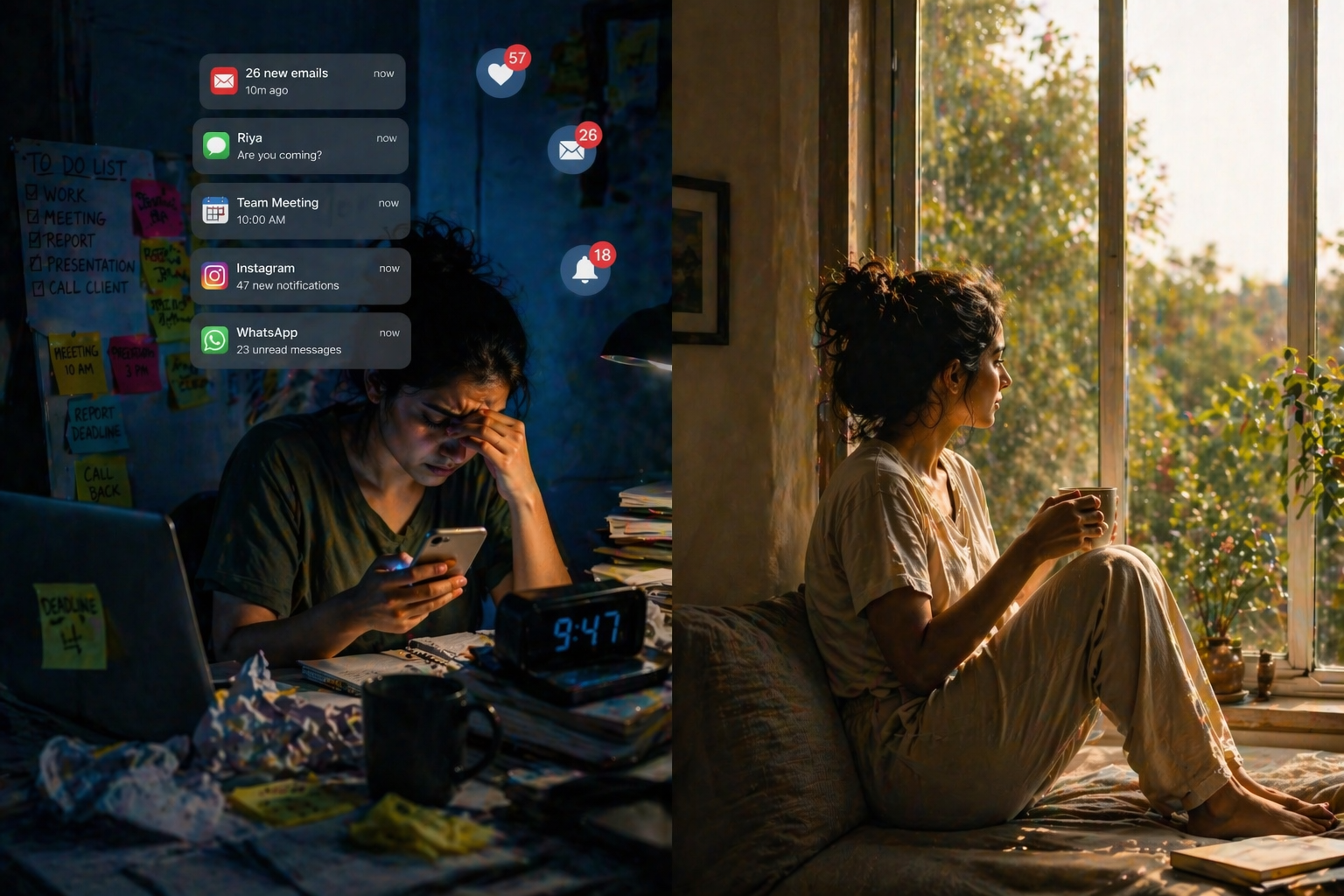
So you pick up your phone. You check Instagram. You see someone doing a 10 km run. Someone else is at a pottery class. Another person has already visited a new cafe, journaled, and apparently started learning Spanish before 9 AM.
By 9:30, you’ve signed up for a macramé workshop you don’t care about, just so you have something to put in your Stories.
Sound familiar?
Welcome to 2026, where doing nothing has become the one thing we are absolutely terrible at.
The weekend is now a productivity report
There is a trend going around called weekend maxxing the idea of squeezing the maximum possible experiences, activities, and self-improvement into your two days off. Hike in the morning, cook a new recipe at noon, read a book in the afternoon, attend a networking event in the evening. Repeat on Sunday. Collapse on Monday.
On the surface, it sounds great. More experiences, more growth, more stories to tell.
But look a little closer and you’ll notice something uncomfortable. We are not doing all of this because it makes us happy. We are doing it because we are terrified of what happens when we don’t.
That terrifying thing is called doing nothing. And somewhere along the way, we decided it was the enemy.
The Indian middle-class guilt trip
If you grew up in an Indian household, you already know that doing nothing was never really an option.
“Khali baithna” just sitting idle was practically a personality flaw. The moment you looked relaxed, someone handed you a textbook. The moment you said you had no plans, an uncle appeared with a list of “useful” activities. Rest was something you earned after hard work, not something you simply took because you needed it.
This is not a criticism of our parents. They came from a generation where survival demanded constant effort. The pressure to study, to earn, to build, to secure it was real and it was necessary. Idleness genuinely had consequences.
But here’s the problem. That mindset got downloaded into us like software, and most of us never updated it. We carried the guilt of doing nothing into lives that are already overwhelmingly full. We have EMIs and emails and fitness goals and social obligations and on top of all that, we have also decided that resting is somehow a moral failure.
The result? An entire generation that does not know how to sit still. Not even for ten minutes.
Meanwhile, in Italy…
There is an Italian phrase il dolce far niente that translates to “the sweetness of doing nothing.” And no, it does not mean lying unconscious on a sofa while Netflix autoplays. It means something much more intentional and much more beautiful.
It means sitting in a piazza with a coffee, watching the world go by, with no agenda and no guilt. It means a long lunch that stretches into the afternoon simply because the conversation is good. It means an afternoon walk with no destination, no step count, no podcast in your ears.
For Italians, this is not laziness. It is not something to be earned or justified. It is simply a part of being a person. A birthright, almost.
Interestingly, Italy ranks among the least at-risk countries in Europe for burnout. Coincidence? Probably not.
The Italians understood something that our productivity-obsessed culture keeps refusing to accept that the brain needs empty space the way the lungs need air. You cannot fill every moment and expect to feel whole. Something has to give, and usually, it is your peace of mind.
What science actually says
This is not just philosophy. The science backs it up.
When you stop filling every moment with stimulation, your brain does not go blank. It switches into what researchers call the “default mode network” a state of quiet background activity where the brain processes emotions, consolidates memories, makes unexpected connections, and essentially tidies itself up.
In simple terms: the big ideas, the sudden clarity, the “aha” moment in the shower; those happen during unstructured, unscheduled time. Not during your third productivity podcast of the day.
Research published in Frontiers in Psychology found that even brief periods of stillness improve attention span and emotional regulation. When you are constantly rushing, your body is flooded with cortisol, the stress hormone which over time affects your sleep, your mood, and your ability to concentrate.
Your brain, in other words, is not designed to be optimised. It is designed to breathe.
The cruel irony of weekend maxxing
Here is the twist nobody is talking about. All this weekend maxxing, all this relentless scheduling of experiences is making us feel more exhausted, not less.
Because there is a difference between rest and the performance of rest.
Taking a solo trip to a café with a book and genuinely losing track of time? That is rest. Taking a solo trip to a café with a book, photographing it from three angles, writing a caption about how much you love slow mornings, and checking the engagement every fifteen minutes? That is a content shoot. And content shoots are work.
We have become so good at performing a relaxed, full life that we have forgotten to actually live one.
How to do nothing (Seriously, you need instructions now)
The fact that this section needs to exist says everything about where we are as a generation. But here we are.
Start with ten minutes. No phone. No music. No podcast. Sit somewhere you like a balcony, a park bench, your kitchen floor and just be there. Watch something. A tree, a street, your own hands. Let your mind wander wherever it wants to go.
It will feel deeply uncomfortable at first. You will want to check your phone within ninety seconds. That urge is not boredom. That is withdrawal. Push through it.
Protect one hour every weekend with no agenda. Not “me time” where you’re doing a face mask and journaling. Just an unscheduled time where you do whatever you feel like in that moment or nothing at all.
Stop narrating your rest on social media. The moment you document your doing-nothing, it becomes doing-something. Let some moments exist only for you.
Give yourself permission to be boring. Not every weekend needs a story. Not every Sunday needs a reel. Sometimes the best thing that happened was a long nap and a good meal and an afternoon that simply slipped by quietly.
The most radical act of 2026
In a year where everyone is maxxing everything their weekends, their mornings, their productivity, their wardrobes choosing to do nothing is quietly, genuinely rebellious.
It says: I am not a machine to be optimised. I am not a content creator whose life needs to be curated. I am a person, and people need rest that is real, not rest that is scheduled between two other activities.
Il dolce far niente. The sweetness of doing nothing.
The Italians have known this for centuries. The question is whether we are brave enough, in this age of infinite stimulation and endless comparison, to finally learn it.
Put your phone down. Make some chai. Sit by the window.
Do nothing. Beautifully. Shamelessly. On purpose.
Subscribe Deshwale on YouTube


