









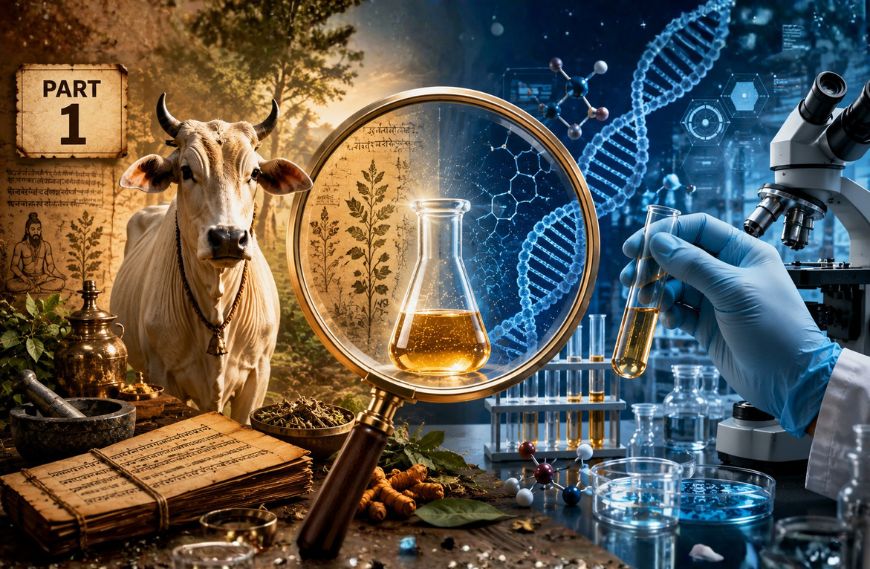


Few substances in India trigger as sharp a divide as gaumutra, or cow urine. Raise it in a science seminar and the room splits into believers and sceptics. Raise it on television and the conversation turns political before anyone reaches the evidence.
On social media, the divide is just as sharp. One side hails gaumutra as a miracle cure, the other mocks it as medieval superstition, and neither camp pauses to ask what tests, if any, back their view.
That is the gap this investigation sets out to close. Not by assuming gaumutra cures everything. Not by assuming it cures nothing. But by asking what the evidence actually shows.
A Civilisation Built Around One Animal
To understand why gaumutra provokes such strong reactions, it helps to look at the cow’s place in Indian life. For centuries before tractors and refrigeration existed, the cow was central to rural survival.
Milk fed families. Bullocks ploughed fields. Dung fuelled hearths and enriched soil, and even hides and bones found practical use after death.
Reverence for the cow, in other words, was never purely religious. It was economic and ecological too, and that history explains why ancient texts so often link the animal with prosperity.
Ayurveda Never Said “Natural” Meant “Safe”
A common misconception holds that anything natural is automatically beneficial. Classical Ayurvedic texts reject that idea outright.
They discuss dosage, purification and contraindications with real precision, and gaumutra is no exception. Ancient literature does not recommend drinking it freely. It describes specific, limited medicinal uses, often mixed with other ingredients, and that nuance regularly gets lost in modern debate.
Gaumutra rarely appears alone in these texts either. It is usually one part of Panchagavya, a set of five cow-derived substances that also includes milk, curd, ghee and dung, used together in certain formulations and rituals.
Modern products sold under the Panchagavya label do not necessarily match those classical recipes, and that continuity should never be assumed without checking.
Old Knowledge Is Not the Same as Modern Proof
This is the crux of the debate. Ancient civilisations were careful observers of nature, and some of their remedies became modern medicine. Willow bark led to aspirin. Traditional Chinese medicine led researchers to artemisinin, an anti-malarial drug. Foxglove led to digoxin, still used for heart conditions.
But thousands of other traditional remedies failed when scientists actually tested them. The lesson cuts both ways: traditional use earns investigation, not automatic acceptance, and a remedy science has not yet explained is not proven false either.
How a Claim Like This Actually Gets Tested
Say a researcher claims gaumutra reduces inflammation. Science does not accept or dismiss that on the spot. It moves through stages.
First comes chemical analysis: what compounds are actually present, and do breed, diet or collection method change them. Next, laboratory studies expose cells or bacteria to samples and check whether results can be repeated with proper controls.
Only then do animal studies test toxicity and effects in a living system, still a preliminary step since many results in mice never hold up in humans. The final and highest bar is the human clinical trial, comparing a treatment against a placebo or existing therapy under controlled conditions. Without that step, a claim remains a hypothesis, however old or widely repeated it is.
When Politics Enters the Lab
Gaumutra rarely stays confined to laboratories for long. Supporters sometimes present it as proof of India’s forgotten scientific wisdom. Critics sometimes wave off any discussion of it as pseudoscience.
Both instincts skip the actual work. Politics asks which side someone is on. Science asks what the evidence shows, and the two questions produce very different conversations.
India today leans on two lazy shortcuts: that anything in an ancient text must be true, or that anything from an ancient text cannot be true. Both positions avoid the harder task of testing the claim.
Why It Is Worth Getting Right
The gaumutra debate is no longer about one substance. It asks whether ancient medical knowledge can still inform modern pharmacology, and how traditional remedies should be judged in the first place.
Researchers worldwide keep mining plants, fungi and traditional healing systems for new drugs, and India holds one of the richest such traditions on earth. Ignoring it outright would be short-sighted. Accepting every old claim without testing it would be just as reckless.
The only honest approach is investigation without a predetermined verdict; observation, experimentation and independent verification, the same standard science applies to any claim, anywhere. That is where this series begins.
Subscribe Deshwale on YouTube


