









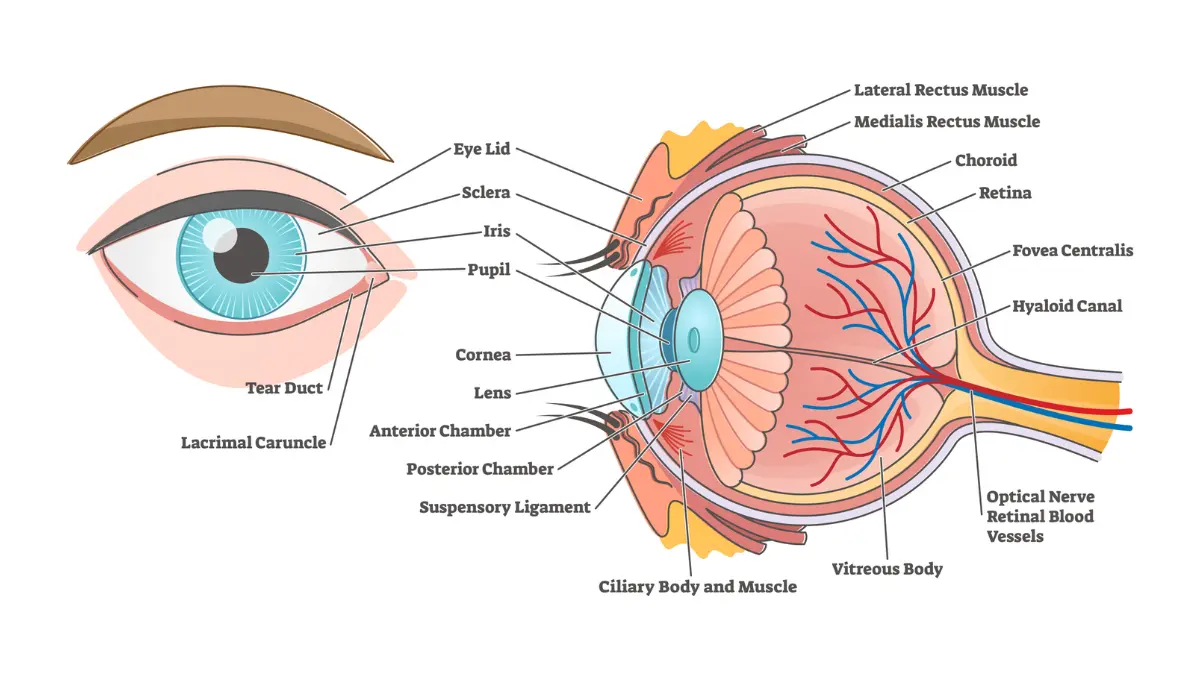
Eyes have always fascinated us. Poets praise them as mirrors of emotion, scientists marvel at their complexity, and cultures across the world imbue them with deep meaning. Yet beyond all the symbolism, eyes are astonishing organs that capture light, interpret emotions, and connect us to the world around us in ways no camera ever could.
How We See
Every time we look at the world, a tiny miracle happens inside our eyes. Light enters through the cornea, passes through the lens, and lands on the retina. Rods help us detect brightness, while cones let us see colour. The retina then sends messages to the brain through the optic nerve. All of this happens in milliseconds, allowing us to instantly recognise faces, objects, and motion.
Humans usually have three types of cones sensitive to red, green, and blue. Some women have a rare fourth cone, giving them the ability to see millions of extra shades. This makes the way we perceive colour wonderfully unique.
A Journey Through Time
Eyes didn’t start out this sophisticated. The earliest eyes, like those of ancient trilobites, were simple patches that sensed light. Over 500 million years, they evolved into complex organs with lenses and retinas, showing just how valuable vision is for survival.
Even creatures far removed from us, like octopuses, evolved eyes remarkably similar to ours. The difference is in the details, their optic nerves run behind the retina, so they don’t have a blind spot like humans do. Nature keeps finding clever ways to solve the same problem.
Tears Tell a Story
We often associate tears with sadness, but they do much more than that. They keep our eyes moist, protect against infection, and even carry stress hormones. Emotional tears probably evolved to signal distress and invite empathy from others, highlighting just how connected our eyes are to our emotions and relationships.
Eyes Across Cultures
Eyes have captured human imagination for thousands of years. Ancient Egyptians worshipped the Eye of Horus as a symbol of protection. In Mediterranean cultures, people wear the Nazar amulet to guard against the evil eye. Hindu and Buddhist traditions speak of the Third Eye, representing spiritual insight. In everyday language, we still say eyes are “windows to the soul,” and modern science shows that even subtle changes in our pupils and expressions can reveal what we’re feeling.
Tricks of the Mind
Our eyes are not always truthful. Optical illusions like the Müller-Lyer or checker shadow show that vision is not just about light, but also about interpretation. The brain constantly fills in gaps and makes sense of patterns, meaning what we “see” is shaped by experience and expectation as much as by reality.
Protecting Your Vision
In today’s screen-filled world, our eyes face new challenges. Long hours on phones or computers can cause dryness, strain, and fatigue. The simple 20-20-20 rule, looking 20 feet away for 20 seconds every 20 minutes can make a big difference.
Eye problems such as cataracts, glaucoma, and macular degeneration remain common, but many can be prevented or managed if detected early. Taking care of your eyes today protects the way you experience tomorrow.
Nature’s Supercomputers
Each eye sends about a million nerve fibres to the brain, processing nearly 10 million bits of information every second. Cameras may capture high-resolution images, but nothing matches the speed, adaptability, and complexity of human vision.
So whether you see eyes as the mirror of your soul, a window into emotion, or simply a marvel of evolution, they remain one of our most precious tools. They connect us, protect us, and allow us to experience life in all its colour and detail.


