











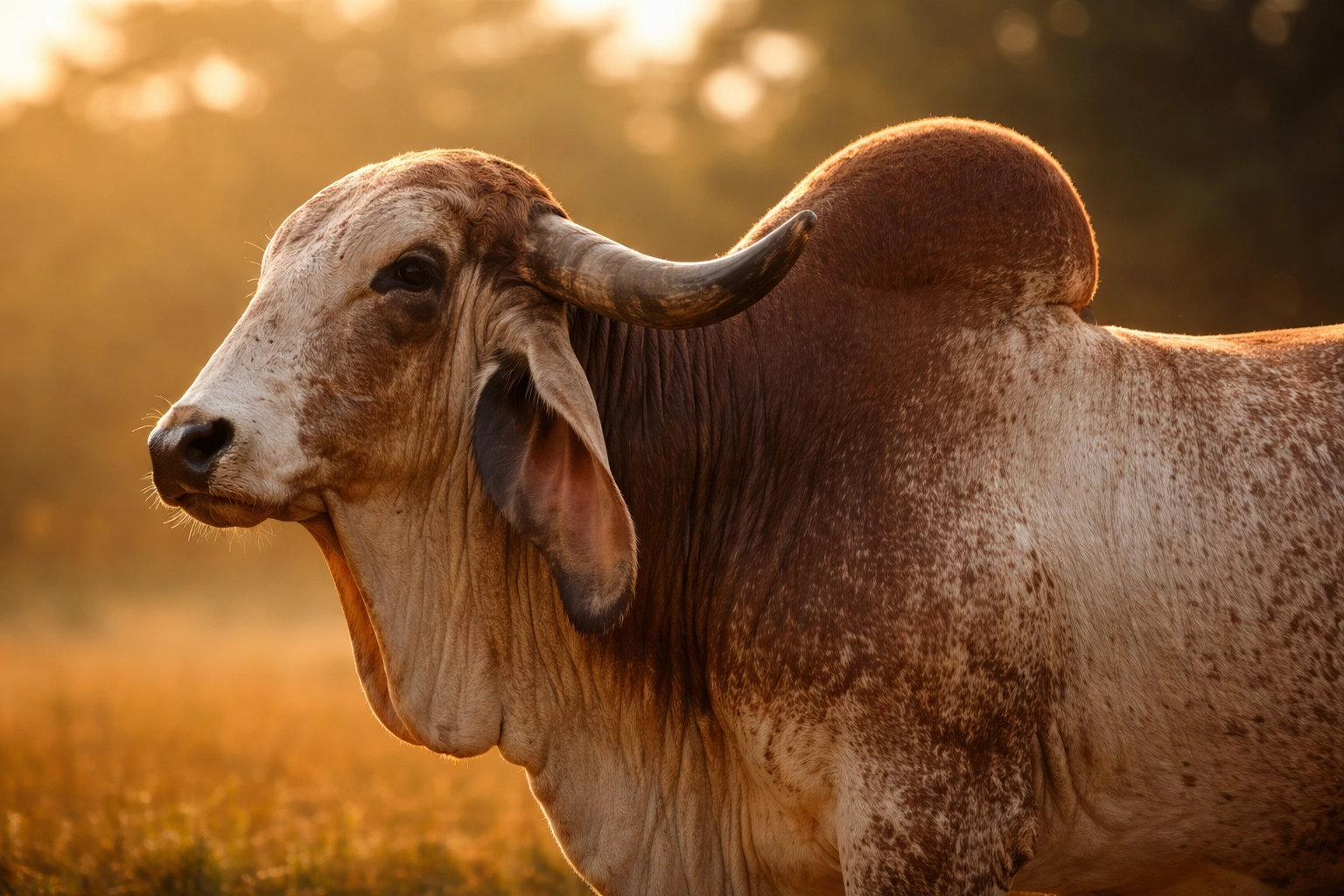
It sits above the shoulders like a crown. It has shaped civilisations, survived ten thousand years of selective breeding, and still confounds modern science in the most interesting ways. The hump of the Indian cow is not an accident of evolution. It is evolution’s masterpiece.
Stand in front of a Gir bull on a warm Gujarat morning. Let your eyes travel up from the hooves, past the deep chest and the loose pendulous skin hanging from the neck, up along the strong back and stop there, at the shoulders. Rising from the spine like a slow wave frozen mid-break is the hump. It can stand 30 centimetres tall on a mature bull, sometimes more. It sways very slightly when the animal walks. In the early morning light, it casts its own shadow.
You are looking at one of the oldest and most consequential biological features in the history of human civilization. That hump Mupuram in Tamil, Khuba in Hindi, formally the cervo-thoracic hump veterinary anatomy has been part of the Indian cow’s silhouette for at least seven thousand years of recorded human history, and for far longer before that. It appears on the seals of Harappan traders at Mohenjodaro. It is carved into the stone of temples at Khajuraho. It rides on the back of Nandi, Shiva’s sacred bull, in a thousand sculptures spread across the subcontinent.
It is also, as science has spent the last century gradually discovering, a piece of biological engineering so elegant it continues to produce fresh insights in the age of genomics.
Where It Begins: The Story of Bos Indicus
To understand the hump, you must first understand the animal that carries it.
The Indian cow formally Bos taurus indicus, commonly called the zebu, colloquially the desi cow is one of only two primary lineages of domesticated cattle on earth. The other is Bos taurus taurus, the humpless European or taurine cattle: the Holstein that fills bottles in supermarkets, the Angus that becomes steaks. These two lineages share a common ancestor in the wild aurochs (Bos primigenius), a massive prehistoric bovine that once ranged across Europe, Asia, and Africa before being hunted to extinction in the 17th century.
But they diverged from each other roughly a quarter of a million years ago, and their domestication histories are entirely separate. European cattle were domesticated in the Near East approximately 10,500 years ago from the western aurochs. The Indian cow was domesticated independently, in the Indus Valley region of what is now Pakistan specifically around the ancient site of Mehrgarh approximately 7,000 to 8,000 years ago, from a distinct subspecies called the Indian aurochs (*Bos primigenius namadicus*).
This matters for the hump because the hump is not an invention of human breeding. It is an inheritance from that original Indian aurochs, shaped and amplified by thousands of years of human selection in one of the hottest, most demanding environments on earth. The wild ancestor was already humped. Humans simply kept the trait, and over millennia, made it bigger because bigger, as we shall see, was better.
The Indian aurochs itself is now extinct. Its latest remains have been dated to approximately 3,800 years ago, making it the first of the three aurochs subspecies to disappear, its final representatives absorbed by interbreeding with the very domestic cattle it had given rise to.
The Architecture: What the Hump Actually Is
Here is where most popular accounts go wrong, and where science becomes genuinely fascinating.
The hump is not a hump of bone. There is no skeletal protrusion, no bony excrescence rising from the spine. If you were to X-ray a mature Gir bull and look only at the skeleton, you would see a vertebral column that does not look dramatically different from that of a European cow the same 7 cervical vertebrae, the same 13 thoracic vertebrae, the same 6 lumbar vertebrae. What you would notice is that the spinous processes the bony projections that rise upward from each thoracic vertebra are somewhat more pronounced in the Bos indicus than in taurine cattle, particularly between the 3rd and 13th thoracic vertebrae.
But the hump itself is built above and around these bony projections, not from them. Research published in the Tanzania Veterinary Journal, among the most thorough anatomical investigations of the zebu hump, established that the hump is composed primarily of the rhomboideus cervicis muscle, together with adipose tissue, collagen, and elastic fibres. It lies between approximately the 1st and 9th thoracic vertebrae, anchored to the spine by the ligamentum nuchae the remarkable elastic nuchal ligament that runs from the back of the skull to the spine, functioning in all large-headed grazing animals as a passive spring that reduces the muscular effort needed to raise the head from grazing.
In Bos indicus This nuchal ligament has a uniquely adapted attachment mechanism. The spinous processes of the 7th through 13th thoracic vertebrae are forked literally bifurcated at their tips with each terminal branch covered in cartilage that provides attachment for the funicular (cord-like) portion of the nuchal ligament. In Bos taurus, these same spinous processes are merely widened into small tubercles. The forked spinous process of the zebu creates what researchers describe as a concave dorsal face at the ligament’s insertion, a structural difference that is one of the defining skeletal distinctions between these two great cattle lineages.
So when you look at that hump, you are looking at a dense architecture of specialised neck and shoulder muscles primarily rhomboideus cervicis, but also components of the trapezius and splenius enormously hypertrophied through both evolution and sexual selection, packed with adipose tissue, woven with collagen for structural resilience, and anchored by an elastic ligament system that is uniquely engineered for this particular animal. It is muscular, it is fatty, it is connective, it is elastic. It is, in short, a multi-material biological structure that no single description fully captures.
In mature zebu bulls, the hump typically measures between 30 and 50 centimetres in height. In cows, it is present but markedly less developed. This difference is not incidental.
Bulls and Cows: Why the Same Species Wears It Differently
If you observe a herd of Indian cattle, the sexual dimorphism of the hump is immediately striking. The bull’s hump is a declaration. The cow’s whisper.
This difference is hormonal and functional in equal measure. In bulls, the hump is significantly enlarged relative to cows of the same breed and age, driven by testosterone-induced hypertrophy of the cervical and shoulder musculature. It is, in the language of evolutionary biology, a secondary sexual characteristic one that simultaneously signals genetic quality, confers mechanical advantage in competition, and may have been shaped by generations of both natural and human selection.
Mechanically, the enlarged hump and associated neck musculature give the bull the powerful forward thrust and neck strength needed in dominance contests. Bull fights in zebu cattle whether in the wild evolutionary context or in ritualised forms like the Tamil Nadu jallikattu involve precisely the kind of neck-and-shoulder wrestling that the hump architecture supports. A well-humped bull can leverage its weight through the neck more effectively. The musculature is not decoration. It is a fighting instrument.
In cows, the hump is present from birth but grows more modestly, constrained by lower androgen levels. It still serves the thermoregulatory and metabolic functions described below; it is not a vestigial trait in females but its relative smallness means it is rarely remarked upon, which has led many observers to incorrectly describe the hump as a male-only feature. It is not. It is a breed feature, present in both sexes, expressed dramatically differently.
Among Indian breeds, hump size and shape varies considerably. The Ongole bull of Andhra Pradesh, a magnificent draught breed exported in large numbers to Brazil and beyond, carries what breed descriptions consistently call a “high and massive” hump. The Kankrej of Gujarat and Rajasthan, likely the breed depicted on the famous Pashupati seal from the Indus Valley Civilisation, shows a strongly developed hump sitting forward of the shoulders. The Gir, the premier dairy breed from the Gir forest region of Saurashtra, has a well-formed hump that reflects its dual-purpose heritage. The Sahiwal of Punjab, perhaps India’s finest dairy cow, has a more modest hump relative to its considerable body size. The Haryana breed’s bull is described in agricultural literature as possessing an “attractive high hump” that gives it a particularly distinguished bearing.
Each of these is the same hump, shaped by the same evolutionary logic, expressed differently through centuries of selective breeding for different purposes: milk, draft, meat, endurance.
The Thermoregulation Engine: What That Hump Actually Does
Here is the question that generates the most genuine scientific interest, and the most popular confusion. What does the hump do?
The most commonly stated answer “it stores fat as an energy reserve, like a camel’s hump” is partially true but substantially misleading. Yes, the hump contains adipose tissue. Yes, this adipose can be metabolised during periods of nutritional stress, making it a genuine energy buffer for droughts and lean seasons. This is particularly important for Indian cattle that evolved in environments where feed availability was seasonal and unpredictable. A cow whose reserves are stored externally and accessibly rather than internally around organs is a cow that can survive a bad monsoon more elegantly.
But the more consequential function of the hump, according to Colorado State University’s AgNext research programme and a body of physiological literature reaching back to the 1950s, is thermoregulatory: by concentrating fat deposits and dense musculature in a raised structure over the shoulders rather than distributing them evenly across the body, the hump effectively reduces the insulating fat layer over the animal’s core body surface. Less insulation over the main body means more heat can escape through the skin. The fat, rather than trapping the animal’s own metabolic heat next to its vital organs, is raised above the body’s core, elevated into the breeze.
This is a subtle but meaningful engineering solution. The hump allows the animal to carry necessary energy reserves without sacrificing the heat dissipation capacity it needs to survive in the tropics.
But the hump is only one instrument in a much larger thermoregulatory orchestra that *Bos indicus has been assembled over millennia. The animal also has larger and more superficially located sweat glands than European cattle positioned closer to the skin surface, higher in density, and capable of generating higher sweat rates. Research has documented that zebu cattle have lower rectal temperatures under heat stress (averaging 39.28°C in the Nelore breed versus 39.47°C in less adapted crosses), lower respiratory rates (26 breaths per minute versus 36 in more stressed animals), and a lower basal metabolic rate that reduces the internal heat the animal must first dissipate. The loose skin of the dewlap that great pendulous fold hanging from the neck and chest increases surface area for radiative cooling. The large, pendulous ears, characteristic of Indian breeds, are vascularised in ways that help shed heat.
The Bos indicus animals are not simply tolerant of heat. It is designed for it. Every external feature that distinguishes it visually from a European cow: the hump, the dewlap, the ears, the loose skin, the sleek short coat is a component of an integrated cooling system. The hump is the most visually dramatic component, but it is not the only one, and understanding it in isolation misses the point of what evolution built.
Ten Thousand Years of Selection: The Hump as Human History
The hump is also, in a very literal sense, a document of Indian agricultural history.
When the Harappan civilisation flourished in the Indus Valley between approximately 3,300 and 1,300 BCE, cattle were already central to economic life. Bones from Harappan sites constitute roughly half of all animal remains found there, bearing marks of butchery and often charred by fire. The Pashupati seal, one of the most famous artefacts of the Indus Valley Civilisation, depicting a seated figure surrounded by animals shows humped cattle prominently. A bull seal from Sivikotada in Gujarat is thought by some archaeologists to depict an early Kankrej, hump and all.
What this tells us is that by 4,000 years ago, the hump was already a fully developed, visually prominent feature of Indian cattle and already associated with power, plenty, and the divine. Cows were domesticated for milk; bullocks drew carts and threshed grain; bulls were kept for breeding. Wealth was measured in cattle. The word for “war” in Sanskrit gavishti literally means “search for cows.”
Over the subsequent millennia, different regions of India developed distinct breeds through intentional selection. The breeders of Saurashtra selected for the heavy-milking Gir. The pastoralists of Rajasthan developed the drought-resistant Tharparkar and the powerful Kankrej. The farmers of Andhra Pradesh bred the massive Ongole, whose bulls were eventually exported to Brazil where they gave rise to the Nelore today the dominant beef breed across tropical South America, carrying Indian humps across the equator. The farmers of Punjab developed the Sahiwal, whose dairy genetics have spread to 29 countries.
In every case, the hump was carried along. Not because breeders were consciously selecting for it, necessarily, but because it came bundled with the heat tolerance, the disease resistance, the parasite tolerance, and the drought resilience that made these animals worth having in the first place. The hump is not separable from the rest of what *Bos indicus* is. It is the signature of a genetic package.
The Cultural Hump: Myth, Belief, and the Border Between Science and Devotion
India’s relationship with the cow’s hump does not exist only in laboratories and breed registries. It exists in temples, in Ayurvedic texts, in Vedic hymns, in the daily rituals of millions of households.
In traditional Hindu cosmology, Nandi the great bull, vehicle of Shiva is invariably depicted with a magnificent hump. The hump is part of what makes Nandi sacred, what identifies him as both animal and divine messenger. Every Shiva temple in India places a stone Nandi opposite the Shiva Linga, facing it with his characteristic bulk and his crowned back.
Among those who follow traditional Vedic approaches to cattle husbandry, the hump is described as the seat of the Surya Ketu Nadi a channel said to absorb solar energy and transmit it through the cow’s body into her milk, ghee, and other products. The milk of the desi The cow is described as acquiring a faintly golden quality from this solar absorption. The ghee made from it glows. The tradition links the hump directly to the cow’s sacred productivity.
It is important to approach this layer of the story with both intellectual honesty and cultural respect. The Surya Ketu Nadi is not a structure that appears in veterinary anatomy; no such vessel has been identified in dissection or imaging. What anatomists find in the hump region is the rhomboideus muscle, adipose deposits, the nuchal ligament, and its associated vasculature. The gold salts described in traditional accounts are not measurable in standard biochemical analysis of desi cow milk, though the yellowish tint of *desi* milk is real, attributable to higher beta-carotene content from the cattle’s foraging diet and breed-specific metabolic processing.
What is also true is that desi cows predominantly produce A2 beta-casein protein in their milk as opposed to the A1 beta-casein found in most European breeds and the scientific literature on A1 versus A2 milk, while still developing, suggests real biological differences in how these proteins are digested and how they interact with the gut. The ancestral wisdom that distinguished the milk of Indian breeds from that of foreign cattle was not wrong in its conclusion, even if its mechanism was articulated in a different vocabulary.
This is the interesting truth about traditional knowledge systems: they often arrive at genuine insights through pathways that science cannot verify. The hump is important. The milk of the humped cow is biologically distinct. The relationship between the animal’s physiology and its environmental adaptation is profound. These things are true in the laboratory and in the temple, even if the explanations differ.
The Hump Under Pressure: What the Modern Age Is Doing to It
Here, the story takes a melancholy turn.
India’s indigenous cattle breeds, all 54 officially recognised by the Indian Council of Agricultural Research, are under sustained genetic pressure. The push to increase milk yields through crossbreeding with European breeds, primarily Holstein-Friesian and Jersey, has been relentless since the 1960s. These crosses produce more milk per animal. They also produce animals that are less heat tolerant, more disease-prone, more dependent on veterinary inputs, and crucially less humped, or entirely humpless.
The hump is recessive in hybrid genetics, in the sense that first-generation crosses with European bulls tend to significantly diminish the hump’s prominence. As crossbreeding advances across generations, the hump shrinks. The dewlap shrinks. The ears shrink. The physiology that made the Indian cow a survivor in a demanding subcontinent begins to erode.
Several Indian breeds are now listed as endangered. The Punganur dwarf cattle of Andhra Pradesh, the smallest cattle breed in the world, carrying a compact hump on its diminutive frame has critically small population numbers. The Amrit Mahal of Karnataka, a draught breed of great elegance and endurance, has declined sharply. The Gir, Sahiwal, and Tharparkar maintain larger populations partly because of active conservation programmes and the growing global interest in A2 dairy products but even these premier breeds face genetic erosion.
There is a particular irony in the timing of this pressure. As global temperatures rise and the thermoregulatory advantages of *Bos indicus* cattle become increasingly relevant to tropical agricultural systems worldwide, the Indian subcontinent is actively diluting the very genetics that confer those advantages. Brazil understood this earlier: the Nelore, a direct descendant of the Ongole bull exported from India, now dominates Brazilian beef production precisely because it thrives in conditions that European breeds cannot withstand. India exported the genetics, and the world is using them.
The Hump in the Age of Genomics
Science has not finished with the hump.
Genetic research has now mapped many of the loci responsible for the distinctive traits of *Bos indicus* cattle, including the hump. The HSPA1A gene, involved in heat shock protein production, has been identified as a key contributor to the heat tolerance of zebu cattle. Genome-wide association studies have begun to identify specific markers associated with hump size in different breeds work that has implications for targeted breeding programmes seeking to combine the productivity of *Bos taurus* breeds with the resilience of *Bos indicus*, without losing the physiological architecture that makes the latter valuable.
The nuchal ligament research particularly the forked spinous processes unique to zebu thoracic vertebrae has opened conversations about evolutionary morphology: whether this skeletal modification preceded the development of the hump, or co-evolved with it, or was selected alongside it. These are questions that comparative anatomy and ancient DNA research are beginning to address.
What is clear is that the hump is not a simple trait. It is a phenotypic expression of a deeply interconnected genetic and physiological system. You cannot breed for the hump in isolation and get the full package. The hump comes with the sweat glands, with the nuchal ligament architecture, with the forked spinous processes, with the metabolic rate, with the A2 casein genetics. It is the visible signature of a whole genome’s worth of adaptation.
The Hump as Mirror
Every culture that has lived alongside these animals for generations has understood intuitively what science is now quantifying systematically: that the hump is not ornament. It is not an accident. It is the most visible expression of ten thousand years of adaptation to one of the world’s most demanding climates, carried forward through human selection and evolutionary pressure alike.
When a Gir bull raises his head from grazing on a summer morning in Saurashtra hump swaying gently above his shoulders, dewlap swinging below, ears catching the first hot breeze he is a living record of the Indus Valley, of the pastoral economies that fed ancient civilisations, of the selection decisions of ten thousand generations of Indian farmers who knew, without the vocabulary of molecular biology, that this particular shape of animal was the one worth keeping.
The hump is a monument to adaptation. It is also, if we allow it to be, a mirror: reflecting back at us what happens when a species and a landscape spend thousands of years in intimate relationship, each shaping the other. The land made the animal. The animal sustained the people. The people remembered it in stone, in song, and in the daily rituals of a civilisation that has always known, even if it could not always explain, that something extraordinary lives in that curve of muscle and fat and ancient ligament that rises above the Indian cow’s shoulders like a small, unhurried hill.
Subscribe Deshwale on YouTube


