










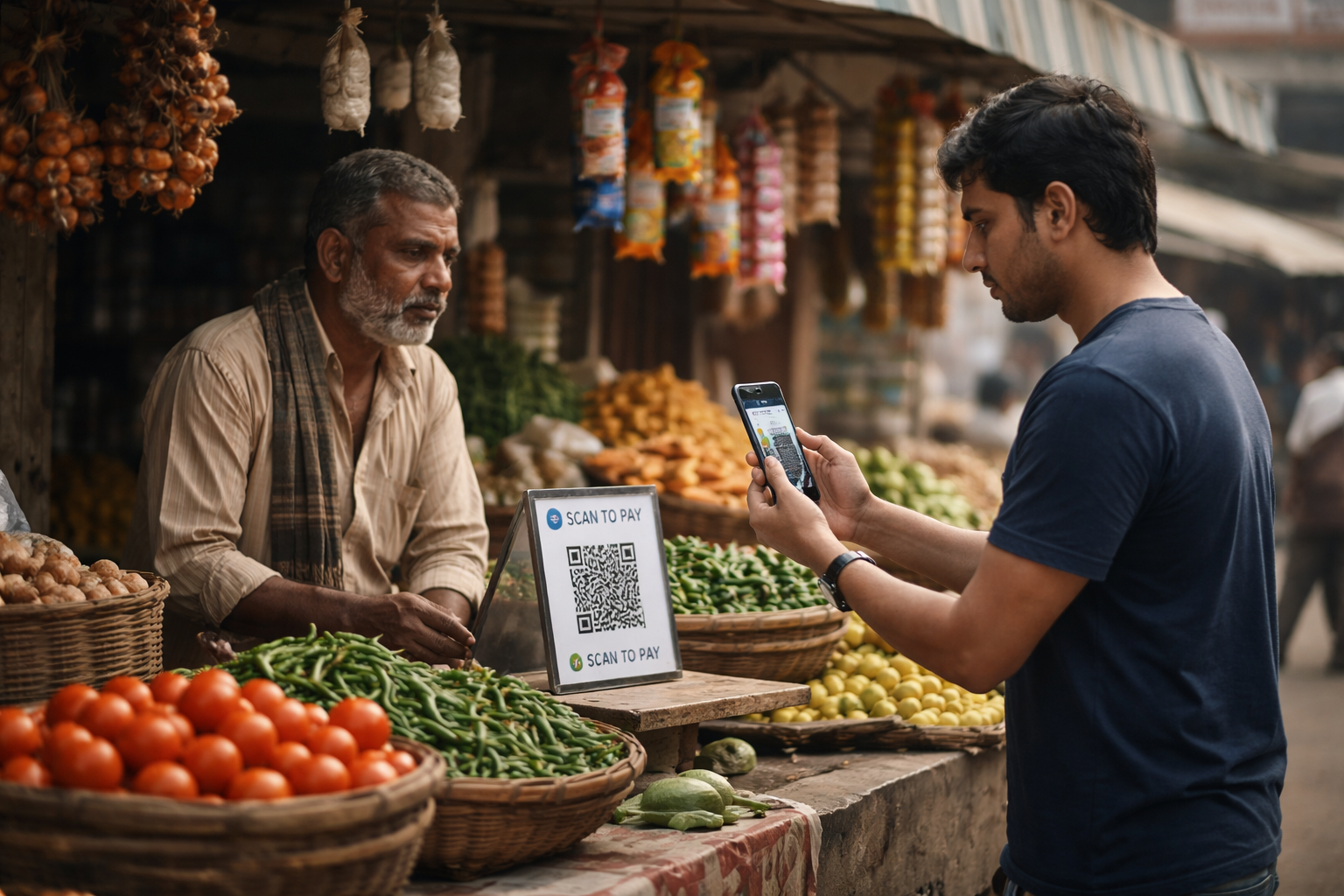
India’s digital payment revolution promises convenience. But beneath it lies a deeper struggle: control of money, sovereignty, and the dignity of ordinary citizens.
I. The morning when money stopped being paper
On a humid Tuesday morning in Kanpur, Rajesh Tiwari stood at a bank counter holding a cheque for ₹1.8 lakh payment for a small consignment of machine parts he had supplied to a factory outside the city.
He had written cheques all his life. His father had done the same. A cheque was simple: ink, signature, trust.
But the clerk barely looked at the paper.
“Sir, digital kar dijiye. Cheque system is changing.”
Rajesh frowned. “Changing how?”
“Soon… everything will be electronic. Even cheques.”
He walked out confused, clutching a piece of paper that suddenly felt like a relic.
That quiet, bureaucratic, forgettable moment is the hinge on which India’s financial future is turning.
Because the Reserve Bank of India is quietly rewriting the architecture of how money moves in the country.
And most people still think it is just about convenience.
It is not.
It is about power.
II. The invisible revolution
Over the last decade, India has become the world’s laboratory for digital payments.
UPI transactions now run into billions every month. Street vendors accept QR codes. Auto drivers say “scan karo” instead of quoting change.
But the RBI’s latest reforms, from stronger authentication rules to the proposed introduction of electronic cheques (e-cheques), signal something larger: a structural redesign of the payment system.
Consider what is happening simultaneously:
• RBI plans to explore e-cheques as part of its Payments Vision 2028 roadmap.
• Digital payment authentication rules are being tightened nationwide.
• The cheque clearing system is being redesigned to enable near-real-time settlement instead of multi-day delays.
• India is piloting the digital rupee, a central-bank digital currency.
Each reform appears technical. Each is presented as modernisation.
But when taken together, they form something far more consequential: the digitalisation of money itself.
And once money becomes fully digital, something subtle but profound changes.
Money stops being something you hold.
It becomes something you are allowed to use.
That difference is civilisation-altering.
III. Why e-cheques matter more than they appear
At first glance, an e-cheque sounds trivial, a digital version of a paper check.
But the humble cheque carries a philosophy of finance that digital systems struggle to replicate.
A cheque is a decentralised trust.
When Rajesh writes a cheque, three things happen:
• He authorises payment.
• The bank verifies the signature.
• The recipient deposits the instrument.
The bank is a facilitator, not an omniscient controller.
Digital payment systems invert this structure.
They require constant verification, central infrastructure, real-time monitoring, and authentication layers.
In India’s new framework, transactions increasingly require multi-factor authentication or risk-based checks.
Security is the justification.
Control is the consequence.
This is the paradox of digital finance: the system becomes faster and safer, yet simultaneously more centralised.
And centralisation is never a neutral technical decision.
It is always political.
IV. The global shadow over India’s payments
No conversation about digital money is honest unless it confronts the geopolitical reality behind it.
For seventy years, the global financial system has been dominated by institutions and infrastructure rooted in the United States.
The dollar system.
SWIFT messaging networks.
Visa and Mastercard rails.
Sanctions regimes enforced through banks.
These are not merely financial tools. They are instruments of geopolitical pressure.
Countries from Iran to Venezuela have learned that access to the financial system can be revoked with a political decision made thousands of kilometres away.
Even allies are not immune.
Ask European companies that were forced to abandon Iran after US sanctions. Ask any nation that has watched Washington weaponise finance.
Israel, too, operates inside this architecture, benefiting from the same geopolitical financial ecosystem that has historically shaped global banking flows.
In such a world, every country faces the same question:
Who ultimately controls the pipes through which money moves?
For India, the answer cannot be foreign.
That is why the RBI’s push toward domestic digital payment infrastructure matters.
Digital payments are not just about convenience.
They are about sovereignty.
V. The word nobody says: permission
There is one word missing from almost every discussion about digital finance.
Permission.
Cash never asked for permission.
A ₹500 note could move from farmer to shopkeeper to mechanic without a server approving the transaction.
Digital money behaves differently.
Every digital payment is a request.
Every request must be authorised.
Every authorisation can theoretically be denied.
The difference between cash and digital money is not technology.
It is permission.
Once money becomes entirely digital, the financial system gains an unprecedented ability to observe, restrict, or shape transactions.
This is not a conspiracy theory.
It is simply the architecture of the system.
A digital payment is always mediated by infrastructure.
And infrastructure always has an owner.
VI. Why RBI’s cautious approach matters
To its credit, the RBI appears acutely aware of these tensions.
Unlike some Western central banks that have rushed toward aggressive digital currency models, India’s central bank has moved cautiously.
It has insisted on:
• Strong authentication mechanisms to prevent fraud.
• Regulatory oversight over fintech platforms entering the payment ecosystem.
• Financial inclusion safeguards for low-income users.
The proposed introduction of e-cheques itself reflects a pragmatic philosophy.
Instead of abolishing legacy instruments, the RBI is attempting to evolve them.
The cheque survives but it becomes digital.
Trust remains but verification becomes faster.
In theory, this is an elegant compromise between the past and the future.
But theory is not reality.
Reality is human behaviour.
And human behaviour introduces risk.
VII. The danger nobody in fintech wants to discuss
The digital payments industry likes to present itself as a miracle of efficiency.
But beneath the polished apps and QR codes lies an uncomfortable truth:
Digital finance concentrates power.
Payment gateways, fintech platforms, telecom providers, and banks all sit inside the chain of a digital transaction.
Each link collects data.
Each link gains influence.
In the wrong hands, financial data becomes surveillance.
The more digital money becomes, the more valuable the map of who pays whom becomes.
And the world has already seen how such data can be abused.
The United States has repeatedly demonstrated its willingness to use financial networks as geopolitical leverage.
Israel has built some of the world’s most advanced cyber-intelligence capabilities, tools that have, in other contexts, raised questions about digital surveillance infrastructure.
India cannot afford to be naïve.
A country of 1.4 billion people cannot allow its financial nervous system to become dependent on external technological ecosystems.
Digital sovereignty is not a slogan.
It is survival.
VIII. The verdict
By the time Rajesh Tiwari returns to the bank next year, his cheque may no longer be paper.
It may exist as a secure digital instrument verified through encrypted signatures and real-time clearing systems.
From the outside, the change will look small.
But it represents a deeper transformation.
India is not merely modernising payments.
It is redesigning the relationship between citizens, banks, and money itself.
The challenge is not technological.
India already has world-class digital infrastructure.
The challenge is philosophical.
Will digital finance empower people or quietly place their economic lives inside systems they do not control?
Because money is not merely currency.
It is freedom in numerical form.
And the day a society forgets that truth is the day its citizens stop owning their money and start merely requesting permission to use it.
The future of India’s digital payments system will be decided by how fiercely that line is defended.


