






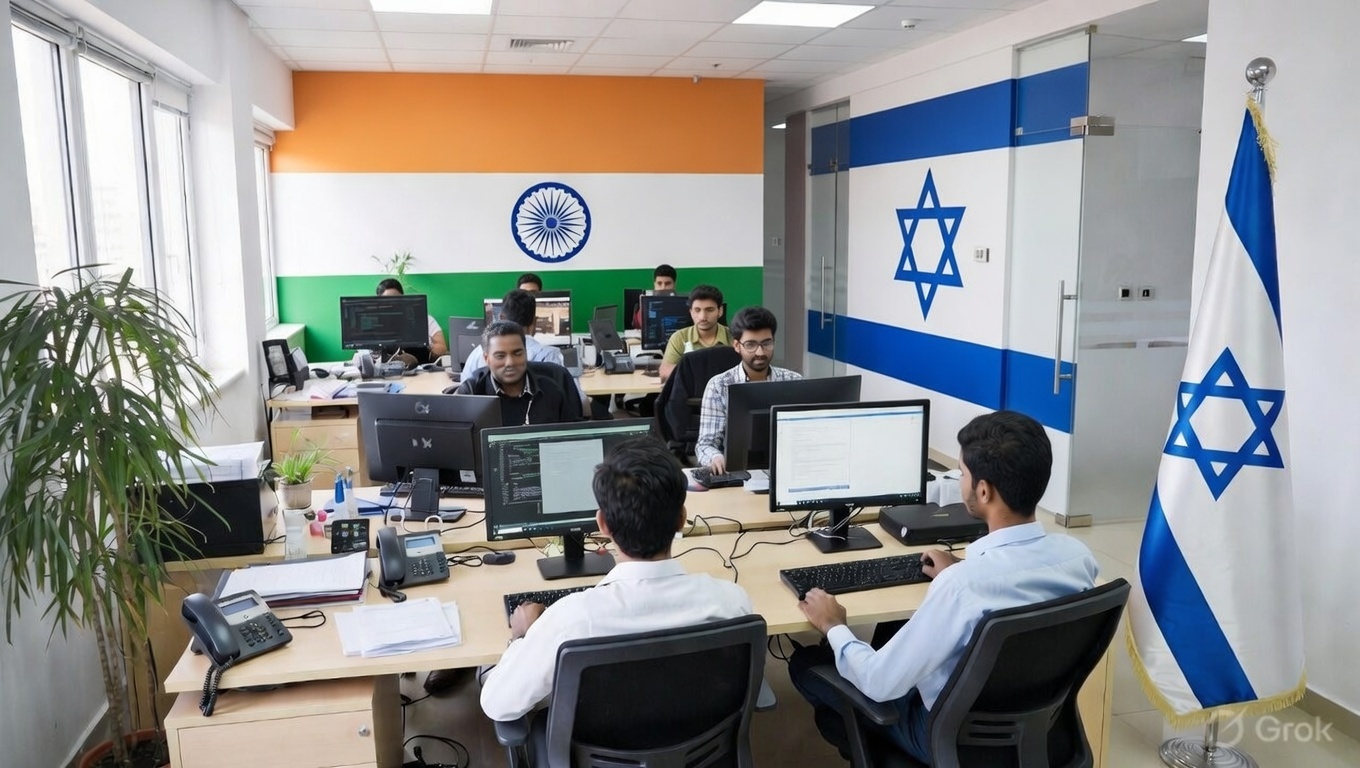
Prime Minister Narendra Modi’s two-day state visit to Israel on 25-26 February 2026 is not simply a diplomatic courtesy call between old friends. It is the most consequential bilateral engagement between New Delhi and Tel Aviv in nearly a decade, and at its centre sits a Free Trade Agreement that both sides have spent years trying, and twice failing, to finalise. This time, the political will appears to be different.
What is also different is the scope: the proposed FTA now explicitly covers artificial intelligence, cybersecurity, quantum computing and semiconductors alongside the older pillars of agriculture and defence. The optics of Modi addressing the Knesset as the first Indian Prime Minister to do so reinforced the gravity of the moment. The economics behind it, though, tell a more complicated and revealing story.
A Long Road to the Negotiating Table
The idea of an India-Israel FTA is not new. The two sides had already completed eight rounds of negotiations before the talks quietly collapsed in October 2021, derailed by disagreement over market access for diamonds, pharmaceuticals and agricultural goods. The relationship continued to deepen in defence and intelligence cooperation but the trade architecture remained thin.
The revival came in September 2025 when Israeli Finance Minister Bezalel Smotrich visited India and the two countries signed a Bilateral Investment Agreement. That deal reduced the local-remedies exhaustion period for Israeli investors in India from five years to three, a technical but significant signal of intent. In November 2025, Commerce Minister Piyush Goyal travelled to Tel Aviv and signed the Terms of Reference for a fresh round of FTA negotiations. The first formal round of those negotiations opened in New Delhi on 23 February 2026, four days before Modi boarded his flight to Ben Gurion airport, covering trade in goods, services, rules of origin, intellectual property rights, customs procedures and sanitary measures.
Israeli Ambassador Reuven Azar said publicly that a deal could be signed within 2026 itself. That is an ambitious timeline for a pact of this complexity, but it reflects a shared sense that this window of political proximity may not stay open indefinitely.
The Numbers Behind the Ambition
The data on current India-Israel trade is useful both for what it shows and for what it quietly concedes. Total bilateral merchandise trade in FY 2024-25 stood at roughly Rs. 30,250 crore (approximately $3.62 billion), placing Israel as India’s second-largest trading partner in West Asia in merchandise terms. India’s exports to Israel during the same year fell 52 per cent to Rs. 17,890 crore ($2.14 billion) from Rs. 37,800 crore ($4.52 billion) the year before. Imports from Israel dropped 26.2 per cent to Rs. 12,370 crore ($1.48 billion). The conflict-related disruptions of 2023-24 in the region clearly took a toll.
Investment flows tell a slightly better story. Israeli foreign direct investment into India between April 2000 and June 2025 totalled roughly Rs. 2,820 crore ($337.77 million). India’s outward direct investment into Israel over a comparable period touched approximately Rs. 3,700 crore ($443 million). The single most striking transaction was the Adani-led consortium’s Rs. 9,850 crore ($1.18 billion) acquisition of Haifa Port in 2022, which made India a presence in Israeli infrastructure in a way that no FTA text could replicate. Israel’s India-Israel Industrial R&D and Innovation Fund (I4F), renewed for 2023-2027, continues to fund joint technology development projects. Meanwhile, 35 of 43 approved India-Israel Centres of Excellence for agriculture are now fully operational across Indian states.
Trade has traditionally been dominated by diamonds, petroleum products and chemicals. That composition is shifting, with electronics, communications systems and medical equipment growing in share. The FTA is meant to accelerate this diversification decisively.
The Diamond Question That Could Define the Deal
Diamonds are not a footnote in India-Israel trade. They are its single most commercially significant category and the one most likely to determine whether the FTA’s final tariff schedule reflects genuine liberalisation or carefully managed ambiguity. India is the world’s dominant diamond-cutting and polishing centre, processing roughly 90 per cent of the world’s diamonds by volume through its hub in Surat, Gujarat. Israel, historically one of the world’s premier diamond-trading nations through the Israel Diamond Exchange in Ramat Gan, has seen its cutting and polishing industry shrink considerably but remains a major trader and certifier of rough and polished stones. The two industries are therefore more intertwined than competitive, which sounds like a recipe for easy agreement but has historically proved the opposite.
The 2021 collapse of FTA negotiations was partly triggered by disagreements over whether Indian polished diamonds would receive zero-duty access to Israeli markets and how Israeli rough diamond imports into India would be treated under existing customs frameworks. Surat’s diamond industry, which employs an estimated 700,000 workers, has a direct commercial interest in the outcome. Any FTA that leaves diamonds in a high-tariff or excluded category would deprive Indian exporters of one of their most natural Israeli market opportunities and would leave the bilateral trade relationship structurally incomplete. The current negotiating round has not yet publicly resolved this tension. It remains the single product category most capable of either anchoring or unravelling the final agreement.
Where AI and Deep Technology Come In
The most forward-looking dimension of the current FTA push is its explicit embrace of technology sectors that barely existed as a trade category in 2021. During the opening session of the February 2026 negotiating round, Commerce Secretary Rajesh Agrawal underscored the significant opportunities available to both sides in sectors such as innovation, science and technology, artificial intelligence, cybersecurity and high-tech manufacturing, emphasising that the FTA would enable both countries to harness and fully leverage these opportunities.
Israel is home to one of the world’s densest concentrations of AI and cybersecurity startups, with approximately 25 per cent of its tech firms now dedicated to artificial intelligence and those firms attracting 47 per cent of all technology sector investment in the country. India is the world’s largest technology services exporter and is building out its domestic AI infrastructure rapidly. The complementarity is real and commercially specific.
Check Point Software Technologies, founded in Tel Aviv in 1993 and now one of the world’s leading cybersecurity firms, opened its second-largest global office in Bengaluru in May 2024, a 42,700-square-foot facility that signals long-term commitment to the Indian market. Tower Semiconductor has already signed a deal with Adani Group to build a Rs. 83,500 crore ($10 billion) semiconductor fabrication plant in Maharashtra, initially targeting output of 40,000 wafers per month.
Two Israeli AI firms illustrate the texture of what a formal bilateral framework could unlock. AI21 Labs, the Tel Aviv-based large-language-model developer founded in 2017 by Yoav Shoham, Amnon Shashua and Ori Goshen, whose Jamba and Jurassic model families have found enterprise adoption across multiple geographies, is a natural candidate for the co-development arrangements that India’s National AI Mission is designed to facilitate.
Tabnine, also founded in 2017 by Dror Weiss and Eran Yahav, is an AI-powered code-completion and developer-assistance platform used by over one million software professionals globally. Its relevance to India’s 5.8-million-strong developer workforce is direct: an FTA that eases licensing, data-sharing and service-delivery barriers could accelerate Tabnine’s penetration of the Indian enterprise software market while simultaneously lifting the productivity of Indian developers working in global technology supply chains.
Where the FTA could shape something genuinely structural is in India’s AI skilling economy. India currently trains roughly 1.4 million engineering graduates annually, many of whom enter technology services with limited exposure to applied AI systems. Israeli universities, particularly the Technion and the Weizmann Institute, have produced some of the world’s most influential AI researchers. A formal education and research exchange mechanism embedded within the FTA, of the kind that India has not yet included in any comparable bilateral agreement, could create pathways for Indian institutions to co-develop AI curricula with Israeli counterparts.
The National AI Mission, launched in March 2024 with a budget of Rs. 10,372 crore, is already seeking international partnerships for its compute infrastructure and research nodes. Israel is an obvious candidate, particularly given that Israel has recently established a dedicated AI Directorate within its Prime Minister’s Office and is advancing its own sovereign supercomputing capacity.
On data-sharing frameworks, the stakes are equally significant. Both countries have invested heavily in digital public infrastructure: India through its India Stack and UPI ecosystem, Israel through its national digital identity and health data systems. An FTA that includes provisions on cross-border data flows, mutual recognition of data protection standards and joint AI research funding could create a bilateral AI corridor that goes well beyond conventional trade. No such framework currently exists between the two countries. The current negotiating round has intellectual property on its agenda; data governance is the logical next step and one that diplomats on both sides have signalled they are willing to explore.
Defence: The Quiet Backbone of the Relationship
Here is where the relationship has always been most durable, even if also most quietly managed. India is among the largest buyers of Israeli defence technology globally. Elbit Systems, Israel’s largest defence electronics company, operates in India through a partnership with Adani Defence and was involved in setting up the country’s first jointly run drone manufacturing facility. Elbit has also submitted proposals related to Helmet Mounted Display systems for India’s Advanced Medium Combat Aircraft programme. Israeli AI systems, including autonomous-decision platforms and battlefield AI, are relevant to India’s Sudarshan Chakra air-defence project, which is reportedly exploring integration with technologies derived from the Iron Dome ecosystem.
An FTA with substantive defence manufacturing provisions could push this relationship beyond buyer-seller into something more genuinely co-developmental. India’s Make in India framework creates structural demand for technology transfer, joint production and local content. The current negotiating round includes investment facilitation and technology transfer within its scope, suggesting both sides are trying to square that circle.
Israeli Companies Already Rooted in Indian Soil
Several Israeli firms have built meaningful presences in India well before the FTA negotiations began. Netafim, founded in 1965 at Kibbutz Hatzerim in the Negev desert, pioneered drip irrigation and entered the Indian market in 1997. It now runs three production plants in India, employs over 1,000 people and its technologies reach more than 1.2 million Indian farmers across roughly one million hectares. Teva Pharmaceutical Industries, founded in 1901 and one of the world’s largest generic drug manufacturers, has a distribution presence in India.
Watergen, which extracts drinking water from atmospheric humidity, has piloted rural water-scarcity projects across Indian states. IDE Technologies, specialising in water desalination, has engaged with Indian infrastructure planners. Mobileye, the Jerusalem-based autonomous driving technology company now owned by Intel, has discussions underway with Indian mobility firms. The India-Israel tech corridor is already functioning. The FTA would institutionalise and scale what is currently ad hoc.
What the Israeli Economy Stands to Gain – and What It Risks
Israel is a high-income economy of fewer than 10 million people. Its technology sector punches well above its demographic weight, but the domestic market alone cannot sustain the growth ambitions of its defence and deep-tech industries. A deepened trade relationship with India, the world’s most populous country and fifth-largest economy, offers Israeli exporters in defence electronics, water technology and precision agriculture a market of transformational scale.
Yet the Israeli economy is not without vulnerability in this deal. India is the world’s largest exporter of generic pharmaceuticals, supplying approximately 20 per cent of global generic volume by quantity. If an FTA opens Israeli markets to Indian generics at significantly reduced tariffs, the price competition could be severe. Israeli generic producers, already squeezed by global pricing pressures that have hit Teva’s revenues in recent years, would face a competitor whose manufacturing costs are structurally lower. Israeli health economists have flagged this as an area needing careful tariff phasing and safeguard mechanisms rather than immediate liberalisation.
The chemicals sector tells a similar story. India is among the world’s top five chemicals exporters, with particular strength in agrochemicals, dyes, specialty chemicals and basic industrial chemicals. Israeli firms in these segments, while technologically sophisticated, operate at a cost base that cannot easily compete with Indian volume producers on price alone. Israeli textile and apparel producers could similarly feel the pressure of Indian competition in the domestic retail market. India’s apparel exports, valued at roughly Rs. 1,50,000 crore ($18 billion) globally, are price-competitive at a level that few small economies can absorb without adjustment costs. The net calculus still favours the agreement for Israel, but the transition costs in generics, chemicals and textiles deserve more candid acknowledgement in the official diplomatic narrative than they have so far received.
What India Gets in Return
India’s export basket to Israel remains concentrated in pearls, precious stones, petroleum products, chemicals, machinery and textiles. An FTA could open Israeli markets more widely to Indian pharmaceuticals, IT services and agricultural products while bringing in Israeli technologies, particularly in water management, precision farming, cybersecurity and defence electronics, at more competitive prices. For Indian businesses, particularly MSMEs, the certainty and predictability that a formal trade framework provides matters as much as the tariff reductions themselves. For India’s larger strategic ambitions, a closer economic relationship with a technologically sophisticated ally in a volatile region is worth considerably more than its balance-of-trade arithmetic alone suggests.
The negotiations will not be simple. Diamonds remain a contentious product category. Intellectual property standards will need careful calibration. Agriculture is politically sensitive on both sides. But the architecture being built, from the Bilateral Investment Agreement of September 2025 to the Terms of Reference of November 2025 and the first formal negotiating round of February 2026, suggests both governments have decided that the cost of delay now exceeds the cost of compromise. The diamond dispute, the AI corridor ambition and the defence co-production agenda will each test that political will. Whether all three survive the negotiating room intact will determine whether this FTA becomes a genuinely transformative agreement or simply a well-intentioned framework that delivers less than the summit promised.
Subscribe Deshwale on YouTube