








Our Grandmothers Knew the Answer. Science Is Just Catching Up.
Think about the last time you sat down for a proper Indian meal the kind your mother or grandmother put together. Not a restaurant thali, but the real thing. A meal that took most of the afternoon to cook, where the kitchen smelled of tempering mustard seeds and something slow-simmering on the back burner.
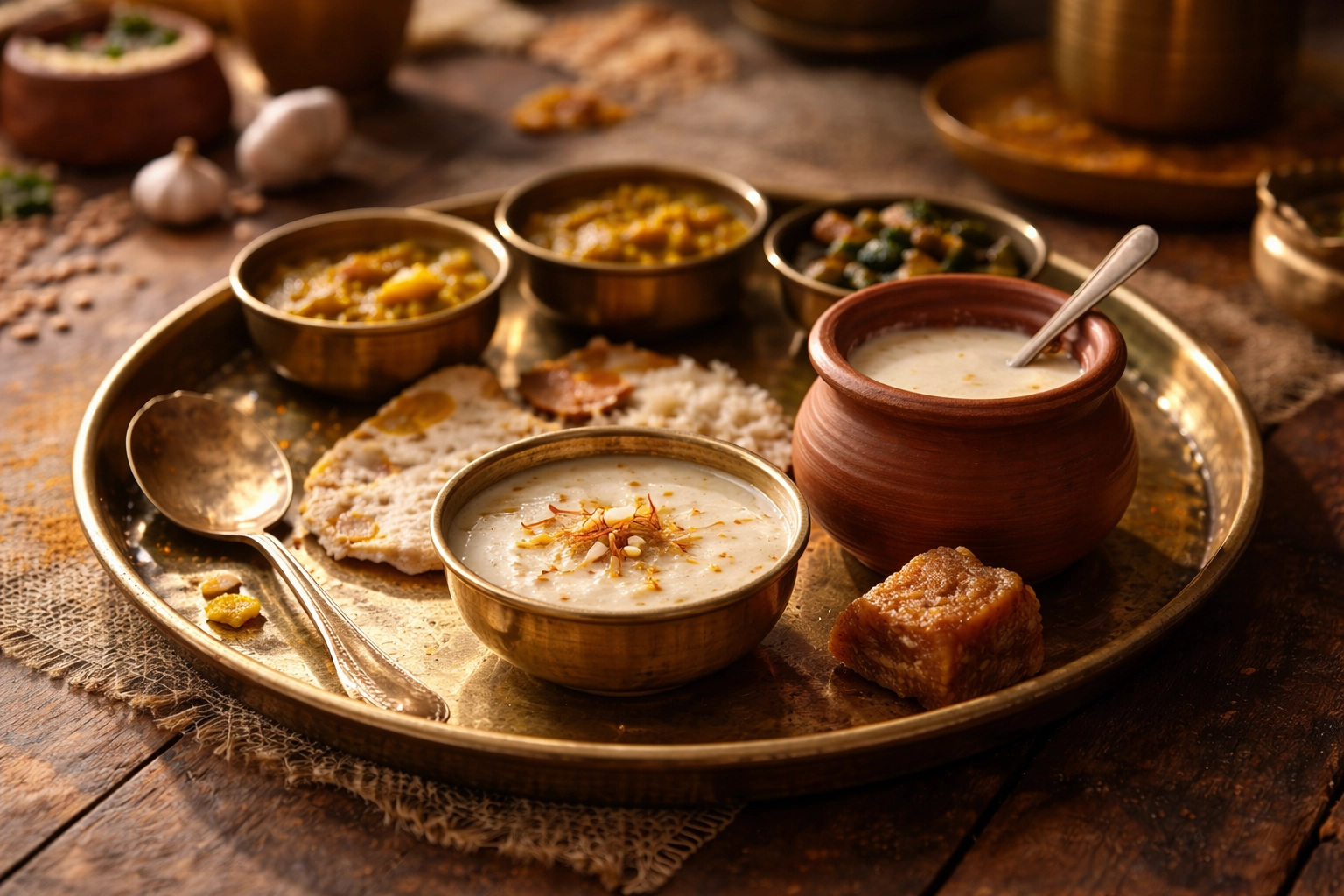
You ate. Maybe too much. The dal was right, the sabzi was perfect, there was rice and roti and something pickled and sharp on the side. And then, just when you thought you were done, a small bowl appeared. A spoonful of kheer. A piece of jaggery. A cup of mishti doi, cool and trembling in its earthen pot. Something sweet is always something sweet.
You didn’t question it. Nobody ever did. It was just how the meal ended. It was tradition.
But what if it wasn’t just tradition? What if the women who built these meals across thousands of years and dozens of regional kitchens were practicing something that modern nutritional science, with all its laboratories and clinical trials, is only now beginning to understand?
A Country that has always known how to end a meal
India is not one cuisine. It is thirty-six cuisines stitched together by a subcontinent, each shaped by geography, religion, season, and the particular genius of the people who lived there.
And yet, across almost all of them, one pattern holds.
In Bengal, a proper thali ends with mishti doi sweetened yogurt set in earthen pots and payesh, a slow-cooked rice pudding fragrant with cardamom. The meal is not considered complete without it. In daily Bengali life, mishti functions as both treat and punctuation: a small sweet at the end of a meal, a shared plate in the office, a stop at a neighborhood shop after evening walks. To a Bengali, ending a meal without something sweet is like ending a sentence without a full stop. Grammatically wrong.
Travel south. The South Indian thali, often served on banana leaves, includes rasam, sambar, curd rice, and payasam, each element creating balance and comfort. The payasam rice or vermicelli cooked slowly in sweetened milk comes at the end, always. In Karnataka, a traditional Kannadiga Oota includes payasam as a fixed part of the meal structure, not an afterthought.
Go west to Gujarat. Gujaratis use jaggery or sugar as a key ingredient in almost every preparation. Sweetness runs through the entire thali, not just the dessert. And the meal closes with shrikhand or aam ras thick, golden, unapologetically sweet. In Rajasthan, the famous Dal Baati Churma is itself a trio where the churma, a crumbled sweet wheat preparation drenched in ghee and jaggery, sits alongside the dal and the baati, integral to the meal, not optional.
This is not a coincidence. Across such vast distances of culture and climate, no culinary habit survives for thousands of years by accident. Something was understood, even if it was never written down in the way a research paper would demand.
The ancient science behind the sweet ending
The written explanation, it turns out, has existed for over three thousand years. It just wasn’t written in a language that 21st-century nutrition journals would recognise.
Ayurveda, the ancient Indian system of medicine whose foundational texts, the Charaka Samhita and Sushruta Samhita, date back to roughly 600 BCE has a remarkably detailed theory of taste. It identifies six rasas, or tastes, that every meal should ideally contain: sweet (madhura), sour (amla), salty (lavana), pungent (katu), bitter (tikta), and astringent (kashaya). Each of these six tastes was understood to have specific energetic properties affecting physical, mental, and emotional wellbeing.
Of these six, the sweet taste occupies a particular position. Among the six tastes, sweet is described as the only rasa that promotes health to every tissue of the body. Madhura rasa primarily pacifies Vata and Pitta dosha and imbalanced Pitta dosha is responsible for poor metabolism, improper digestion, and burning sensations.
A meal of cooked Indian food is, by its nature, heating. Spices, lentils, tamarind, mustard these are warming, fiery foods that stimulate digestion but also stoke what Ayurveda calls Pitta. Madhura rasa helps reduce high Pitta with its cooling potency, eliminating the discomfort associated with it. The sweet at the end of the meal, then, was not a reward. It was a coolant. A digestive balancer. The full stop that told the body calmly, without inflammation that the meal was done and the work of digestion could now begin in peace.
Ayurveda believes that sweet taste enhances Ojas, the vital essence of life nourishing all bodily tissues, relieving thirst and burning sensations, and helping us emotionally by being grounding and comforting.
Our grandmothers did not know the word Pitta. Many of them had never heard of Ojas. But they knew, in the way that knowledge passed through generations of practice becomes instinct, that the meal felt wrong without that final sweetness. That the body felt unsettled, slightly unfinished, without it.
They were right.
What the mishti doi knows that we forgot
There is another layer to this story that even Ayurveda does not fully explain, but modern gut science does.
Consider mishti doi, that extraordinary Bengali invention, thickened milk fermented overnight in porous earthen pots sweetened with date palm jaggery. The gradual evaporation of water through the earthen pot’s walls not only thickens the yogurt but produces the right temperature for the growth of the culture. This is a probiotic food, rich in live bacteria. Before anyone used the word probiotic, before Lactobacillus was isolated in a European laboratory, the people of Bengal were fermenting milk in clay and eating it at the end of meals.
Before the discovery of drugs for typhoid, well-known physicians like Dr. B. C. Roy prescribed mishti doi for their patients, noting its accumulation of B vitamins. The same tradition that existed in homes existed in medical practice, because the line between the two in Indian culture was never as sharp as it became in the modern world.
The payasam of South India tells a similar story. Rice cooked in milk with cardamom and jaggery is not refined sugar, but jaggery, which retains iron, calcium, potassium, and magnesium that white sugar strips away entirely. The kheer of the North, the shrikhand of the West, the Mysore Pak of Karnataka these are not empty indulgences. They are, in the main, milk-based, often spiced, frequently made with jaggery. They carry calcium, protein, and the natural calming effect of tryptophan, an amino acid in dairy that the brain converts to serotonin.
Our grandmothers didn’t know what tryptophan was. But they knew that a small bowl of kheer at the end of the day made you feel settled. Calm. Ready to rest.
The thali was always a complete system
This is perhaps the most important thing to understand, and the thing that gets lost when we reduce the post-meal sweet to a mere “craving” or a nutrient deficiency.
The Indian thali was never a random collection of dishes. It was in its traditional form, in every regional variation a carefully balanced system. When a meal incorporates all six tastes, it creates balance for the doshas, and the person feels truly satiated. This stops further imbalance, helps calm cravings, and reduces the need for snacking.
Think about what a classic thali actually contains. There is bitterness in the karela or the methi. There is astringency in the dal and the unripe mango pickle. There is salt, sourness from the tamarind or the yogurt-based curry, pungency from the ginger and chili. And at the end, sweetness. Every single taste that Ayurveda says a body needs is present, in proportion, on one plate.
Modern nutritional science has a different vocabulary for this, but it arrives at a surprisingly similar conclusion. A meal that contains protein, complex carbohydrates, fat, fiber, fermented foods, and a small amount of natural sugar at the end creates satiety that lasts. It does not spike blood sugar the way eating sweets on an empty stomach would. It does not create the crash-and-crave cycle that drives unhealthy snacking. It ends the meal cleanly, with the brain receiving the signal through a gentle, familiar sweetness that the meal is finished.
The thali did not need a nutritionist to design it. It had thousands of years of accumulated observation, carried and refined by women who watched what made people feel well and what did not.
What we are losing
There is something worth mourning in how this is changing.
The traditional post-meal sweet was small. A spoonful of kheer. Two pieces of sandesh. A small earthen cup of mishti doi. It was never the enormous portion of gulab jamun in sugar syrup that restaurants serve today. It was never the slab of cake or the industrial-scale dessert that has colonised the Indian dining table through the influence of Western eating habits.
The wisdom was not just in the sweetness it was in the restraint. A cooling, nourishing, digestive-friendly small sweet, made from whole ingredients, served in modest quantities at the end of a balanced meal. That is a very different thing from dessert culture as we have imported and amplified it.
The other thing being lost is the knowledge of why. When the reason for a tradition disappears from memory, the tradition either becomes meaningless ritual or gets abandoned entirely in favour of something that seems more modern, more scientific, more legitimate. We stopped trusting the earthen pot of mishti doi and started trusting the blister pack of probiotic supplements. We stopped trusting jaggery and started trusting the refined sugar that has none of jaggery’s nutritional complexity.
Science was always in the kitchen. We just stopped reading it.
The grandmother was the original nutritionist
There is a woman who exists in every Indian family, in every generation just past who knew things about food that no one ever wrote down. She knew that you eat the shukto at the beginning of the Bengali meal because its bitterness prepares the stomach. She knew that you don’t drink cold water with food because it disrupts digestion. She knew that the payasam goes at the end and not the beginning, and she would have looked at you with magnificent bewilderment if you had asked her why, because to her it was simply obvious. The meal worked this way. The body responded well. That was evidence enough.
Modern science is now, tentatively and in the formal language of journals and trials, arriving at many of the same places. Researchers studying post-meal sweet cravings are finding that they are partly neurological. The brain genuinely signals a desire for sweetness at the end of a meal, as a way of completing the digestive cycle and settling the nervous system. Traditional Indian food gave the brain exactly what it was asking for, in a form that was also genuinely nourishing.
That is not luck. That is wisdom refined over millennia by people who paid close attention to the relationship between what they ate and how they felt and who passed that knowledge forward, meal by meal, in the only university that ever truly mattered: the kitchen.
The next time you finish a meal and find yourself reaching for something sweet, a piece of jaggery, a small bowl of kheer, a spoonful of mishti doi from the earthen pot that always sat on your grandmother’s kitchen counter, do not feel guilty about it. Do not call it a craving or a weakness or a habit you need to break.
Call it what it actually is: your body doing exactly what three thousand years of accumulated Indian culinary wisdom taught it to do. Asking for balance. Asking for the cooling sweetness that settles the fire of the meal. Asking, in the oldest language the body knows, to be made whole.
Your grandmother understood the question. She also knew the answer.
She put it in a small clay pot and called it mishti doi.
Subscribe Deshwale on YouTube


