










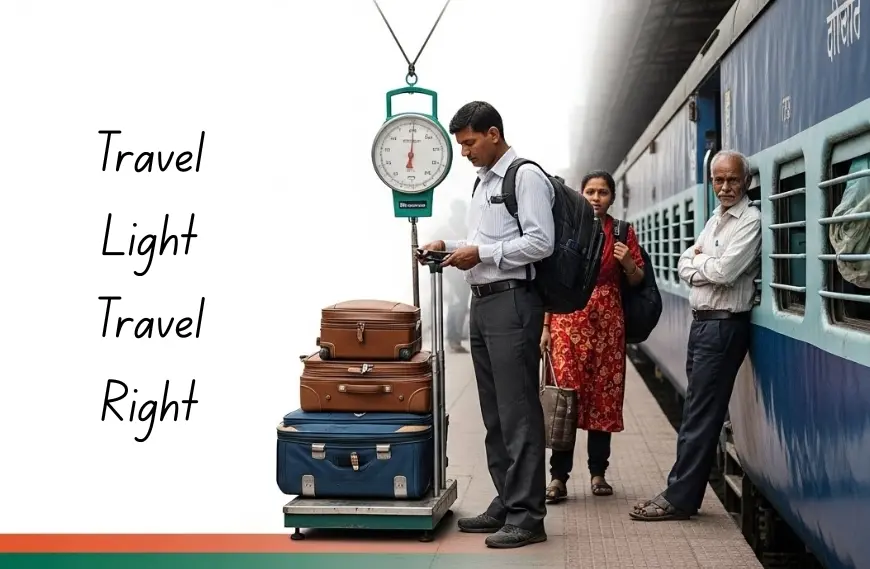
Indian Railways allows passengers to carry personal luggage on trains, but there are limits on how much you can carry without paying extra. These rules are meant to ensure safety, comfort, and fair use of space for everyone travelling. Recently, authorities have emphasised that passengers must adhere to these rules and pay charges when their baggage exceeds the allowed limits.
This article explains these luggage guidelines in straightforward language and also highlights some key challenges in enforcing them.
Free luggage allowance: How much you can carry without extra charges
When you board a train, you can carry a certain amount of luggage for free, this means no additional charges if you stay within these weight limits. The free allowance differs by class of travel:
- AC First Class: up to 70 kg
- AC 2‑Tier / First Class Sleeper: up to 50 kg
- AC 3‑Tier / Chair Car: up to 40 kg
- Sleeper Class: up to 40 kg
- Second Class: up to 35 kg
These limits are intended to cover suitcases, bags, and personal items that a typical traveller would carry during a journey.
Maximum luggage and extra charges
Passengers may carry more luggage than the free allowance, but charges apply for the extra weight. The maximum total luggage allowed, including the free portion, is higher, depending on the travel class:
- AC First Class: up to 150 kg
- AC 2‑Tier / First Class Sleeper: up to 100 kg
- AC 3‑Tier / Chair Car: up to 40 kg only
- Sleeper Class: up to 80 kg
- Second Class: up to 70 kg
If your luggage exceeds the free allowance but is within the maximum limit for your class, you must book the excess luggage and pay a fee. In practice, extra luggage is charged at a rate that is typically higher than the standard weight rate, often around 1.5 times the normal charge for the additional weight. This means that if you carry luggage beyond your free limit, you pay more for every extra kilogram.
If luggage goes significantly beyond these limits or is not booked properly, passengers may be required to pay higher fines, and railway officials can refuse to allow that luggage inside the compartment.
Size limits and special items
In addition to weight, there are size limits for luggage that is carried inside passenger coaches:
- Dimensions must not exceed: 100 cm x 60 cm x 25 cm.
Luggage larger than this, such as big trunks or commercial goods, cannot be placed inside the passenger compartment. Such oversized items must be booked as parcel luggage or transported in separate luggage vans.
Items intended for sale, commercial products, or goods not meant for personal use are not allowed as cabin luggage and must be booked appropriately before the journey.
Why luggage rules matter
These rules are intended to achieve several goals:
1.Comfort: Excessive luggage inside compartments can block aisles and make the journey uncomfortable for other passengers.
2. Safety: Unchecked heavy or oversized luggage can become a hazard, especially during sudden stops or emergencies.
3. Fair Use: Clear limits ensure that no passenger takes up more than their fair share of space.
4. Revenue: When luggage is booked and paid for, Railways earns additional revenue that can support services.
Large or unchecked luggage: Real risks and challenges
One of the biggest practical issues is that, in many stations, luggage is rarely weighed or inspected before boarding. Unlike airports, where baggage is screened and weighed systematically, most railway stations do not have weighing machines or scanning systems at the entry points. As a result:
- Passengers often carry heavy luggage without ever being checked.
- Railway staff at platforms may not enforce the rules consistently.
- Overcrowded compartments with luggage placed in aisles can obstruct movement and pose safety risks.
This raises a fundamental problem: the rules exist on paper, but there is no reliable mechanism to enforce them across all stations. Without proper infrastructure, such as luggage weighing machines, X‑ray scanners, and trained personnel, the Railways cannot ensure that passengers are truly following the guidelines.
If luggage is not checked, the Railways also loses the opportunity to collect legitimate charges for excess weight. This affects safety, revenue, and passenger experience.
Improving the system: What needs to change
If Indian Railways wants these luggage rules to be meaningful, several practical steps are necessary:
- Install weighing machines at station entrances so that baggage can be checked fairly and consistently.
- Deploy X‑ray or scanner equipment for luggage security, especially at major railway stations.
- Train staff to enforce baggage rules politely and efficiently, with clear communication to passengers.
- Educate travellers through announcements and signage, so everyone knows what they can carry and what charges apply.
- Link luggage enforcement to ticketing systems, so passengers can pay any excess charges before boarding rather than face confusion or fines later.
Without these measures, the rules remain aspirational rather than functional, written regulations without the tools to implement them effectively.
A passenger’s checklist before you travel
To avoid surprises at the station or on the train:
- Weigh your luggage at home before you leave for the station.
- Keep bags organized and within size limits, so they fit under seats or on luggage racks.
- If you have heavy items, plan to book them in advance in the luggage or parcel section.
- Ask at the booking counter if you are unsure about charges for excess luggage.
- Arrive early, especially if you need to go through security checks or book heavy luggage.
Indian Railways has clear luggage rules designed to maintain safety, comfort, and fairness. Each class of travel has a free allowance, and it is possible to carry more luggage by paying additional charges, but this requires booking and compliance. The challenge today is not lack of rules, but the absence of consistent enforcement and adequate infrastructure to support them.
If the Railways strengthens its checking systems and trains staff properly, enforcing luggage limits can benefit passengers and the system alike, making journeys safer, more orderly, and fair for all travellers.
Subscribe Deshwale on YouTube


