









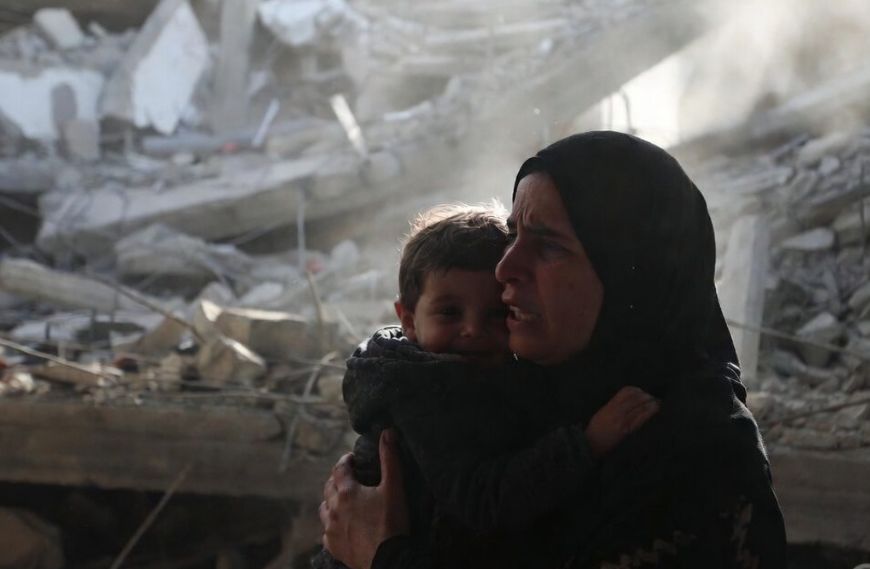
I. A Mother’s Whisper, and the World’s Loudest Silence
In a half‑destroyed school in northern Gaza, a mother named Fatima has not slept properly in eighteen months. She has learned to identify the sound of each type of drone, each calibre of explosion, each hour of the night when the bombing is worst. Last week, she watched her neighbour dig a child from the rubble, a child who had been playing with a deflated football only minutes before. Fatima no longer cries. She has no tears left. What she has is a single, exhausted question, whispered into the dust: *Where is the world?*
That question is aimed at all of us. But it lands with special weight on one man: Pope Francis, leader of 1.4 billion Catholics, head of a state with diplomatic relations across the globe, and the most visible moral voice on earth. When Fatima’s radio crackled with the latest Vatican statement, a call for “dialogue,” “restraint,” and “prayers for peace” she did not feel comfort. She felt abandoned. And she is not alone.
From the refugee camps of Rafah to the parish halls of Manila, from the favelas of São Paulo to the university chaplaincies of Nairobi, a growing number of Catholics and non‑Catholics alike are asking a forbidden question: Is it fair to criticise the Pope when he defends the indefensible?
The answer, this article will argue, is not only yes it is a moral necessity.
II. What the Pope Has Said, and What He Has Not Said
Let us be precise, because precision is the first casualty of moral panic.
Pope Francis has indeed condemned the Hamas attack of 7 October 2023 as “abominable” and “inhuman.” He has called for the release of hostages. He has described Israel’s military campaign in Gaza as “cruelty, not war.” He has even suggested, in carefully hedged language, that an international investigation should examine whether events in Gaza “carry the characteristics of a genocide.”
These are not nothing. In the history of papal statements on modern conflicts, they are unusually direct.
And yet.
The same Pope who spoke of “cruelty” has consistently refused to call for a permanent ceasefire without preconditions. The same Vatican that deplores civilian deaths has not imposed any diplomatic sanction, not withdrawn its nuncio, not broken communion with political leaders who supply weapons. The same moral authority that could be used to demand an immediate arms embargo has instead been deployed in the language of balance: “suffering on both sides,” “legitimate concerns of Israel,” “avoiding antisemitism.”
Here is the problem: when one side possesses F‑35s and the other possesses rubble, “both sides” language is not neutral. It is a form of weighting a subtle but unmistakable equation of unequal things.
The Church’s own *Catechism* teaches that “the deliberate murder of a civilian is a grave sin” and that “collective punishment is a crime against humanity.” These are not optional doctrines. And yet the institution that proclaims them has, for eighteen months, failed to apply them to the most documented campaign of urban warfare in modern history with over 35,000 confirmed civilian deaths (including more than 12,000 children), the systematic destruction of hospitals and universities, the forced displacement of nearly two million people, and a man‑made famine that the world’s leading humanitarian agencies have called “entirely preventable.”
Fatima’s child did not die of a stray bullet. She died of slow starvation while the world’s most powerful moral voice prayed for peace.
III. The Global South Has Already Made Its Judgement
One of the most dishonest arguments against criticising the Pope is that it represents a Western, liberal, or secular impatience and a failure to understand the slow, patient diplomacy of the Vatican.
The truth is the opposite.
Across the Global South in Latin America, Africa, Asia, and the Middle East millions of Catholics have watched the Vatican’s caution with growing disillusionment. They do not need lectures on patience from Rome or Washington. They have lived through colonialism, dictatorships, structural adjustment, and the quiet complicity of Western institutions. They know, from bitter experience, that the Church speaks one language when its own power is threatened and another when the victims are far away.
Consider: when clerical abuse scandals erupted in Ireland, the United States, and Germany, the Vatican moved with extraordinary speed not always effectively, but with unmistakable urgency. Lawyers were hired. Archives were searched. Bishops were summoned. Institutional survival was at stake.
Now consider Gaza. The same institutional machinery has produced… statements. Prayers. A few phone calls. And then, silence.
A bishop in a conflict zone once told me: “The Church protects its own. The question is always: who counts as ‘its own’?” For too many in the Global South, the answer has become painfully clear. Palestinian Christians a living, breathing community in the land of Christ’s birth have been bombed, displaced, and starved alongside their Muslim neighbours. Their patriarchs have pleaded for action. And Rome has responded with the moral equivalent of a shrug wrapped in a homily.
This is not a failure of theology. It is a failure of solidarity.
IV. Just War, Just Peace, and the Pope’s Own Principles
The Catholic tradition of just war theory is not a blank check for self‑defence. It is a stringent set of constraints. To be morally legitimate, a war must meet five criteria: just cause, legitimate authority, right intention, last resort, proportionality, and discrimination between combatants and non‑combatants.
Israel’s campaign in Gaza fails nearly every one.
– Proportionality? Over 35,000 civilian deaths versus approximately 1,200 Israeli deaths (including the 7 October victims). The ratio alone is indefensible.
– Discrimination? Bombing hospitals, schools, refugee camps, and humanitarian aid convoys is not a failure of precision, it is a pattern.
– Last resort? A ceasefire and hostage exchange was on the table multiple times. Each time, the fighting resumed.
– Collective punishment? The siege, the blockade, the forced starvation of an entire population these are explicitly forbidden by the Fourth Geneva Convention.
The Pope knows this. He has studied the tradition. He has quoted it. And yet, when asked to apply it to Gaza, he has demurred.
This is not a theological disagreement. It is a moral abdication.
V. The Fear of Antisemitism Is Being Weaponised and the Pope Knows It
One of the most painful realities of this conflict is the cynical exploitation of Jewish suffering to shield Israeli state policy from criticism.
The Pope has repeatedly condemned antisemitism rightly, passionately, and with the full weight of the Church’s history of complicity in the Holocaust. That condemnation is sacred. It must be repeated.
But it is also being abused.
Israeli officials call any criticism of the military campaign “antisemitic,” when Western politicians demand that any mention of Palestinian suffering be balanced with a reminder of 7 October, when the memory of six million Jews is invoked to justify the bombing of a refugee camp that is not solidarity. It is a hostage taking of history.
Palestinians are not responsible for Europe’s crimes against Jews. They should not pay for them with their children’s lives. And the Pope of all people should be able to say this clearly, without qualification, without fear.
He has not. And that failure is not caution. It is cowardice dressed in diplomacy.
VI. What Would 10/10 Moral Leadership Look Like?
To criticise is not enough. We must also imagine what we are asking for.
If Pope Francis truly wished to lead not just speak he could do the following tomorrow, without changing a single doctrine:
1. Declare, unequivocally, that the military campaign in Gaza is a violation of just war principles and must end immediately not “as part of a negotiated settlement,” but now, unconditionally, because civilian slaughter cannot be bargained away.
2. Announce that the Vatican will use its diplomatic relations with Israel to demand an independent international investigation into war crimes and that continued refusal will result in the suspension of diplomatic ties.
3. Call on all Catholic institutions worldwide to divest from any company supplying weapons to the Israeli military, a move that would echo the anti‑apartheid campaigns of the 1980s and would cost the Vatican nothing in theology but everything in credibility.
4. Travel to Gaza not to a secure compound in Jerusalem, not to a photo op at the border, but to the rubble, to the hospitals, to the starving children. A Pope who visited a refugee camp in Africa, who washed the feet of prisoners, who kissed the hands of abuse survivors knows what a prophetic witness looks like. He has simply refused to apply it here.
None of this would end the war overnight. But it would shatter the comfortable fiction that moral authority is powerless. It would force the United States, the European Union, and the United Nations to respond. It would give cover to every Catholic politician, every Christian voter, every ordinary person who wants to act but feels alone.
That is what leadership looks like. Not prayers. Pressure.
VII. The Wound Will Not Close with Silence
Fatima, the mother in that half‑destroyed school, does not need another prayer for peace. She prayed until her voice broke. What she needs is a world that finally stops performing balance and starts acting.
Criticising the Pope is not an attack on faith. It is an act of faith, the faith that the Church can be better than it has been, that moral authority can be wielded rather than hoarded, that the successor of Peter can choose the crucified over the comfortable.
Millions of Catholics already believe this. They are waiting for a sign that Rome agrees.
The wound of Gaza will not close with careful language. It will not heal with diplomatic niceties. It will close only when those with power, including the man in white decide that the bodies of children matter more than the approval of presidents and prime ministers.
Until then, it is not only fair to criticise the Pope.
It is the bare minimum required of anyone with a conscience still intact.
Final Note:This article does not claim certainty about every tactical decision in a complex war. It does claim that mass civilian starvation is always and everywhere indefensible. It does claim that moral leadership requires more than measured statements. And it does claim that loyalty to the Gospel not disloyalty demands speaking plainly when the powerful fail the powerless.
If that is radical, then Christ was radical first.
Subscribe Deshwale on YouTube


