










A ceasefire that lost its meaning before the ink could dry
History occasionally produces moments where an announcement becomes, in itself, the problem. The night of April 7, 2026 was precisely such a moment.
According to sources close to the negotiations conducted by US envoys Witkoff and Kushner, Pakistan’s army chief, Turkey’s foreign minister, and his Iranian counterpart Trump announced the ceasefire just 15 to 20 minutes after a verbal agreement was reached. That breathless haste, that eagerness to claim the headline before the details were settled, is now the single greatest obstacle sitting across the table in Islamabad today.
The question is not whether a ceasefire happened. The question is what, exactly, anyone agreed to cease.
Lebanon: one word, three separate truths
Pakistani Prime Minister Shehbaz Sharif announced that all parties had agreed to an “immediate ceasefire everywhere, including Lebanon.” Iran accepted the truce on that understanding. Sources involved in the talks confirmed that both Iran and Pakistan were given the clear impression that Lebanon was included in the agreement.
Israel immediately said otherwise. And the White House echoed that position without blinking.
“Lebanon is not part of the ceasefire. That has been relayed to all parties involved,” White House Press Secretary Karoline Leavitt said flatly at a briefing on Wednesday.
Three parties. Three separate agreements. One announcement.
This is not diplomatic failure, this is diplomatic ambiguity as strategy. And without understanding that distinction, nothing about the Islamabad talks makes sense.
The architecture of deliberate vagueness
There is a particular kind of deal that powerful men make when they need a headline more than they need a solution. The terms are left soft at the edges, the definitions conveniently unresolved, the difficult clauses buried under the noise of the announcement itself.
A former Pakistani ambassador to China noted that Sharif’s invitation had explicitly referenced Lebanon, suggesting prior discussions with Washington. This was not a misunderstanding that crept in accidentally; the ambiguity was baked in from the start, because resolving it would have required forcing Israel’s hand, and nobody in Washington was prepared to do that before the cameras rolled.
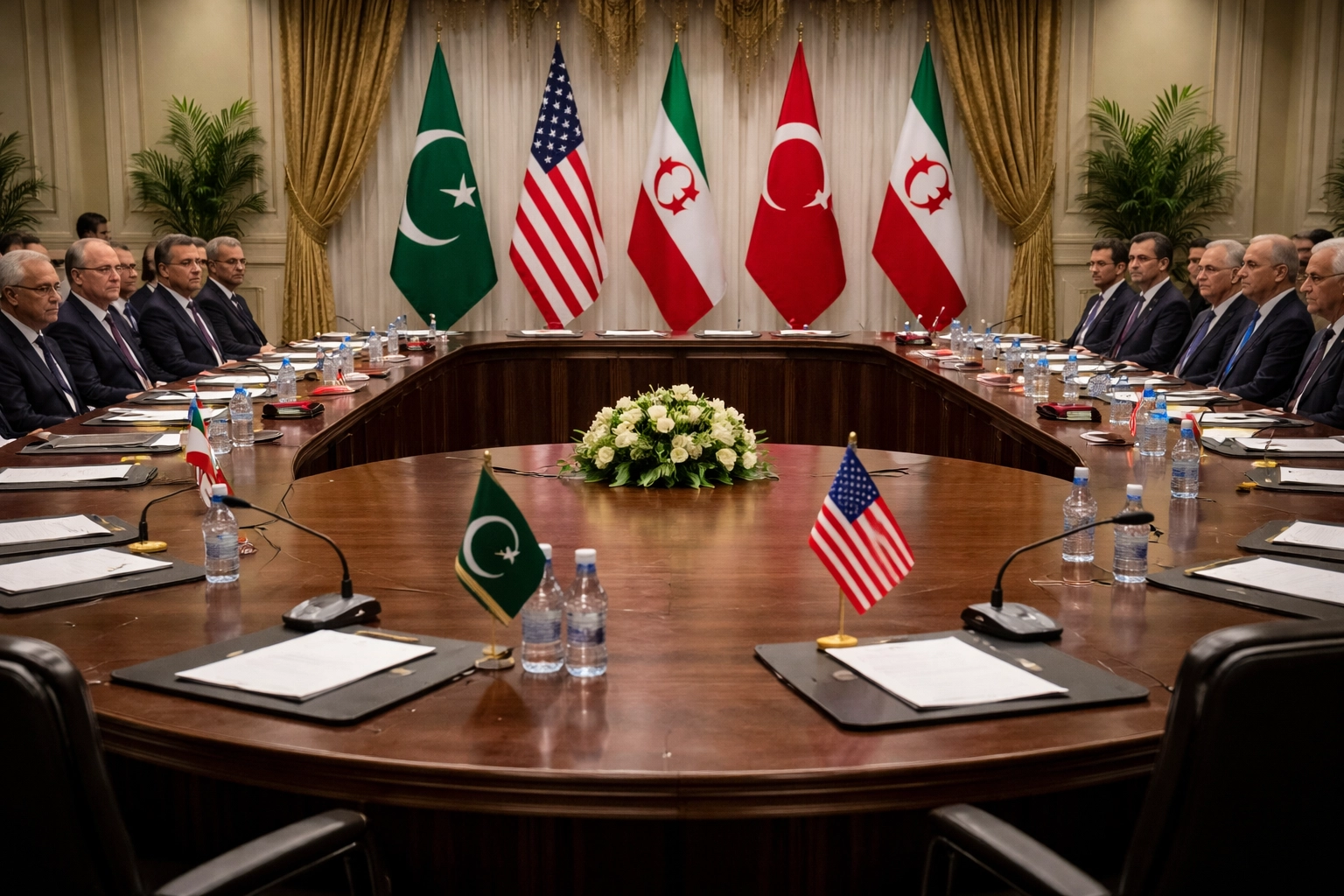
The result is a ceasefire that meant different things to everyone who signed it, and now the parties have gathered in Islamabad not to negotiate a peace, but to negotiate what they actually agreed to three days ago.
Pakistan’s extraordinary gamble
The most remarkable story in this entire crisis is not the ceasefire itself, it is the country that brokered it.
This weekend, senior representatives from the key players in the war converged in Pakistan’s leafy capital, nestled in the lower reaches of the Margalla Hills, a city that, until recently, was more associated with economic distress and IMF negotiations than with brokering the end of a Middle Eastern war.
Pakistan is a nuclear state teetering on the edge of financial crisis, squeezed between an unstable Afghan border and a restive domestic politics. Yet it has pulled off something that the United Nations, the European Union, and decades of American diplomacy could not: it made itself the only credible room in which both Washington and Tehran were willing to sit.
The reasons are structural. Pakistan shares a long border with Iran. It has historical ties with the United States. It carries credibility in the Islamic world. And critically, it has no obvious stake in the outcome beyond its own regional stability which made it, paradoxically, the most trusted party in a room full of deeply distrustful ones.
But Pakistan is also gambling here. The atmosphere, as one former diplomat bluntly put it, had been poisoned before talks even began with Israel’s continued bombing of Lebanon hardening positions on all sides. If Islamabad fails, Pakistan’s carefully constructed image as a responsible mediator collapses with it.
The Strait That Holds the World Hostage
To understand Iran’s negotiating position, you have to understand what the Strait of Hormuz actually means not as a geographic feature, but as a political instrument.
Through this narrow waterway passes 20 percent of the world’s oil and gas during peacetime. Iran’s effective closure of the strait after the February 28 attacks rattled global markets and drove energy prices to record highs.
On the first day of the truce, only four ships carrying dry cargo, not oil or gas managed to pass through, while Iran was charging tolls of over a million dollars per vessel. The waterway that normally sustains global energy supply was operating at a fraction of its capacity, and Tehran showed no urgency to change that.
Iran is not going to surrender this leverage cheaply. The Strait is the one card that forces the world’s largest economies to pay attention. Asking Tehran to simply open it on Washington’s timetable, without verified concessions, is asking them to disarm before negotiations have truly begun.
Trump’s language problem
Less than twelve hours before declaring a historic peace, Trump had threatened to wipe out Iran’s entire civilization. Then came the triumphant Truth Social post. Then the press conference. Then the victory lap.
This whiplash is not incidental, it is the method. Maximum pressure, rapid deal, instant declaration of victory regardless of what the fine print says. It is a negotiating style forged in real estate boardrooms and reality television, now applied to one of the most complex geopolitical crises in a generation.
The problem is that Iran’s negotiators are not real estate lawyers. When Trump told NBC that Iranian leaders are “agreeing to all the things they have to agree to remember, they’ve been conquered, they have no military,” those words were heard in Tehran. They were translated, parsed, and filed away. And they will sit in the room in Islamabad today as surely as any official delegate, poisoning the atmosphere before the first handshake.
A nation you have publicly humiliated does not make lasting concessions it makes temporary ones while waiting for circumstances to change.
The question nobody is asking
Iran’s 10-point proposal is ambitious to the point of appearing unrealistic at first glance it demands the lifting of all primary and secondary sanctions, termination of all UN Security Council resolutions, full compensation for war damages, withdrawal of US combat forces from the region, and a cessation of war on all fronts including Lebanon.
Western commentators have largely dismissed this as an opening gambit. But read it again carefully. Every single point on that list is a response to something the United States actually did to Iran over the past two decades. These are not fantasies, they are grievances. And grievances, unlike demands, do not dissolve at a negotiating table. They accumulate.
One analyst put it plainly: a sustainable settlement is only achievable if Israel stops attacking. In every previous round of negotiations, it was Israeli military action that broke the process. This time is structurally no different.
This is the question that hangs unspoken over Islamabad: Is the United States actually willing to constrain Israel? Not in rhetoric, not in carefully worded statements but in practice, with consequences?
Because Iran has already given its answer to the alternative. Tehran cannot be seen by its own public, or by Hezbollah, or by the wider region, accepting a deal that leaves Lebanon exposed to continued bombardment while Iran alone stands down. Iran’s parliamentary speaker stated that a bilateral ceasefire that ignores Lebanon is, in his words, simply unreasonable.
The small country in everyone else’s deal
Lebanon deserves a paragraph of its own not as a strategic variable, but as a human fact.
At least 1,497 people have been killed since the war erupted on February 28, including 57 health workers. These are not abstractions. They are the cost of a war that Lebanon did not start and cannot stop. And yet Lebanon’s fate whether it is “included” in a ceasefire or casually excluded is being decided in conversations between men in Islamabad, Washington, and Jerusalem who have barely mentioned the Lebanese people at all.
History will record this with a particular kind of sadness: that in the negotiations over the Middle East’s most consequential crisis in years, the country suffering most acutely was reduced to a clause that powerful men couldn’t agree to include.
What Islamabad can and cannot do
Iran expert Trita Parsi captured the moment precisely: the talks in Islamabad could fail, “but the terrain has shifted.”
He is right, and it is worth sitting with what that means. Even if today’s talks collapse, even if the ceasefire frays, the Strait closes again, and the missiles resume, something has changed permanently. Pakistan has demonstrated that it can sit at the table of great powers. Iran has shown that it can absorb American military strikes and still negotiate from a position of some strength. And the United States has shown, for perhaps the first time in this conflict, that there are limits to what force alone can achieve.
One analyst observed that ceasefires are iterative and the first goal is simply to build trust. The real test is whether Washington is willing to use its influence over Tel Aviv not in press statements, but in the field, during these critical days of negotiation.
That word tame is telling. It acknowledges, quietly, what everyone in the room already knows: that the party most likely to derail these talks is not Iran, not Pakistan, not even the unresolved clauses of the ceasefire itself.
It is the ally that was never fully party to the agreement, yet whose actions determine whether it holds.
Diplomacy’s oldest lesson is that the most dangerous document is not the one that says too much it is the one that leaves too much unsaid. The ceasefire of April 7 was announced in haste, celebrated prematurely, and interpreted differently by every party that signed it.
Today in Islamabad, negotiators are not building peace from scratch. They are excavating what was actually agreed to three nights ago, and hoping there is enough there to build upon.
The Strait of Hormuz remains barely open. Lebanon is still burning. The Supreme Leader’s message vows to avenge the dead. And JD Vance is flying to a city in the foothills of the Himalayas to explain what his president meant when he said ceasefire.
History has a word for agreements where no one is quite sure what was agreed. It calls them the beginning of the next war.
Let us hope Islamabad proves history wrong.
Subscribe Deshwale on YouTube


